Atrium
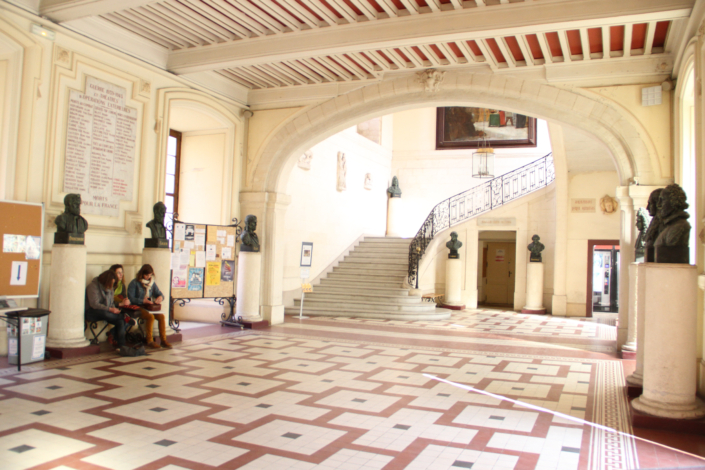
In the atrium, everything reminds us of the medical school’s more than 800 years of history through commemorative plaques, plaster busts of renowned physicians, and historical paintings.
Learn more
The Faculty Lobby: A History of Medicine and the University
The hall (or atrium) is a living testament to the city’s academic and religious history, with roots dating back tothe 14th century, when Guillaume de Grimoard—who later became Pope Urban V—decided to build the city’s first building dedicated to students, the College of Saint Benedict, where you are now standing.
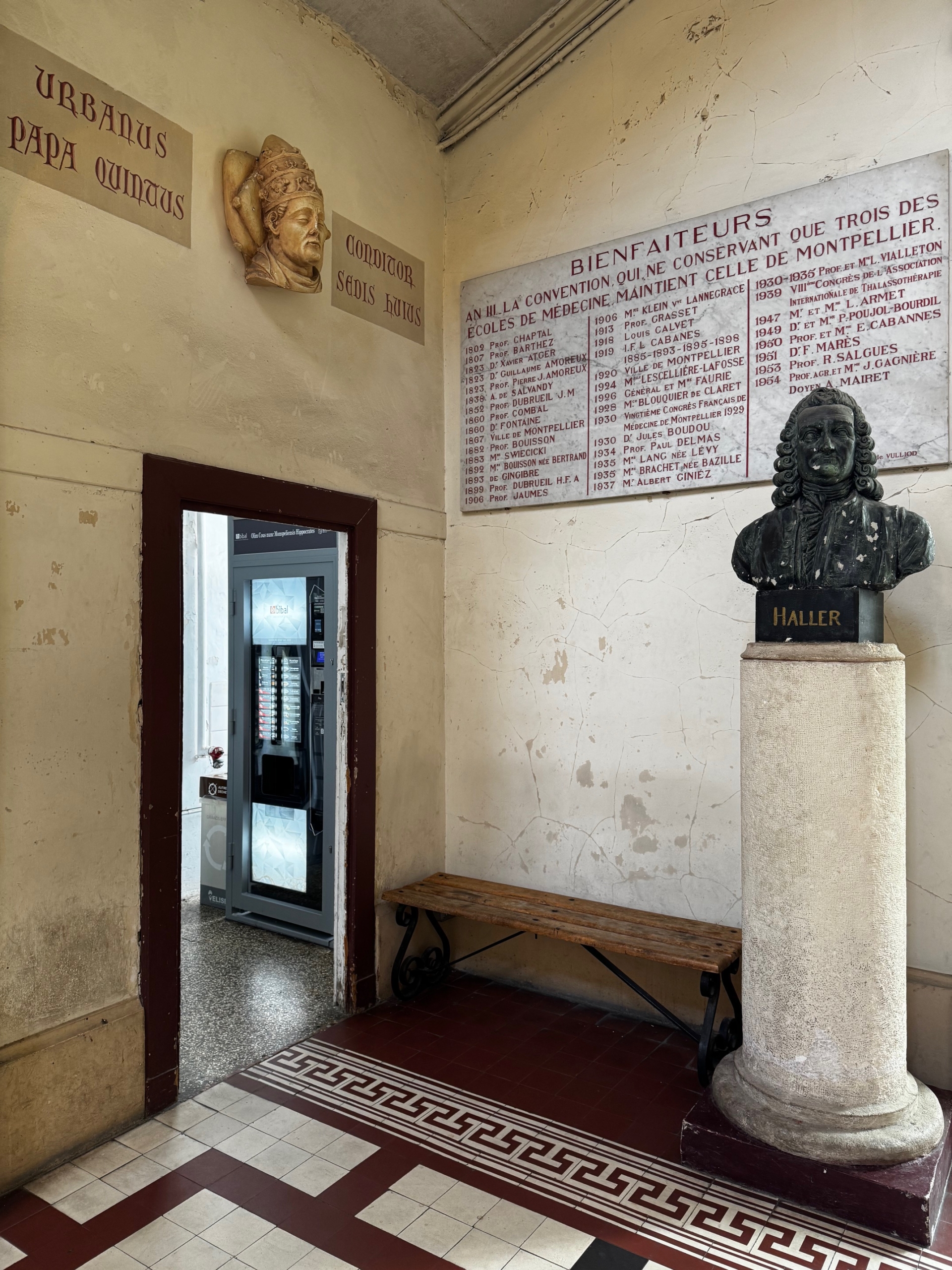
His death mask pays tribute to him, stating in Latin that Pope Urban V is the founder of this place. Note that this mask, a copy of the papal recumbent statue, can be found in other locations throughout the city marked by the pope’s history, such as St. Peter’s Cathedral adjacent to the Faculty—which was also built by the pope—or the cloister of the Faculty of Law and Political Science, where Urban V was one of the most famous students and teachers.
The 12 scholarships awarded by Urbain V: Support for Students
While the Saint Benoît College was reserved for law and theology students, Urban V also commissioned the construction of a college for medical students: the College of the Twelve Physicians (more recently known as the Mende College or the Pope’s College). It is located two streets away from here, at the intersection of Urbain V and Alexandre Germain streets.
The pope established a scholarship program for students enrolled in the colleges of Montpellier. He awarded 12 scholarships to students at the Collège des Douze Médecins, enabling the most financially disadvantaged students to continue their studies. This demonstrates the importance this pope placed on access to education for all, regardless of social status.
This financial support policy was a precursor to modern scholarship systems, demonstrating Urban V’s commitment to promoting an inclusive education system designed to cultivate an academic elite capable of making an impact throughout Europe.
Grand Staircase – Thesis Ceremony (Song of the Scrap Metal)
On the grand staircase leading to the library, the new doctors gather with their fellow students and professors after each thesis defense to sing “La Ferraille,” a nursery rhyme adopted by the residents of the Montpellier-Nîmes School of Medicine, which visitors regularly hear sung throughout the year
Paintings on the Staircase
A13th-century lease agreement for the Salle L’Évêque, by Auguste Privat (1925). Before the University had its own premises, its assemblies were held in church buildings, such as the Salle Lévêque, the Montpellier residence of the Bishop of Maguelone in the Middle Ages. On the left, we can see the figure of the bishop wearing his miter and presiding over the ceremony; the red robes worn by students receiving their medical degrees; and the University beadle—representing the administration—carrying the ceremonial mace, an Asclepius staff shaped like a club. Trivia: This silver mace was granted as a mark of distinction to the University of Medicine in Montpellier by King John the Good of France in 1351. The title of the painting is therefore completely anachronistic, with an error of a century!
The Montpellier Student Association office during the6th Centennial celebrations, by Ernest Michel (1892). The students are wearing the famous faluche, the traditional headwear of French students since 1889. The Montpellier version is distinguished by its four colored stripes, a tribute to Rabelais. It is still worn today by some students interested in the traditions and history of the University.
Busts
There are 16 of them, representing leading figures in medicine and surgery, such as Ambroise Paré. These busts, created in the early19th century, once inspired students to reflect in the Faculty’s former atrium (now the Dugès Room) before they went to class at the theatrum anatomicum, the amphitheater.
Marble commemorative plaques
They pay tribute to the first known physicians of Montpellier—many of whom were Jewish—as well as to the benefactors of the Faculty, including King John the Good of France, mentioned above for having granted the University of Medicine the privilege of a ceremonial Mass in 1351 (New Style calendar) or 1350 (Old Style calendar, the date engraved on the marble).
Two plaques pay tribute to the Faculty’s staff, students, and doctors who died for France. The plaque commemorating World War I was the subject of extensive research as part of the 1914–2014 centennial. Information about it is available on the University’s website. Every year, the November 11 ceremony takes place in front of these plaques, with the participation of the Faculty’s administrative staff, faculty, and students. Students read selected biographies and perform the “Taps” and “La Marseillaise” to conclude the ceremony.
Ancient Ruins: A Roman Legacy in Montpellier
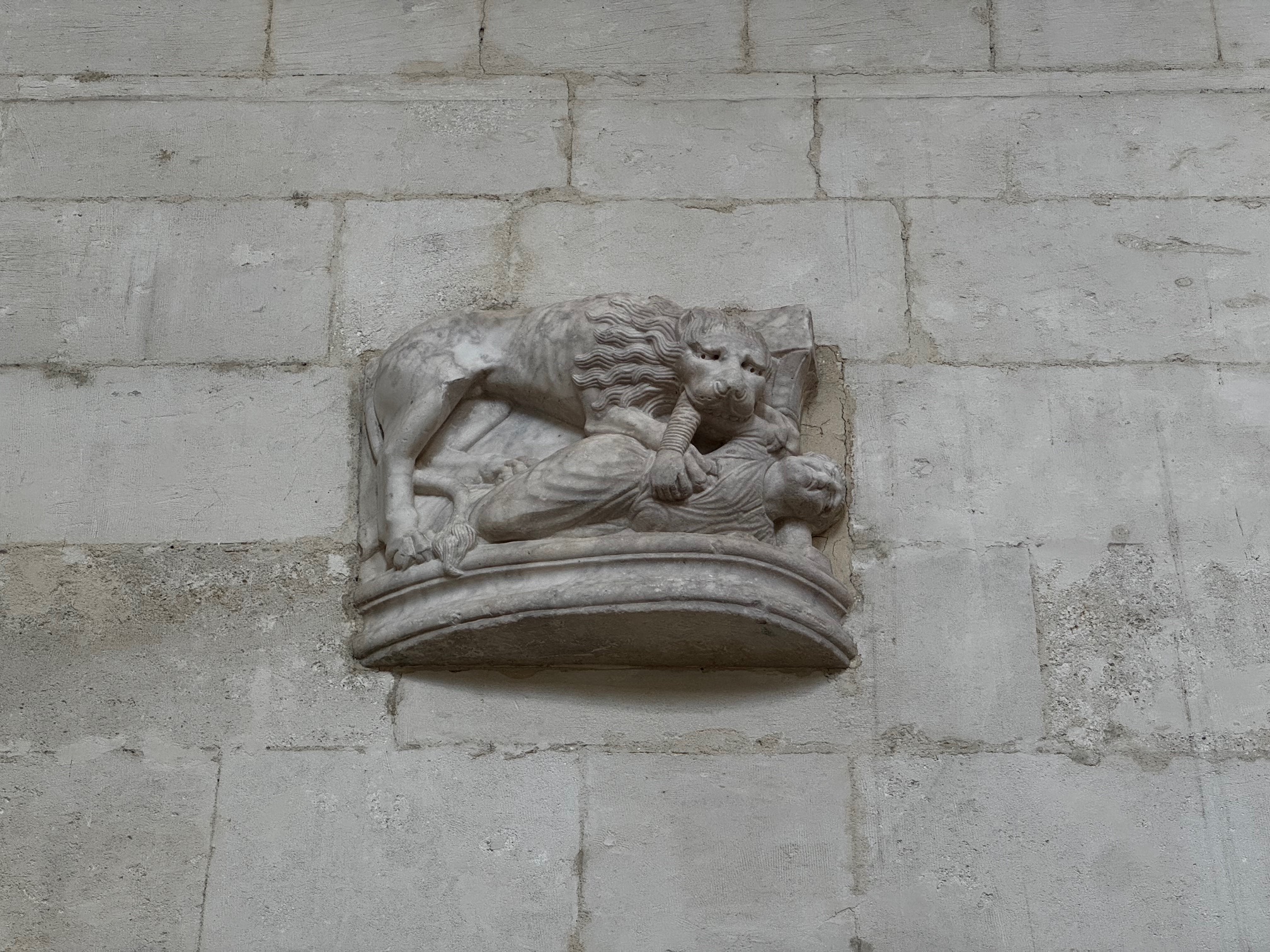
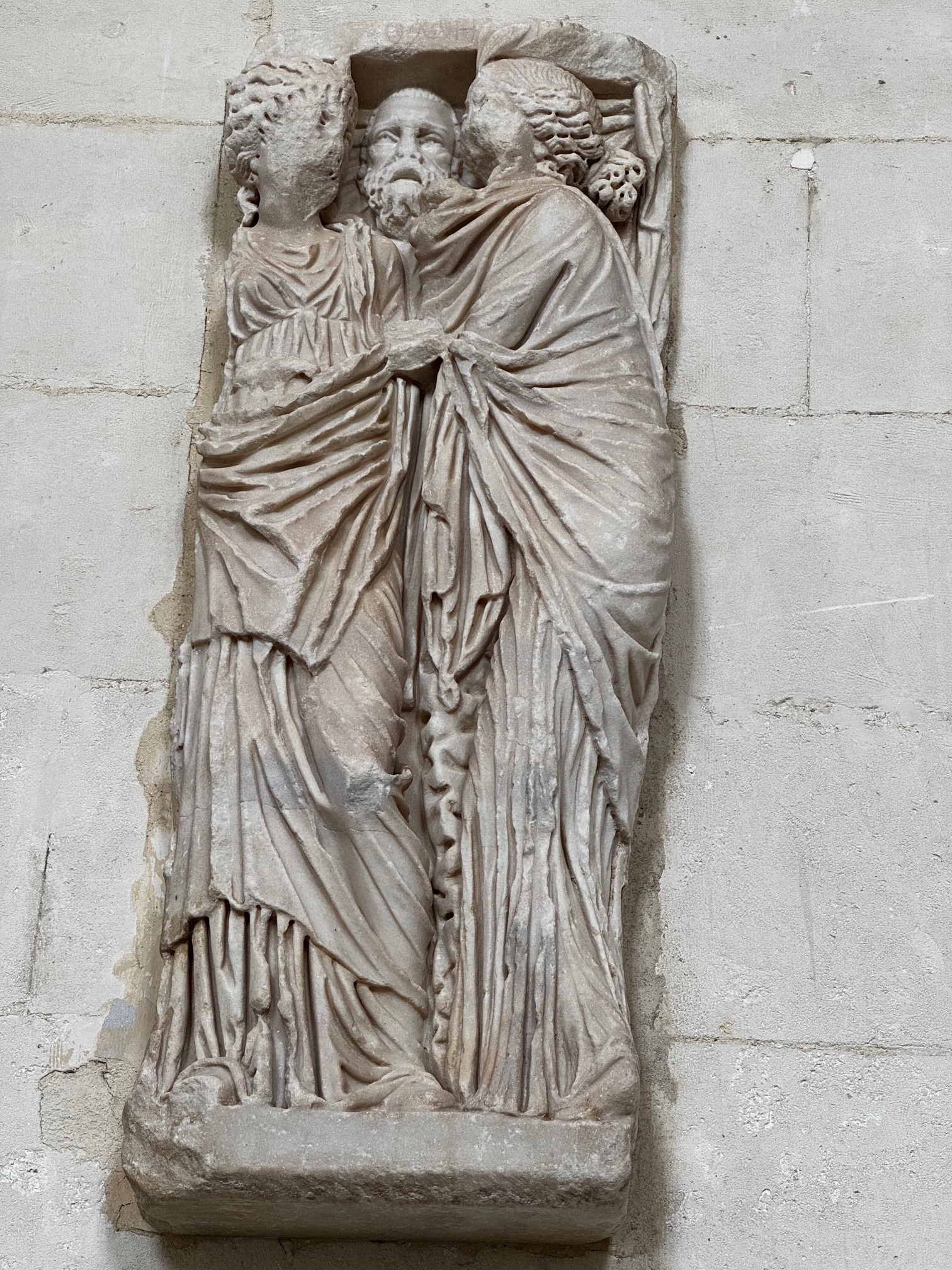
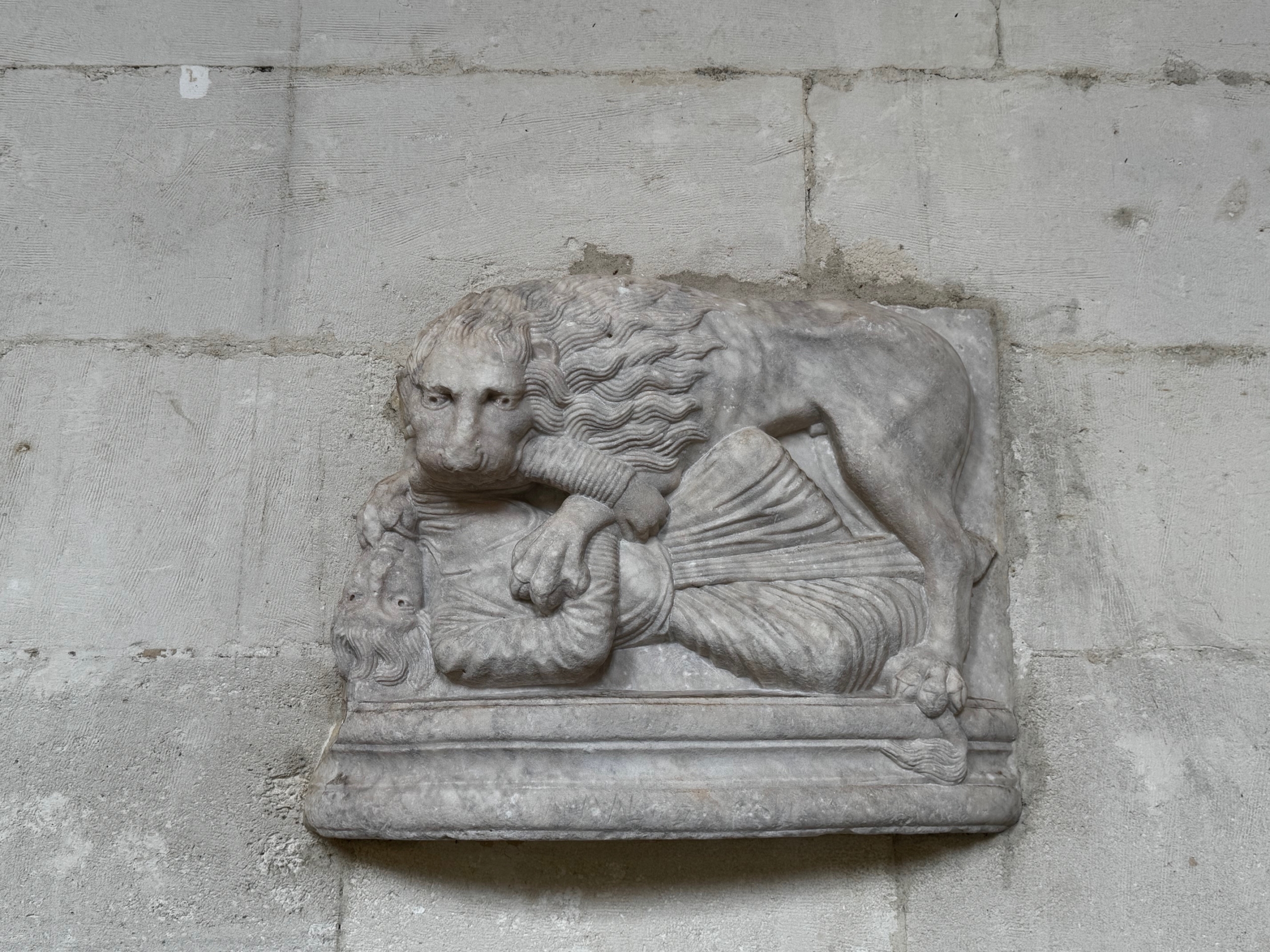
The marble objects on display in the monumental staircase leading to the library come from the Arena of Nîmes. They were brought to Montpellier in the 1620s by Ranchin, chancellor of the University of Medicine (the equivalent of today’s dean). Two bas-reliefs depict lions devouring unfortunate victims, while the central bas-relief depicts Homer (according to the name engraved at the top) and his muses, Tragedy and Comedy.