Cour d’Honneur
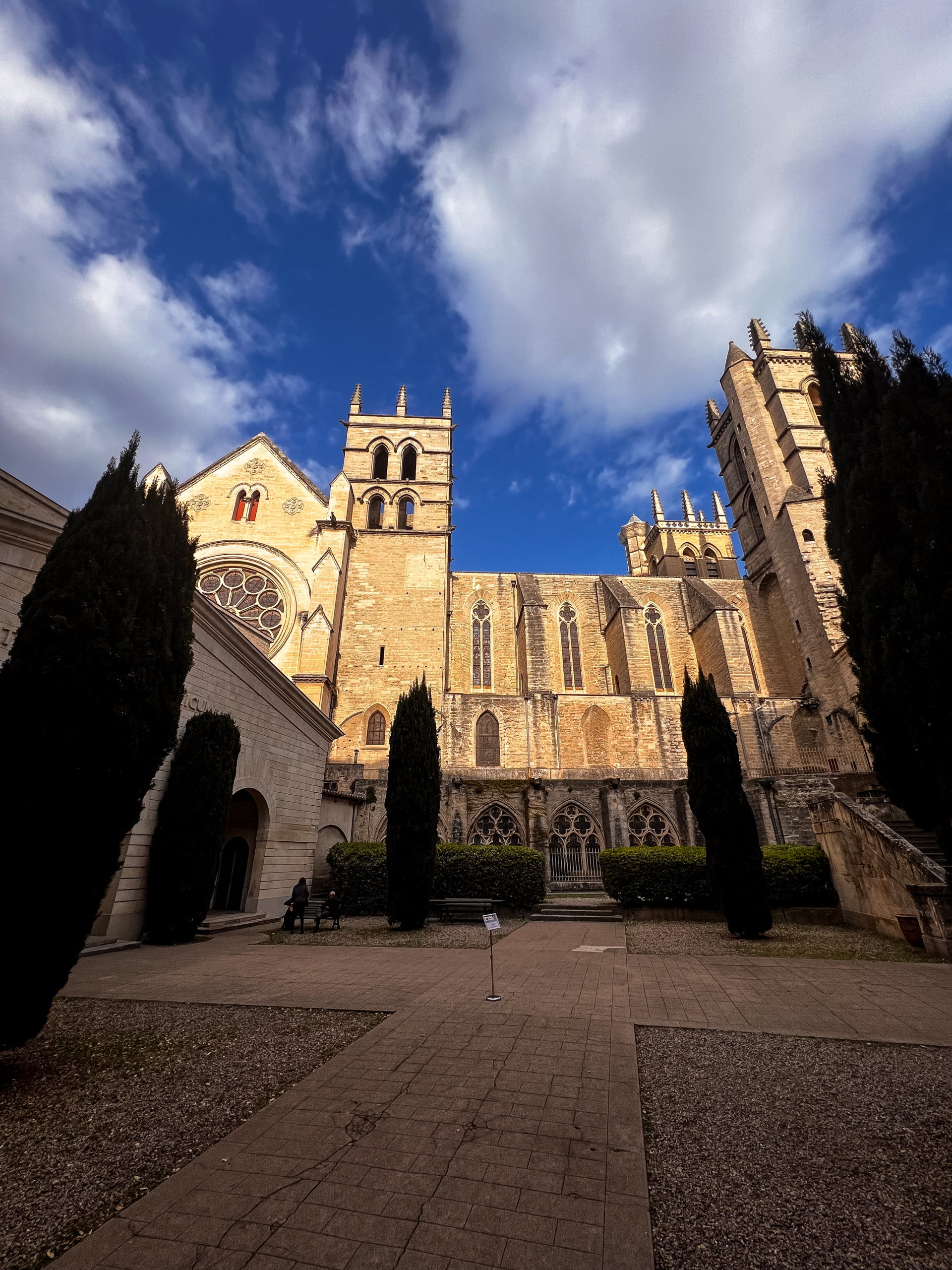
Look around you—the walls speak to us! The main courtyard bears traces of the architectural evolution of this place as it has unfolded throughout history:
- the Hundred Years' War and the construction of the Saint-Benoît-Saint-Germain monastery-college by Pope Urban V, who inaugurated it in 1367 to bring students back to Montpellier (look for its14th-century remains: narrow windows adorned with “trilobe” arches and traces of the former cloister)
- the Renaissance, during which the church became a cathedral when the bishop took possession of the building in 1536
- the Wars of Religion between Catholics and Protestants, which left the bishopric and the cathedral in ruins in 1567
- the 17th and18th centuries, when the bishops rebuilt a sumptuous episcopal palace (note the new Italian-style windows—those large rectangular windows that create a contrast in height with the medieval openings; note, too, the differences in the roofing in some places, such as on the wall of the Urban V Tower between the cathedral and the council chamber)
- the Revolution, which established the school of medicine there in 1795, along with its “new” neo-classical amphitheater (a tribute to Hippocrates?)
- until the end of the19th century, as exemplified by the nave and the rose window of the cathedral: built in the Neo-Gothic style, they were completed in 1875!
The various architectural styles reflect the nearly 7 centuries of history of this building, one of the oldest surviving university buildings in Europe.
Learn more
St. Peter's Cathedral: A University Chapel Turned Fortress
The university building is closely linked to Saint-Pierre Cathedral, since the original church (Saint-Benoît Church) was built at the same time as the monastic college and was integrated into a cohesive complex. Originally a university church (students protected by the charter of Urban V in Montpellier—including medical students—were required to attend daily services), it became the Cathedral of Montpellier when the bishopric was transferred there in the early16th century.
During the Wars of Religion, the cathedral sustained heavy damage. Protestants looted and ransacked it, leaving it in ruins for nearly a century. It was not until the17th century that the bishops undertook its reconstruction, adding architectural elements such as new windows and additional stories.
Today, the cathedral retains its imposing character with its original monumental portal, which suggests that Urban V wished to leave behind a significant work. Although this portal serves no real defensive purpose, it adds to the building’s impressive aura.
Fun Facts
Choretto / Cloister Gallery
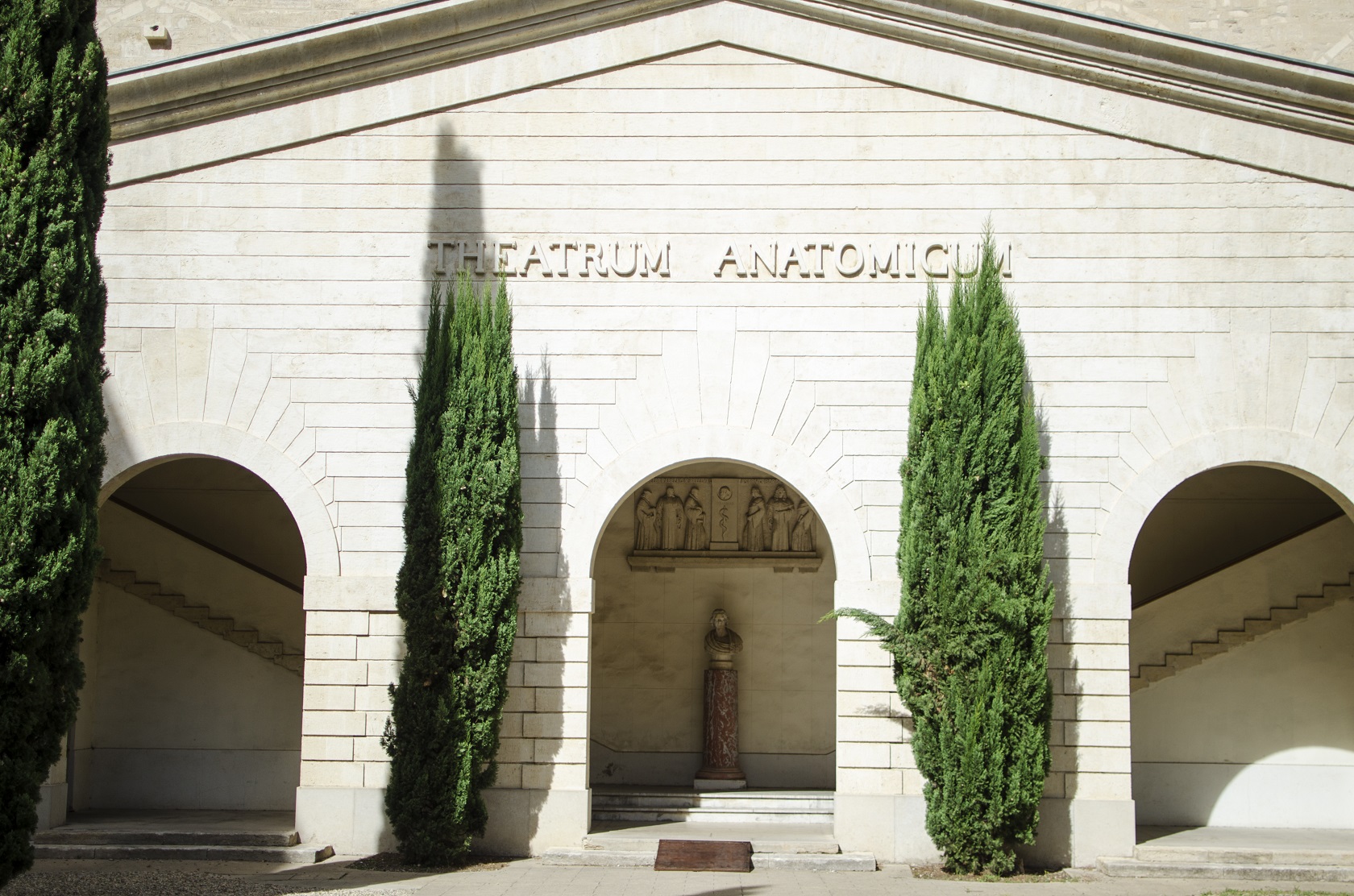
Its four medieval arches are inspired by the remains of the former cloister that encircled the Saint Benoît College on two levels. Dissections were performed there when the Faculty was established during the Revolution, before it was reassigned to the cathedral in 1823!
Explore the six architectural periods spanning six centuries
- Southern Gothic style: the courtyard walls and the narrow windows topped with a three-semicircle (trefoil) arch date fromthe 14th century, as do the oldest part of the cathedral (St. Benedict Church, then the abbey church of the St. Benedict-St. Germain College) and its four square towers, one of which, the Urbain V Tower, adjacent to the Faculty’s assembly hall, remained intact after the Protestant siege of 1567. Above the roof of the lecture hall—which was rebuilt beginning in the17th century—one can see, when standing on the exterior steps of the theatrum anatomicum, alcoves corresponding to the former student rooms (the wing of the building on Rue de l’École de Médecine was dedicated to students when it served as a college).
- Neo-Gothic style: the cathedral’s nave and rose window were built between 1855 and 1875! Note the variation in the color of the stones. The tiles are rather incongruous for the south of France, since they are glazed and are more typical of the architecture of the Hospices de Beaune!
- Neoclassical style: the Theatrum Anatomicum, begun in 1802 and inaugurated in 1806—one could easily imagine that it pays homage to ancient Greek medicine!
- Classic style: The large, rectangular Italian-style windows were cut into the walls inthe 17th and 18th centuries, when the bishops restored the building, which had been severely damaged by the Wars of Religion. One notices the sense of openness and light compared to the medieval windows—some of which still remain on various levels—which also helps illustrate the modifications made to the different floor levels.
- Recent additions: of note are the grand grand staircase built in the second half ofthe 19th century, and a newer section constructed between the late19th and early20th centuries at the left corner of the theatrum, where it meets the building’s west wing, housing the laboratories of a brand-new medical discipline emerging at that time: histology (the study of tissues, along with its pathological counterpart: pathological anatomy, or “anapath”)
The Transformation After the Revolution: From College to School of Medicine
After the French Revolution, the building underwent a major transformation. In 1795, with the confiscation of Church property, the former college was assigned to the new School of Health, founded in 1794 (which served as a bridge between the former medical university and the future school of medicine). This transfer was symbolic, as it marked a return to the site’s original academic purpose: that of a college. Nevertheless, since the bishop was the supreme head of the universities—in a sense equivalent to today’s academic rector (hierarchically above university chancellors and deans)—the bishop’s residence could be viewed somewhat like today’s university administration office! As such, it was regularly visited by the university community throughout the academic year as a matter of protocol.
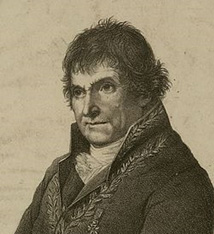
The renowned chemist and politician Jean-Antoine Chaptal, who played a key role in the reorganization of institutions under Bonaparte, facilitated this transformation. Chaptal was also the driving force behind numerous industrial and educational reforms. His portrait hangs in the Salle des Actes, and his bust is displayed in the center beneath the pronaos of the theatrum.