The forecourt
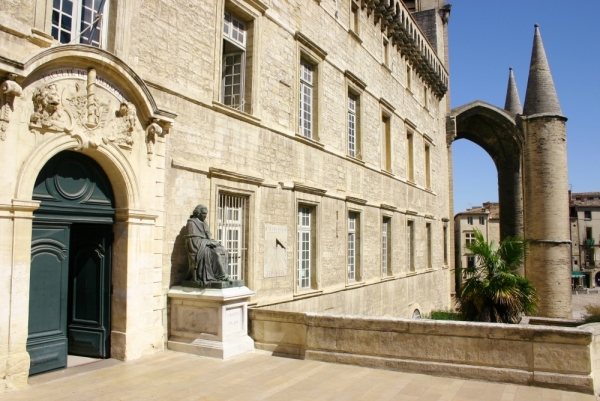
Built inthe 18th century, the forecourt of the School of Medicine features numerous symbols associated with the University: statues of the surgeon François Gigot de Lapeyronie and the physician Paul Joseph Barthez, a sundial associated with Hippocrates, and the rod of Asclepius, the god of medicine.
Learn more
The Montpellier School of Medicine, the oldest medical school in the world: a legacy preserved
Founded on August 17, 1220, the Montpellier School of Medicine is the world's first medical university established under official legal statutes.
Montpellier is also the only city to have remained in continuous operation, even during the most turbulent periods of its history, such as the Wars of Religion, the French Revolution, and the German occupation.
During the Revolution, when all French universities were closed between 1792 and 1794, the Montpellier School of Medicine managed to continue its operations thanks to support from the city, which made up for the loss of royal funding.
The Faculty’s archives, along with the Hérault departmental archives, preserve several authenticated historical copies (13th–15th centuries) of the statutes of 1220, thus attesting to the antiquity and continuity of this institution. These statutes, drafted under the auspices of Pope Honorius III, provide students and faculty with a solid legal framework—a precursor to what would later become the modern university system: students are clearly recognized therein as users protected by law!
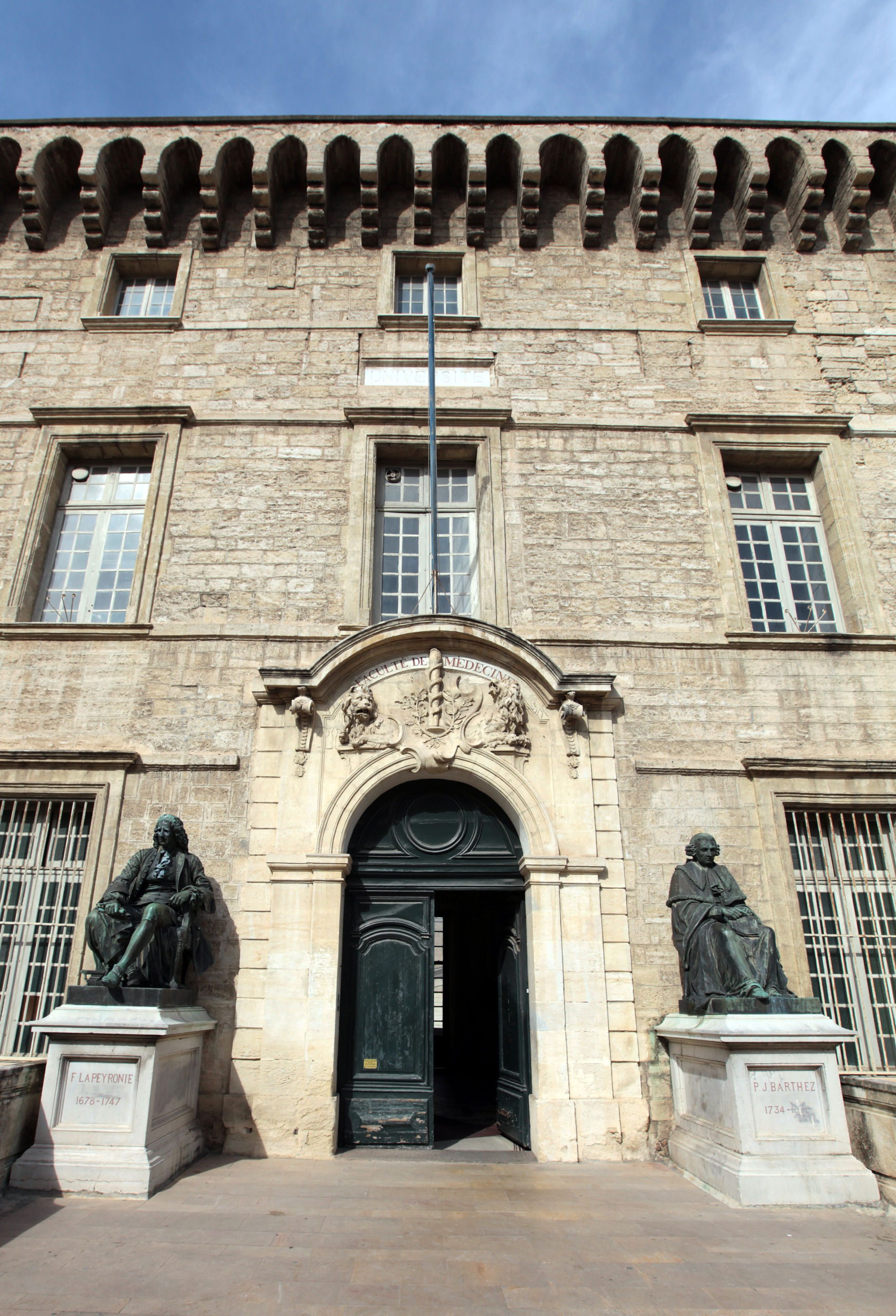
The statues of Barthez and Lapeyronie: symbols of medicine and surgery in Montpellier
Riddle: Without looking at the inscriptions on the statues' pedestals, figure out which of the two statues represents the surgeon!
Built in 1742 along with the bridge, the entrance has been flanked since 1864 by statues depicting iconic figures from the Faculty in the18th century.
Lapeyronie, chief surgeon at the Hôtel Dieu Saint Eloi in Montpellier, would become King Louis XV’s chief surgeon. He would politically cement the separation between barbers and surgeons. By founding the Royal Academy of Surgery, Lapeyronie helped establish surgery as an academic profession, bringing it closer to medicine.
Barthez was a physician and philosopher of the Enlightenment. He developed the theory of vitalism, a neo-Hippocratic doctrine that sought to bridge the gap between ancient Greek medicine and the new sciences applied to medicine (chemistry, physics, biology, etc.). This doctrine views the human being holistically, in all its dimensions (anatomical, physiological, and sensory). Like Hippocrates, it also situates the human being within their natural environment. The proximity of the School of Medicine to the botanical garden makes perfect sense!
To bring together the surgeon Lapeyronie and the physician Barthez is to inextricably link practice and theory. One cannot exist without the other: a word of warning to our student community!
Historically, this also brought surgeons closer to physicians, a trend that would become permanent during the Revolution: surgeons and physicians would become students at the same school. And it was during the Revolution that the Faculty of Medicine moved from its former premises at the Royal College of Medicine (now the Panacée) to the historic building it occupies today, right here before you.
Saint Benoît College: one of the oldest surviving university buildings in Europe
This medieval building was inaugurated by Pope Urban V in 1367. It was originally a college for students of law and theology: the College of Saints Benedict and Germain. The building that runs along Rue École de Médecine and faces you was the wing reserved for students.
Today, it extends to the left toward the Jardin des Plantes, thanks to an addition built in 1850 that mirrors the silhouette of the school. This addition, which houses the anatomy museum, was built on the very site of the city walls, “la commune clôture,” of which the Tour des Pins—visible from the boulevard—is one of the few remaining vestiges.
The school’s proximity to the city walls explains its defensive appearance. It was built after the Black Death, during the Hundred Years’ War. At the time, the region was under constant threat from mercenary bands that ravaged the countryside and threatened the towns.
This building is the political initiative of Urban V, a former student and law professor at the University of Montpellier, aimed at bringing students back to European cities. The colleges were, in effect, student residences—the “cités U” of the Middle Ages. Less affluent students found shelter, room, and board there, as well as study rooms and a library.
Inside the building, two other sections were reserved for abbots and Benedictine monks. The adjoining church was part of the complex. This abbey church (or collegiate church) served as the church for the students of Montpellier who were under the protection of the Pope’s foundation. Medical students, who were housed in another college (the College of the Twelve Physicians, or College of Mende, also built at the request of Urban V in the physicians’ quarter, two streets from here), were required to attend services in this church. The two colleges (Saint Benedict and the College of the Twelve Physicians) were interconnected.
The church was elevated to the status of a cathedral in 1536, after the bishopric of Maguelone was transferred to the College of Saint Benoît.
During the Renaissance and up until the Revolution, the Collège Saint Benoît thus served as the bishop’s palace, the residence of the Bishop of Montpellier. Nevertheless, there was no complete break with the site’s academic history. In fact, up until the Revolution, the bishop represented the supreme legal authority over the chancellors and deans of the universities. He received the faculty in this building throughout the academic year and awarded diplomas to the students!
The Sundial and Hippocrates’ Inscription: A Reflection on Time and the Art of Medicine
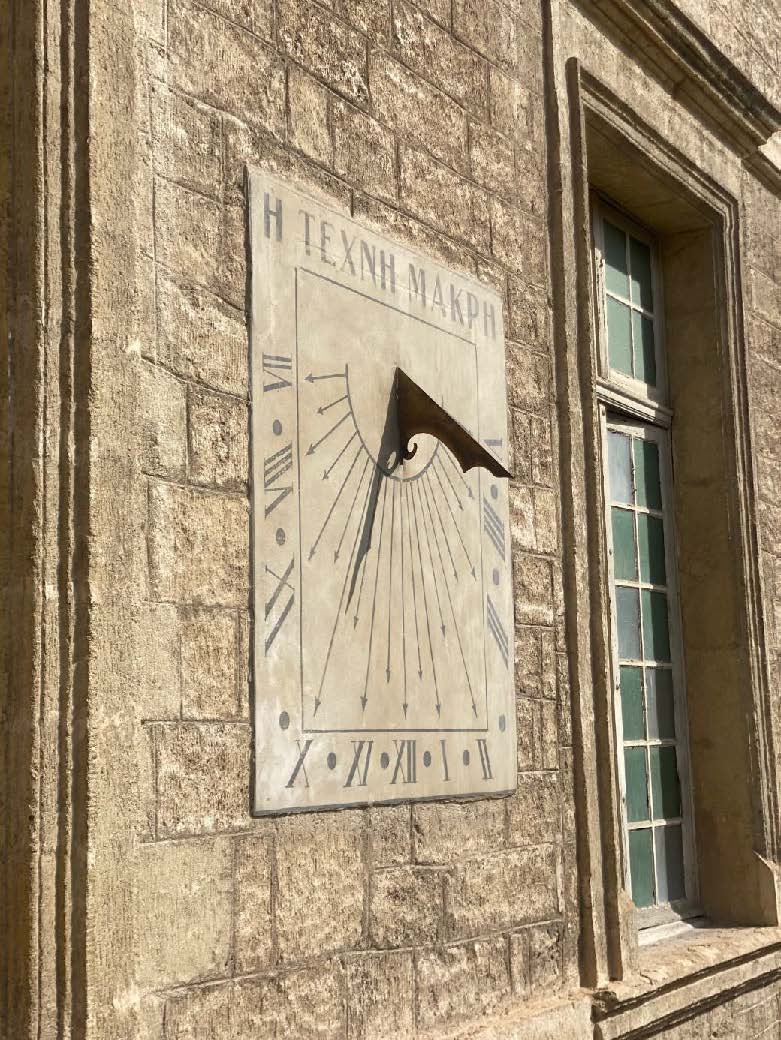
Near the statues of Barthez and Lapeyronie stands a sundial bearing an inscription in Ancient Greek, a famous quote from Hippocrates: H TEXNH MAKPH (Ê teknê makrê) “The art is long,” which forms part of Hippocrates’ first aphorism (“Life is short, the art is long, the opportunity fleeting, experience deceptive, and judgment difficult”).
The sundial is not only a symbol of the relationship to time in the practice of medicine (a healthcare provider’s ethics develop over the course of a lifetime), but it also serves as a reminder of the importance of continuing education—a principle now enshrined in the code of medical ethics, which requires physicians to continue their professional development throughout their careers.
The rod of Asclepius adorning the top of the entrance
It is the symbol of Asclepius, the Greek god of medicine (Aesculapius to the Romans): a gnarled wooden staff with a single serpent coiled around it. The staff symbolizes humility and old age—and thus wisdom (which echoes Hippocrates’ first aphorism: “The art is long…”).
The snake is also a symbol of longevity, and through the process of shedding its skin, it symbolizes regeneration and self-healing. It embodies a profound Hippocratic philosophy: according to the body’s natural balance—the source of health—the Hippocratic physician does not cure; rather, he helps nature maintain balance (through prevention via exercise and diet) or restore balance (through treatment).
Not to be confused with the “caduceus,” a luxurious scepter topped with two wings and entwined by a pair of snakes facing opposite directions: it is the attribute of Hermes, messenger of the gods, but also the god of thieves and merchants! The confusion stems from the fact that some countries have adopted it as a symbol of medicine, mistaking it for the staff of Asclepius…