Conference Hall
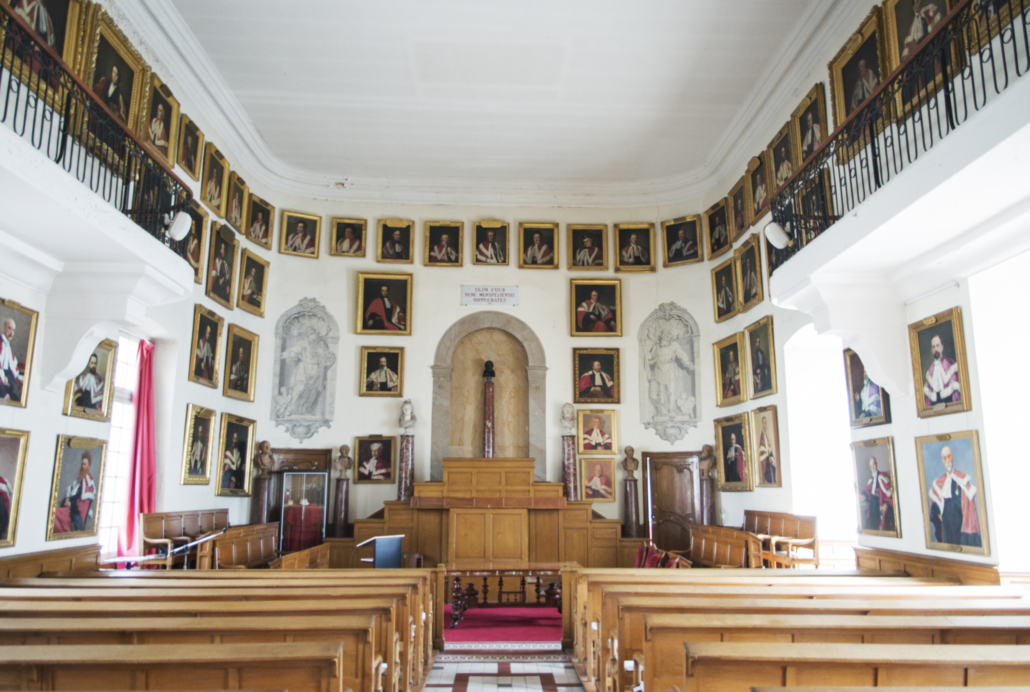
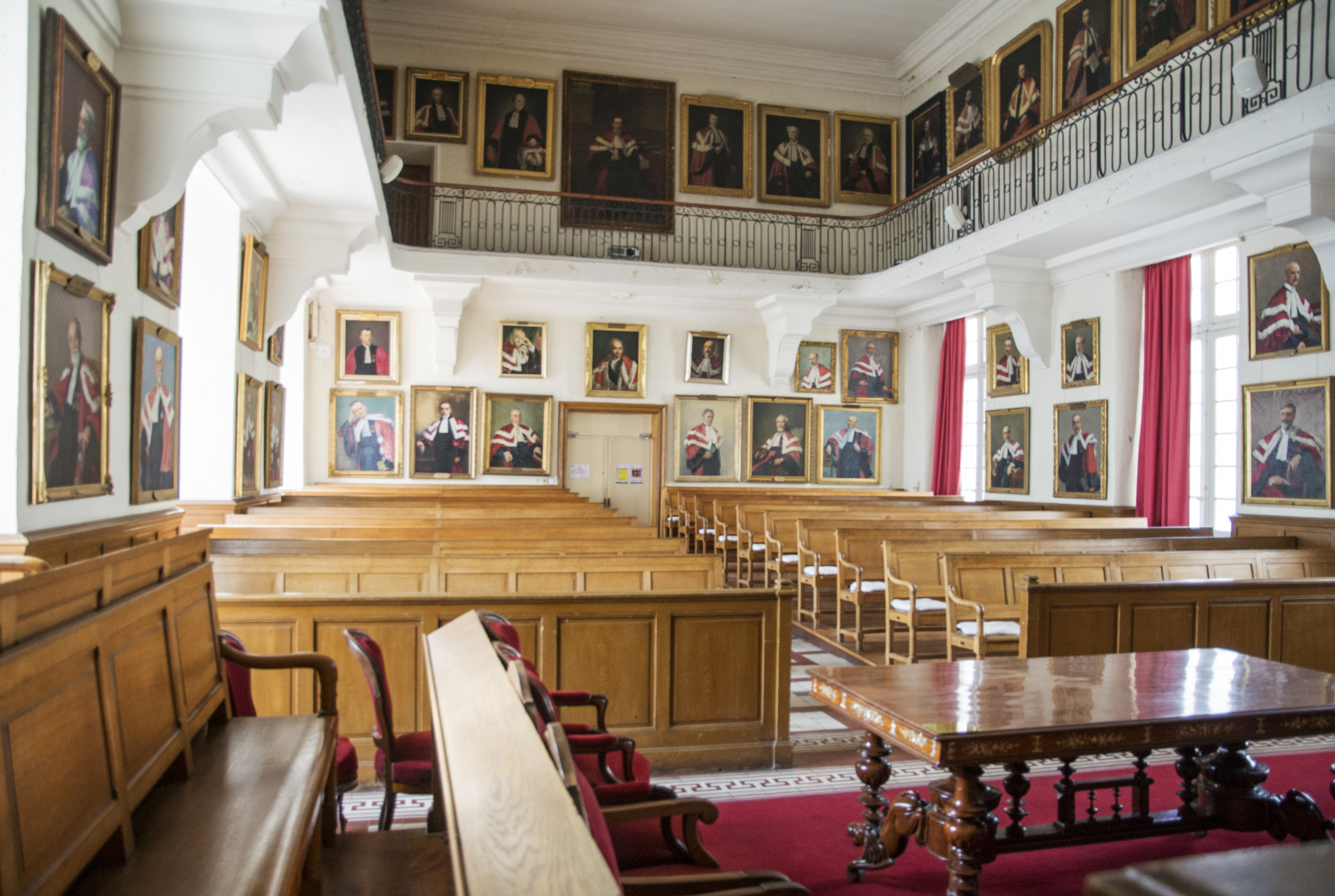
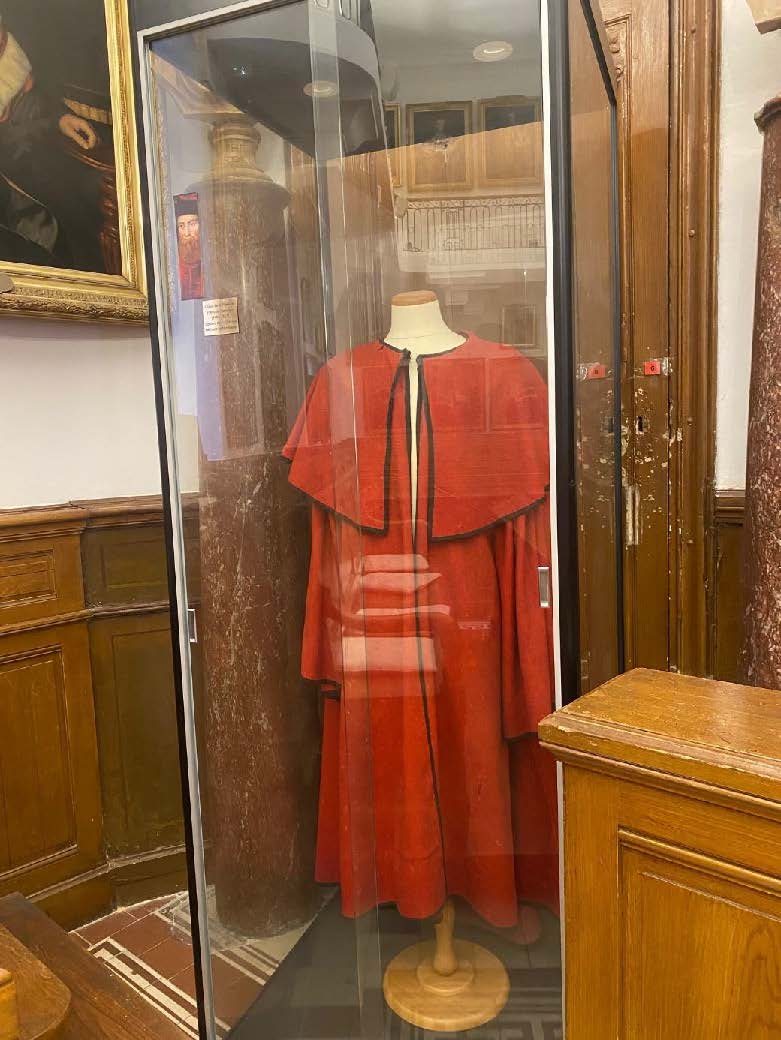
Formerly the bishop’s conclave hall, where he would gather his clergy in the 17th and 18th centuries, the Salle des Actes has served as the Faculty’s thesis defense hall since the Revolution. It is there that, dressed in the famous Rabelais robe, the student who has just been awarded a doctorate is invited to recite the Hippocratic Oath.
Learn more
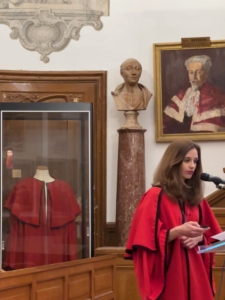
In Montpellier, students don the robe of Rabelais—a former student and professor at the Faculty—for this solemn occasion; a19th-centuryreplica of the robe is on display in the hall.
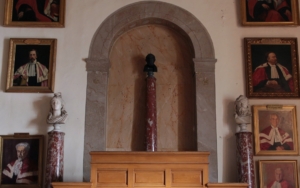
Formerly the bishops’ conclave hall, the Salle des Actes has been the venue for thesis defenses for over 200 years, under the watchful gaze of 91 portraits of19th-century professors and most of the deans ofthe 20th century, “under the image of Hippocrates,” an ancient bust dating from the1st or2nd century, donated to the Faculty by Bonaparte in 1801.
Hippocrates, the “Father of Modern Medicine” and a Greek physician ofthe 5th century B.C., was a pioneer of rational medicine. Before him, medicine was primarily magical, heavily influenced by religious beliefs and ritual practices.
Hippocrates introduced the idea that diseases had natural, rather than divine, causes, thus marking a break with magical medicine and a shift toward a scientific approach.
The busts of Asclepius and Hygieia: symbols of ancient medicine
In addition to the bust of Hippocrates, the room houses the bust of Asclepius (Aesculapius), son of Apollo and god of medicine, and the bust of Hygieia, his daughter, goddess of health and prevention (while her sister, Panacea, the goddess of remedies, embodies healing and the universal remedy, also known as “the panacea”).
Chaptal commissioned these two busts in 1803. They serve as a reminder of the intellectual legacy of ancient medicine. Historians consider Hippocrates to be the17th descendant of Asclepius, a famous physician who most certainly lived in antiquity before being deified by tradition. It is worth noting that the Hippocratic Corpus was officially taught in Montpellier from the university’s founding until the Revolution, and that Barthez, in the second half ofthe 18th century , theorized vitalism, a “neo-Hippocratic” doctrine bridging the gap between Hippocrates and the modern sciences (chemistry, physics, biology).
The Hippocratic Oath
In 1804, the medical school’s board instituted the recitation of a modern version of the Hippocratic Oath to conclude the thesis defense. Remaining unchanged to the letter in Montpellier to this day, this oath is believed to be the first known use of a Hippocratic Oath in the academic training of physicians. The Montpellier Oath inspired the oaths of other French medical schools, as well as the oath of the National Council of the Order of Physicians. The introduction of this oath in Montpellier was part of a reaffirmation of the Hippocratic legacy at the dawn of the Enlightenment, alongside the vitalist work of the physician-philosopher Barthez, the ancient bust of Hippocrates, and the classical busts of Asclepius and Hygieia, donated to the Faculty by the French government.
The Architecture of the Salle des Actes: A Chapel Transformed into a Space Dedicated to Medicine
At first glance, its architecture resembles that of a chapel, and for good reason: it was originally the synod hall (where the bishop’s conclave met) and perhaps also the bishops’ private chapel. Frescoes (grisailles) depict the patron saints of the bishops who restored the site inthe 17th century: Saint Charles Borromeo on the left (patron saint of Bishop Charles de Pradel, who was commissioned by Louis XIV to build the General Hospital of Montpellier) and Saint Francis of Paola on the right (patron saint of Bishop François du Bosquet).
After the Revolution, it became the formal hall for thesis defenses and faculty ceremonies.
One of the highlights of this room is the “Rabelais robe,” a traditional red toga associated with the illustrious writer and physician François Rabelais, who studied at the Montpellier School of Medicine in the16th century. This robe, which archives from 1612 indicate had come to be known as the “Rabelais robe,” has likely existed since the Middle Ages. It bears witness to the Faculty’s connection to the figure of Rabelais from 1612 to the present day.
There is a special story behind this robe: over the years, students would symbolically take a piece of it, likely to keep a memento of their time at the Faculty. As time went on, the robe became very worn. Chancellor Ranchin decided to have a new one made in 1612. This red robe, worn during formal ceremonies, has been passed down and renewed over the centuries, serving as a link between the Faculty’s history and the modernity of its teaching. Today, it remains a symbol of unity and authenticity for the academic community, embodying the legacy of Rabelais and the first generations of students.
91 paintings but 92 people
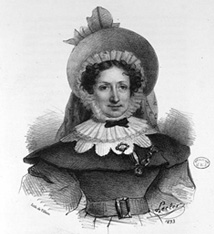
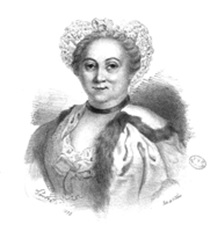
A woman is depicted in a painting by her husband, a professor at the Faculty. Her name is Glafira Ziegelmann, a Russian student enrolled at the Faculty in 1894; she was the first woman to pass the competitive exam for residency positions at provincial hospitals in 1896, the first woman to pass the competitive exam for chief resident, and the first woman to dare to sit for the competitive exam for the agrégation in medicine in France. She passed the written (anonymous) exam with flying colors in 1910, but the Parisian jury asked her not to take the oral exam because she was a woman. She had the courage to take it anyway but did not pass… Upon the deaths of Glafira and her husband, Professor Amans Gaussel, their children expressed the wish that their mother be depicted alongside her husband in the portrait of the professors in the auditorium. This pioneering woman in medicine embodies the glass ceiling that has long hindered the academic advancement of female physicians. One of the lecture halls on the new health sciences campus, inaugurated in 2020 in the presence of her descendants, was named in her honor.
It is worth noting that the first French woman to earn a Doctor of Medicine degree was Madeleine Brès in 1875, and that the first female dean to serve as president of the National Conference of Deans of Medical Schools was elected in 2025, 150 years later (Isabelle Laffont, dean of the Montpellier-Nîmes School of Medicine).
The painting by Jean-Antoine Chaptal, Bonaparte's minister
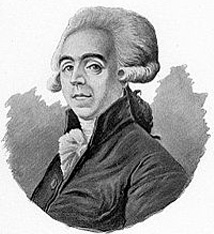
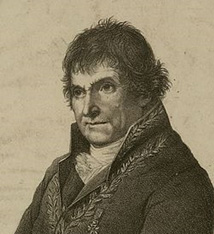
Above the front door hangs a portrait of Chaptal (1756–1832). Chaptal is the third notable figure from the Lozère region at the Faculty, alongside Pope Urban V and the great surgeon Gui de Chauliac. A physician trained at the Faculty, he turned to chemistry and became a professor of the subject. His knowledge of chemistry led him to oversee the production of gunpowder during the Revolutionary Wars and to help develop the French chemical industry. He is credited with theorizing a process well known to winemakers and instrumental in the growth of the local wine industry: chaptalization (the process of increasing the alcohol content through yeast fermentation after adding sugar to the wine)!
Chaptal served as Minister of the Interior under Consul Bonaparte from 1800 to 1804. His portfolio was the most important in the government, encompassing territorial administration, public order, the economy, and industry, as well as public education, higher education, and health. He can be considered the de facto prime minister. We likely owe it to Chaptal that, as early as the Revolution, he lobbied the government to secure the transfer of the school of medicine to the bishop’s palace confiscated from the church; but we may also owe him the gift of the bust of Hippocrates from Bonaparte, and we certainly owe him the commission of the busts of Asclepius and Hygieia, as well as the four other terracotta busts in the Assembly Hall, the reconstruction of the medieval ceremonial mace that had been melted down during the Revolution, the Faculty’s amphitheater (theatrum anatomicum), as well as the restoration of the historical library and the establishment of the anatomy conservatory, in accordance with his nationwide educational policy that benefited university towns.
He was also responsible for the overhaul of the entire higher education system that paved the way for the Imperial University of 1808, including the standardization of academic regalia (first for medical schools as early as 1803, whose regalia remains unchanged to this day), the integration of midwifery studies into the medical schools as early as 1803, and the creation of pharmacy schools (the first three established by the same decree were those in Montpellier, Paris, and Strasbourg; the Montpellier school occupied the Royal College of Medicine—now known as the Panacée—which had been vacated by the medical school).