Showcases
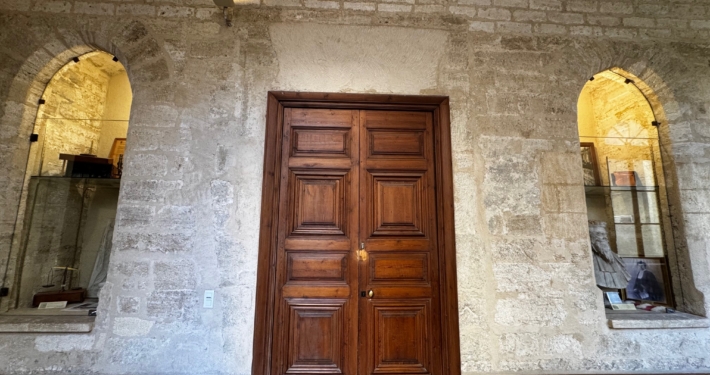
The display cases feature various items related to the history of the medical school: carved decorations, busts, photographs, and traditional objects that tell us several stories.
Learn more
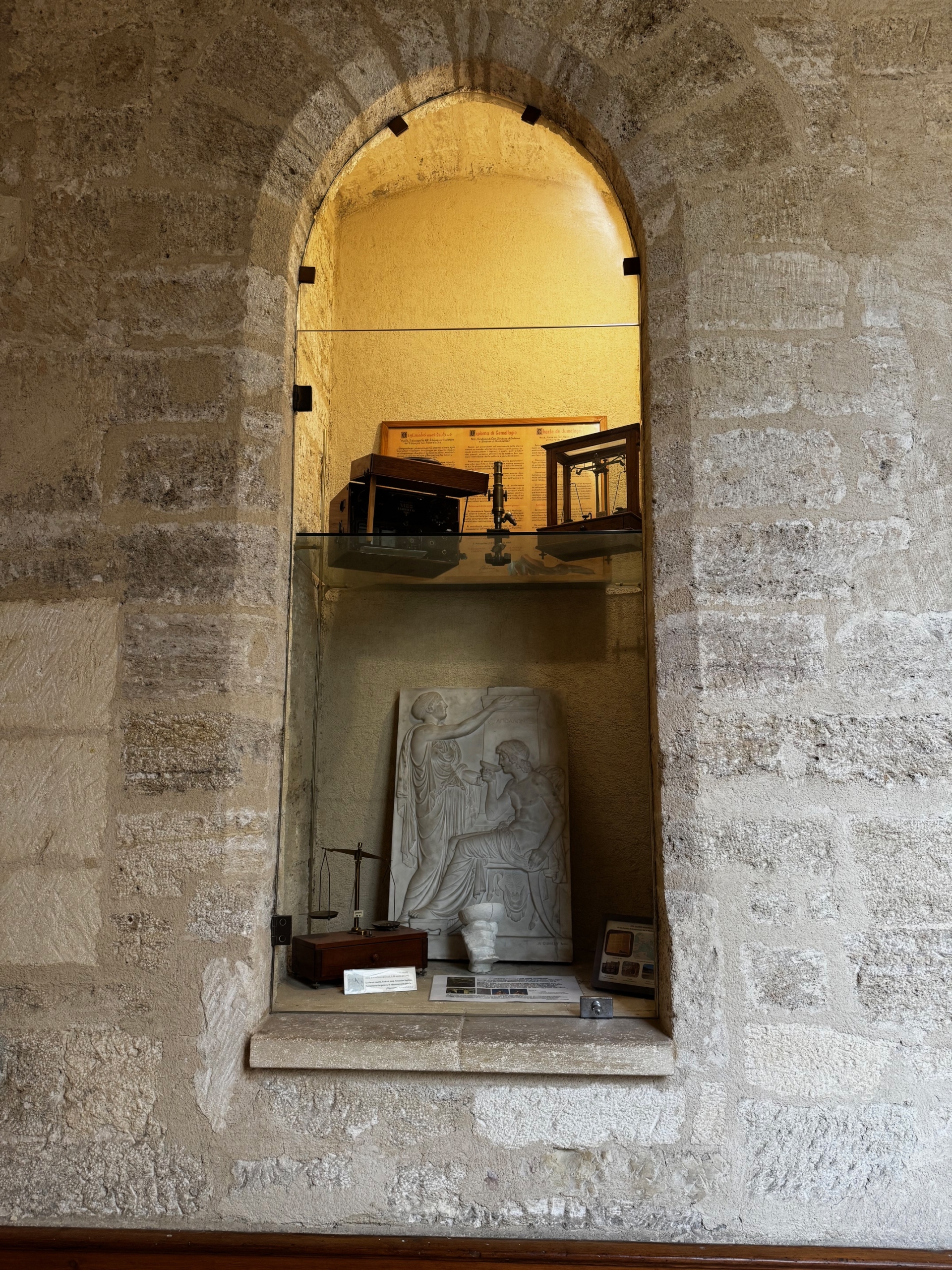
The display case on the left contains:
• A marble relief carved by Charles-Alphonse Gumery, the sculptor of the statue of Lapeyronie at the entrance to the Faculty. This renowned sculptor received the Prix de Rome for sculpture in 1850 and resided at the Villa Medici from 1851 to 1855. He also created the sculptural groups *L’Harmonie* and *La Poésie*, which crown the left and right sides of the Opéra Garnier in Paris. This marble relief depicts a nymph serving a cup to Apollo, the healer, god of purification and healing, and father of Asclepius, the god of medicine. This relief may date from the sculptor’s stay in Rome.
Fun fact: This decoration was discovered on December 2, 2011, in the Faculty’s basements by Lionel Eberlé, head of the Faculty’s technical and maintenance department, during a safety inspection. An explanatory plaque pays tribute to him.
• The plaster prototype of the student’s hand from the Rabelais Monument in the Jardin des Plantes, holding out a cup of wine: this hand had broken and was reattached in 1986. The repair did not hold, and the hand was permanently lost. It was reconstructed by sculptor Laurent Poggiale during the monument’s restoration in 2022. The hand was modeled on site, first in polystyrene and then in clay to facilitate adjustments in accordance with archival documents. After approval, the model was removed and cast in plaster to create a full-scale direct carving in Fontvieille stone, which was then “grafted” onto the arm. The plaster cast was returned to the Faculty to be displayed in the showcase and reused in the event of further loss.
Fun fact: This depiction of a student raising a toast to Rabelais holds special significance for the student community of the Faculty. The goblet represents not only a tribute to the author of *Pantagruel*, but also the thirst for learning, freedom of thought, and academic achievement—as symbolized by the *Dive Bouteille* emitting the sound “Trinc” on the side of the monument. The Dive Bouteille appears at the end of the final book in the adventures of Panurge, marking the completion of a journey of initiation. Panurge is told that he is now sufficiently educated to make his own decisions—an ironic ambiguity underscored by the invitation to toast. This could refer to the intoxication of knowledge, the pleasure of studying, but also—more satirically—to the scholarly discourse and academic abstractions that Rabelais mocks. This ending could thus be read as a tribute to free thought, critical of closed systems of knowledge and open to a wisdom grounded in experience and individual reflection. The Faculty’s student community continues to celebrate this literary work each year during a ceremony at the Rabelais monument (see also the display case on the right).
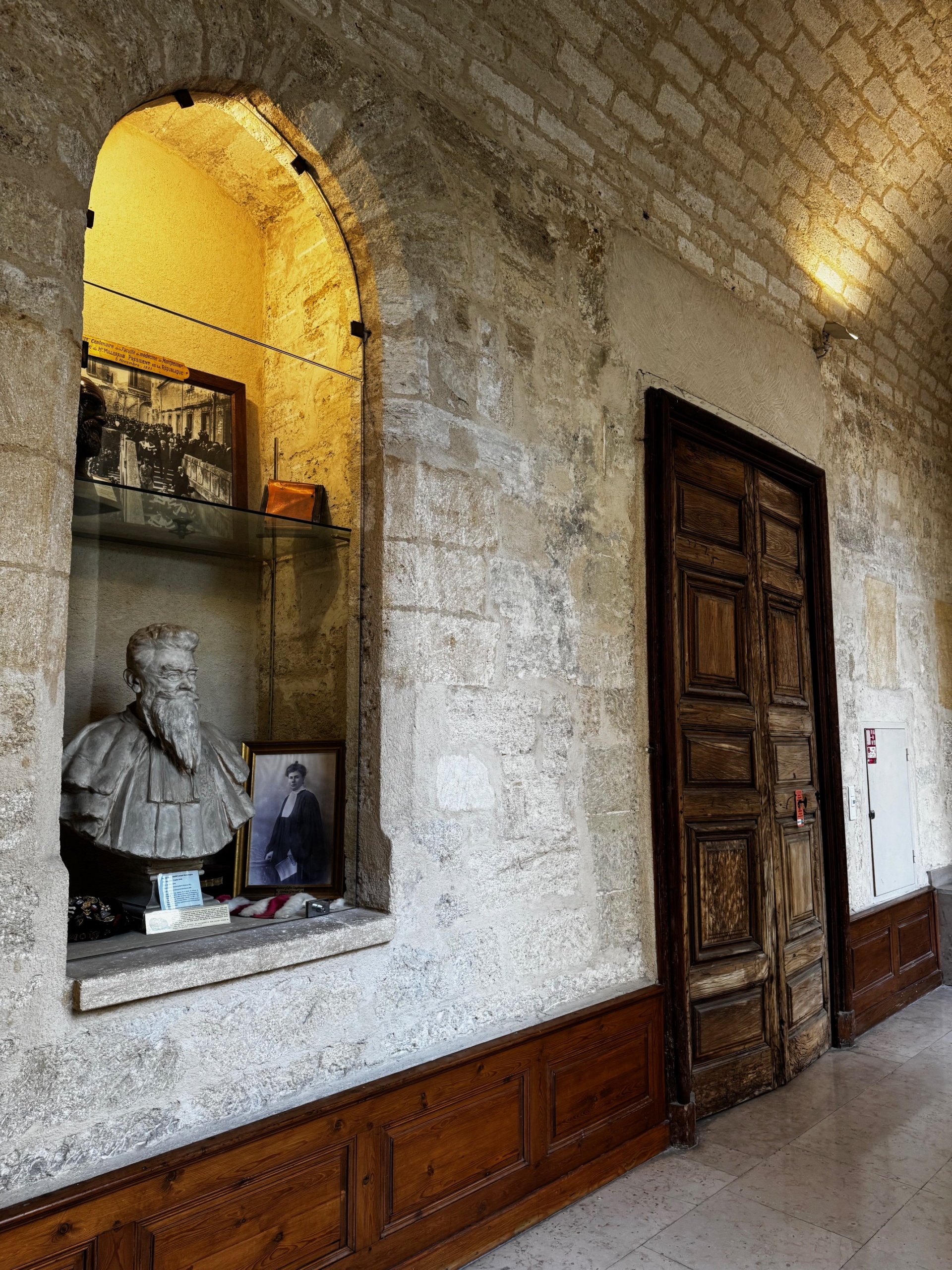
The display case on the right is dedicated to the Faculty’s pioneering women in medicine and also features items of academic regalia:
• Reproduction of a photograph of Scottish student Agnès McLaren,the first student to enroll in the School of Medicine in 1876 andthe first woman to earn a doctorate from the School in 1878 (as was often the case at the time, she had begun her studies well before her official enrollment).
• Photograph of Russian student Glafira Ziegelmann, who enrolled in 1894, becamethe first female resident at provincial hospitals in 1896, earned her medical degree in 1899, wasthe first woman admitted to the clinicat competitive exam, and wasthe first woman to pass the anonymous written portion of the medical agrégation exam in Paris in 1910.
• Professor's cap, doctoral gown (each row of ermine trim corresponds to one of the three academic degrees: bachelor's, master's, and doctorate)
• A faluche adorned with pins from each office of the Association Carabine Montpelliéraine, which opens its display case every year to hang the new pin representing the current class of students (the faluche has been the traditional student headwear at French universities since 1889; see below).
• Bust of Joseph Grasset, the Faculty’sfirst neuropsychiatrist
• Bust ofHippocrates
• Photograph of the ceremony marking the Faculty’s 7th centennial in 1921; note the crowd gathered in the main courtyard, stretching all the way to the rooftops of the cathedral
The Late Entry of Women into the Medical Profession in France
Although Agnès McLaren and Glafira Ziegelmann paved the way for women in medicine, it would still take several decades before women gained full access to teaching and research positions in French medical schools. The agrégation in medicine, which was once an insurmountable obstacle for women, gradually became accessible after World War II, thanks to fierce struggles for gender equality in academia.
Montpellier thus played a pioneering role by welcoming women as early as the late19th century, helping to change attitudes and secure recognition of their rights to practice and teach medicine.
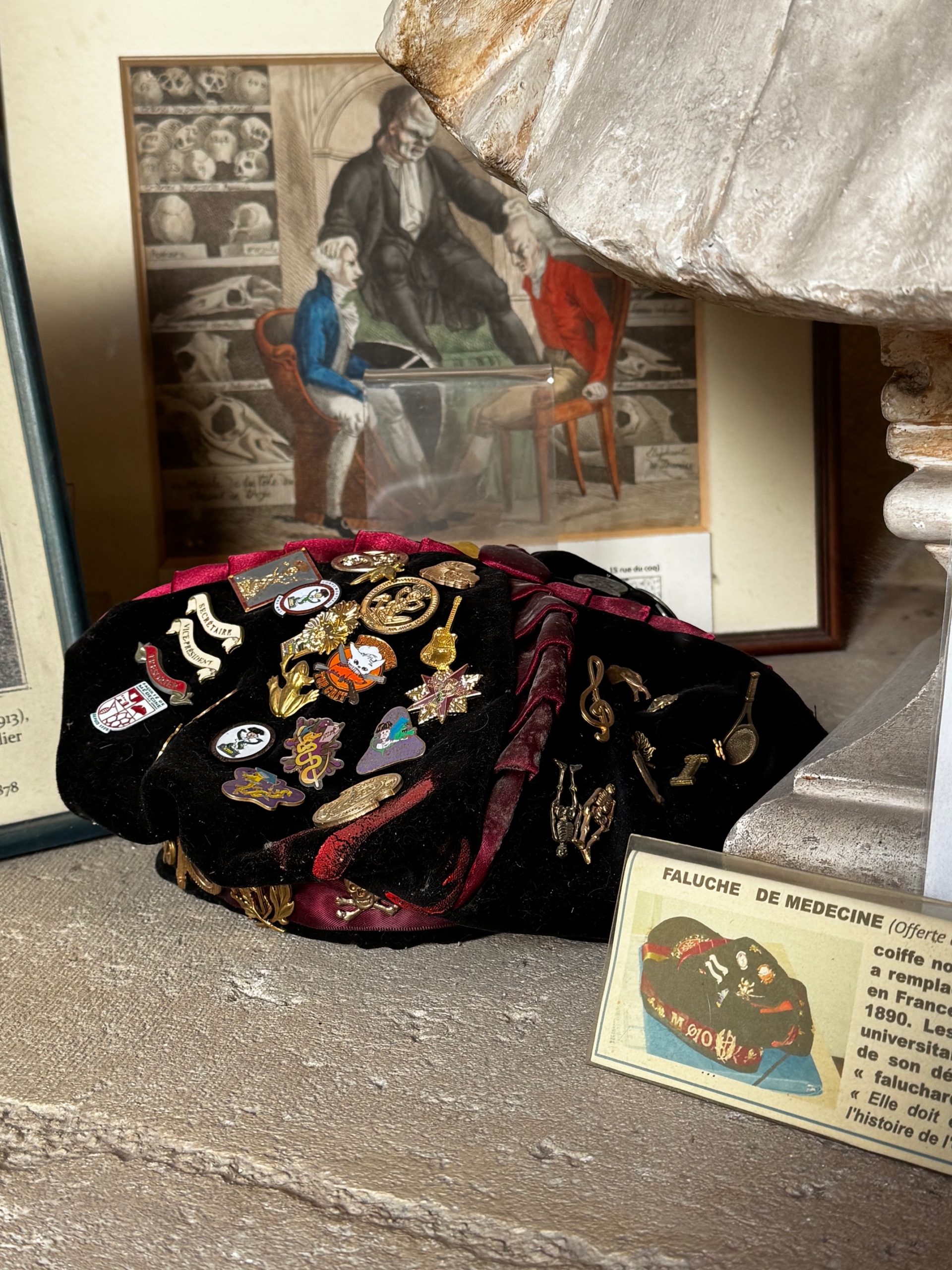
The Faluche: Montpellier's Unique Features
The faluche, a famous hat worn by French students since 1889, holds a special place in Montpellier. Here, the faluche features colored “crevés” (openings in the hat) arranged in a cross pattern on its black velvet—a Montpellier-specific detail that sets it apart from those of other university towns. This distinctive feature, which is meant to resemble a Renaissance-era hat, is a direct tribute to Rabelais, who was a student and professor (doctor) at the Montpellier Faculty of Medicine inthe 16th century.
When the faluche was adopted in 1889 by French students to represent higher education, Montpellier chose to distinguish it by adding this cross, whose color corresponds to the student’s field of study—dark red for medicine. This Montpellier-specific tradition was accepted by the national faluche code as early as the late19th century, recognizing Rabelais as a figure of academic humanism.
The Rabelais monument, located in the Jardin des Plantes and donated in 1921 by the student body to celebrate the Faculty’s 700th anniversary, is further evidence of the students’ attachment to this historical figure. An interesting anecdote is that the monument, which depicts a student raising a toast with one hand and holding his Montpellier student cap in the other, had the hand holding the cup broken by the elements (see the left display case). During the monument’s renovation in 2022, following the Faculty’s800th anniversary, the student community voted by a majority to oppose the reconstruction of the hand. The reasoning was that modern students no longer deserved to raise a toast, as they no longer studied with the same fervor or possessed the same humanistic culture as the medical students of Rabelais’s time. Ultimately, after the monument regained its original whiteness, the absence of the hand proved so unsightly that it was decided to restore it—if, and only if, sufficient documentation allowed it—to avoid creating a “historical falsification.” This was achieved, after several unsuccessful attempts, thanks in part to student mobilization, which resulted in the compilation of a rich iconographic dossier.
Note regarding the faluche: The Faculty administration and faculty members are working together with the student community to ensure that students who wish to continue the faluche tradition understand its historical significance (in terms of community, solidarity, and reflection), with the aim of preventing any potential abuses—whether or not related to the faluche—that might occur at student events, including orientation events and parties. This initiative by the Faculty of Medicine applies to all student club events and, more broadly, to the general framework of academic studies and internships.