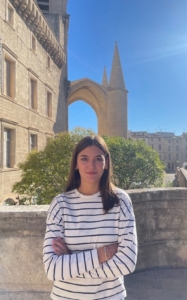
Hello, Marianne. For those who might not know you, could you please introduce yourself?
Hello, my name is Marianne KERMARC. I am athird-year medical student at the Montpellier campus. Before that, I completed a year of the PASS program, my first year of undergraduate studies (L1), and my second year of law (LAS2) at the Faculty of Law and Political Science in Montpellier.
I am the president of ADEMMOOS, the Association of Student Representatives for Montpellier-Nîmes in Medicine, Speech-Language Pathology, Orthoptics, Midwifery, and Psychomotor Therapy. I also represent medical students from Montpellier-Nîmes at the national level with the ANEMF (National Association of Medical Students of France). I was elected to the Academic Council for the 2024–2026 term and serve as the representative for the class of 2023–2028. Finally, I have been the Student Vice Dean of the Montpellier-Nîmes School of Medicine since October 2024.
What made you want to run for the position of Vice Dean for Student Affairs?
Ever since my second year of medical school, I’ve wanted to get involved in student representation, as I was already very active in advocating for student rights at the law school. As a result, I was elected class representative at the start of the academic year, with the responsibility of representing students at the student union. I wanted to take it a step further and represent students at the national level. With that in mind, I ran for the position of Vice President for National Representation for Montpellier within ADEMMOOS.
In this role, I had the opportunity to actively participate in ANEMF conferences, where I represented students’ interests on a wide range of topics, from the Reform of Admission to Health Studies (REES)—with the help of the Montpellier Health Tutoring Association (ATSM), to the reform of the second cycle of medical studies (R2C), as well as issues such as combating sexual and gender-based violence (VSS) and, above all, student mental health.
This experience motivated me to help bridge the gap between the local and national levels by bringing together all students from every program in the faculty, across both campuses. It was with this in mind that I decided to run for the position of Student Vice Dean of the Montpellier-Nîmes School of Medicine.
How will you balance your duties as Vice Dean with your obligations as a student and your other roles?
For me, the key word for this year will be organization. To be able to juggle my various roles, stay attentive and responsive to the students, and prepare my lessons, I’m very organized. The advantage is the synergy and overlap between my different roles, which complement each other and are therefore easier to balance.
I was able to anticipate this workload by observing Elie GHATTAS, Honorary Vice Dean of Student Affairs, whom I worked with during his term. I saw firsthand the workload he handled and the exemplary organizational skills he demonstrated. I am also supported by a team of people, including my co-advisor for the graduating class, Kinsy PONIN-GOBALOU, who helps me manage information related to the class, as well as my conference partner, Yanis LEMOUCHI, the Vice President for National Representation at the ACM.
I also make time for myself, with my friends, outings, and family time so I can step back and take a breather, because these are time-consuming jobs that require almost constant monitoring and hypervigilance.
What are your goals and priorities for this term?
My term as Student Vice Dean is divided into several key areas, with three main responsibilities: overseeing the second cohort of students taking the National Exams since the Reform ofthe Second Cycle of Medical Studies (R2C); organizing workspaces, student organization offices, and the area dedicated to students during the renovation of the Arnaud de Villeneuve campus; And finally, combating gender-based and sexual violence (VSS), as well as promoting student mental health.
These tasks are carried out in close collaboration with the faculty administration, the various associate deans, and Dean Isabelle Laffont. Through these discussions, I am able to represent the students by explaining our needs and expectations.
I also attend various faculty council meetings (both academic and administrative) and numerous other meetings to gain a comprehensive understanding of the various issues facing the faculty, to represent the students’ perspectives, and to conduct in-depth work on several topics.
As president of ADEMMOOS, I also oversee the various events organized by the association and its members. For example, we continued our flu vaccination clinic in partnership with the Bertrand Buisson Institute and the University Hospital, and this year we also offered COVID-19 vaccinations. As a result, nearly 120 students came to get vaccinated. We also have “Mars Sensi,” which is a month-long awareness campaign focused on specific topics chosen by the Vice President for Well-Being. And finally, in April, we’ll host the Forum for Future Interns (FFI), which is ADEMMOOS’s largest event and provides an opportunity to introduce the various medical specialties to external students.
We also have many other responsibilities, which are handled by elected officials, often behind the scenes. These are very important tasks, such as this year’s procurement of ID badges for students doing internships at the university hospital, or the work on the academic organization of the Department of Orthoptics and Midwifery.
Can you explain how you plan to promote students’ mental health within our faculty, as well as the specific measures you intend to implement as an association to support students facing challenges related to their psychological well-being during their time at the university?
ADEMMOOS, the association of elected student representatives, addresses a wide range of issues, including mental health. It all began with a survey conducted by the office of Théo LACOSTE, Student Vice-Dean for 2020–2021, which sounded the alarm. This prompted us, along with all the faculty’s student organizations, to support students and offer them several initiatives designed to promote their well-being.
As mentioned earlier, the Well-Being Center organizes numerous events focused on student mental health. This year, they offered other student organizations the opportunity to participate in the Mental Health First Aid (MHFA) training.
The mental health of health sciences students is of the utmost importance, given the challenges of their studies, but it’s also a difficult topic to broach because it’s so personal. In addition to the initiatives organized by the school and various student organizations, I serve as a point of contact for students who might need someone to talk to. I’m available if anyone feels the need to talk, and to refer them to professionals. It’s very important to me to remain available and accessible to all students at the school who might not know where else to turn.
In conclusion, I would say that the position of Student Vice Dean is a huge responsibility, but also an incredible opportunity to work on a wide range of issues with various student organizations and faculty members, and to keep an eye on almost everything that happens in the faculty and across its different programs. It also allows me to represent the students of the faculty wherever I go and at every event I attend. It’s a position for which I am very grateful.