Interview with Vice Dean Philippe Deruelle, Chair of the Academic Council
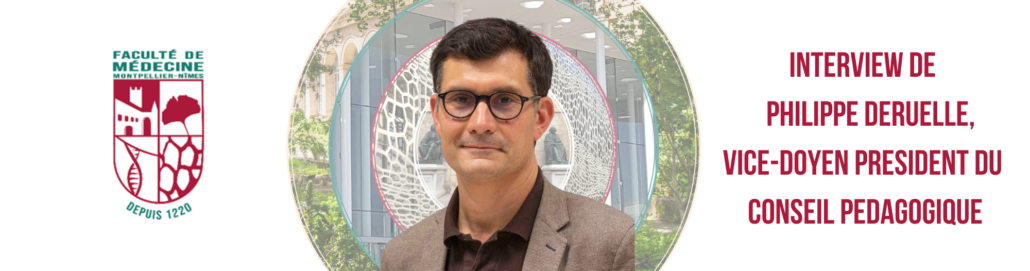
- You have been elected Chair of the Pedagogical Council. Could you tell us about your background and your area of expertise?
My career path has been that of a clinician passionate about teaching. As an Associate Professor of Gynecology and Obstetrics since 2008, I cut my teeth in Lille and Strasbourg before joining the Montpellier-Nîmes School of Medicine in September 2023. My clinical specialty led me to coordinate postgraduate education for my discipline at the national level (CEGO), including drafting the curriculum guidelines and creating a national bank of clinical skills assessments (ECOS).
Teaching has always been a fundamental pillar of my work, not a secondary activity. I had the opportunity to lead the PACES program in Lille for 8 years, and then to serve as Vice Dean in charge of graduate studies in Strasbourg. More recently, here in Montpellier-Nîmes, I have been co-coordinating the University Diploma (DU) in Medical Education. My identity is also shaped by the values of judo, in which I hold a black belt: humility, respect, and sincerity guide my actions every day.
- How do you plan to balance your professional responsibilities with your role as Chair of the Academic Council?
It’s a balancing act, but I’m approaching it with a clear strategy: collegiality. This presidency is not the responsibility of a single person, but of a committed group; to be effective without burning out, I will draw on the intelligence and energy of all the board members.
It is essential to remember, however, that pedagogy is not limited to the walls of this body. It is in the very DNA of all the teachers in our faculty, regardless of their location or the setting in which they work. My role will be to foster this shared passion and ensure that every faculty member feels supported and valued in this mission of knowledge transmission, which lies at the heart of our profession. By better structuring our governance—in particular through a Department of Medical Pedagogy equipped with adequate resources at each site—we will enable everyone to fully commit to this mission without hindering their other university-hospital responsibilities.
- What will your contributions and goals be? What projects do you hope to carry out in your role?
Our collective ambition can be summed up in one sentence: to put people and clinical practice back at the heart of our training. To achieve this, our priorities are centered around five areas of transformation:
- Prioritizing clinical time and reasoning: Itis essential to reaffirm the central role of the clinical rotation and to emphasize clinical reasoning and the assessment of symptoms.
- Building a Department of Pedagogy of Excellence: Together withthe dean, we aim to strengthen the Department of Medical and Health Sciences Pedagogy to make it a national and international center of excellence. This will require securing funding to support dedicated staff (educational engineers, coordinators) and actively supporting research in pedagogy—a field in which our faculty already excels, particularly in the area of artificial intelligence (AI), as evidenced by its publications in prestigious journals such asNEJM AI andMedical Teacher.
- Making AI an Educational Ally: AIshould not be something we simply endure, but something we master. It is essential to train students and teachers in the use of these tools. The goal is to use AI to personalize learning and free up time for tutoring and critical human skills. We are fortunate to have experts in this field who will lead the entire community toward this revolution.
- Valuing and Supporting the Teaching Community: It is important to restore a sense of purpose to the teaching profession and to recognize everyone’s dedication. It will be important to provide specific support for the careers of our CCA members, who will be our future academics.
- Strengthening dialogue with student representatives: Education is a collaborative effort that requires everyone’s commitment. I want to maintain regular communication with student representatives, particularly to establish guidelines—such as a joint charter—for new technologies like artificial intelligence, and to ensure that the Council’s decisions reflect the realities of their academic programs.
The idea is to move beyond simply imparting knowledge to truly designing learning experiences, where technological innovation supports clinical excellence and respect for human dignity. The Montpellier-Nîmes School of Medicine must uphold its centuries-old tradition by drawing on five core values:collegiality,transparency,high standards,commitment, andinnovation.
- What motivated you to run for office?
My motivation stemmed from an immediate connection to this school. From the moment I arrived three years ago, I was struck by the energy and innovative spirit of our community. I was inspired by a group of incredibly dedicated colleagues who share a common vision: that of a rigorous yet deeply human approach to teaching.
I do not view this presidency as an end in itself, but rather as a position of service. I want to draw on my national and cross-disciplinary experience to lead this collective effort. My decision to run was driven by a desire to help ensure that the Montpellier-Nîmes Faculty remains a national leader, while continuing to listen to every faculty member and every student.