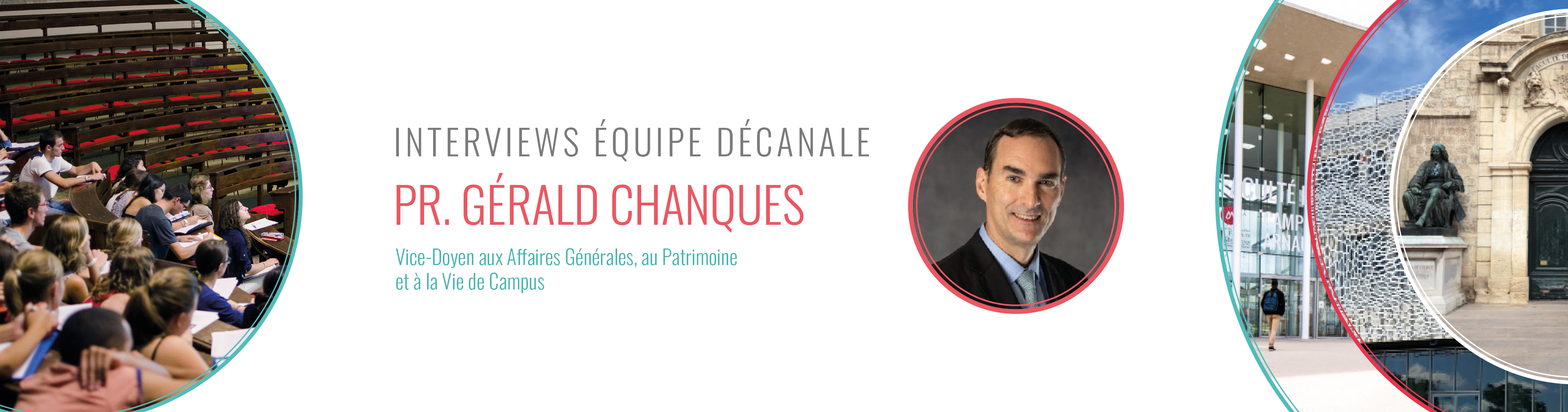
Every five years, a new dean’s office team—composed of associate deans and program coordinators—is appointed by the dean to represent him or her in carrying out specific tasks. This year, Prof. Gérald Chanques was appointed Associate Dean for General Affairs, Heritage, and Campus Life. Read his interview here: learn about his background and the projects he hopes to implement as part of his role!
You were appointed by the Dean, Ms. Isabelle Laffont. Could you tell us about your background and your area of expertise?
I earned my high school diploma and completed my undergraduate studies in Montpellier, so you could say I’m one-quarter Parisian and three-quarters Montpellier native. I loved my studies so much that it was difficult for me to choose a “specialty.” I chose anesthesiology and critical care for several reasons: first, because of the interdisciplinary nature of medical knowledge, but also because of the human and material resources available within our teams to provide safe care, including pain management and the treatment of the most critical situations.
How do you plan to balance your duties as associate dean with your other professional responsibilities?
This is a project that took shape within my hospital department, in collaboration with my colleagues and my department head, who has always supported and encouraged me throughout my professional career. My involvement at the faculty has grown gradually since my appointment 8 years ago. I continue to maintain a clinical practice that constantly enriches my teaching and research. Conversely, my understanding of academic institutions shapes all my responsibilities as a University Physician-Professor (PUPH). The Faculty and its unique history, as well as the University (I serve on the Committee on Education and University Life and on the disciplinary sections of the Academic Council), prompt me to reflect on every facet of my work—from patient care to teaching and innovation. The societal shift taking place in how we relate to one another—including the fight against inequality and against sexual and gender-based violence—represents a major turning point that our institutions have long anticipated.
What will your contributions and goals be? What projects do you hope to carry out in your role?
I gradually came to realize the importance of teaching and passing on knowledge to the younger generation, as well as the importance of having a faculty that draws on multiple campuses (Nîmes and Montpellier, modernity and heritage) and embodies a true university spirit—one that is meaningful to our patients, our students, and society alike. The Faculty has an urban history. It serves as a bridge to the general public.
Our faculty currently faces multiple challenges in terms of the institution’s organization, its campuses, and the promotion of its heritage: the university community—students, faculty, and administrative staff—must embrace this past and future history and share it with others—our colleagues in other parts of the University, our healthcare colleagues, and the general public. Among the general public are potential patients. The image we project of the faculty through our history and heritage must align with today’s demands—innovation, excellence in care, but also addressing vulnerability and access to care. All of this together defines our faculty, and we cannot rest easy unless we strive to address all these challenges. The unity of the leadership team, united around our dean, will be the strength of the institution—involving all its faculty and administration, those from previous teams, and those preparing future generations.
What motivated you to accept this appointment?
My desire to contribute to a dean’s office initiative focused on community, kindness, and active listening, with ambitious goals for the institution. I was very grateful for this appointment because it allows me to consistently continue the work I’ve been doing for several years with Dean Mondain and Vice Dean Lavabre-Bertrand on complex projects (preparing state-region planning contracts for long-term renovations to the historic building; conducting studies for the learning center; and liaising with the general affairs departments of the Faculty and the University to develop a large number of projects involving institutions, local governments, and businesses as part of the 800th-anniversary celebrations…).