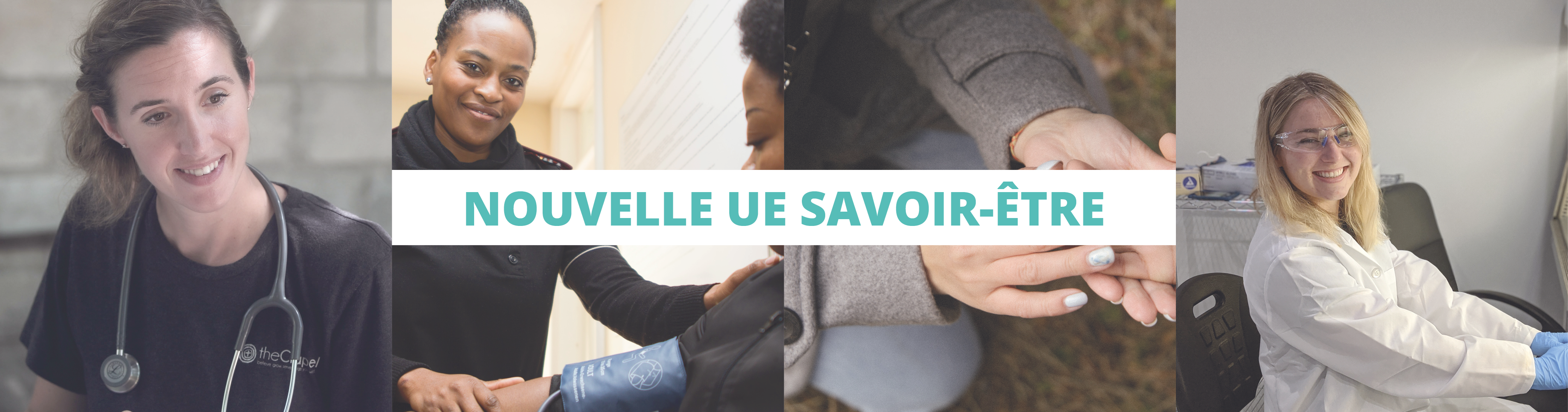
As discussions about student mental health have resurfaced in the wake of the health crisis and amid reforms to graduate-level programs, our faculty teams have developed—in collaboration with students and service users—a one-of-a-kind educational concept. Temporarily titled “Interpersonal Skills and Therapeutic Communication,” this empathy-focused curriculum represents a true ethical and pedagogical innovation. To learn more, we spoke with the project’s leaders: Dr. Amandine Luquiens and Prof. Céline Bourgier, as well as Théo Lacoste, a student member of the steering committee.
The Origins of a Project Centered on Empathy
A need for evaluation arising from the R2C evaluation procedures
In 2018, the proposed reform of the second cycle of medical studies (R2C) was presented to the various academic administrators at the Faculty, prompting Professor Céline Bourgier to take notice. She noted that, under the R2C, student assessment would focus, among other things, on evaluating students’ interpersonal skills and empathy through the Certificate of Clinical Competencies (C3). However, at that time, our curriculum did not include any courses entirely dedicated to developing this competency.
Joined in 2019 by Dr. Amandine Luquiens, a psychiatrist specializing in addiction at the Nîmes University Hospital, the two doctors will therefore team up to lead the project to develop an innovative teaching unit capable of meeting the requirements of R2C. Their first step is to study the current level of empathy among medical students.
A striking finding: medical students’ empathy declines as they progress through their studies
Their initial findings are surprising. In fact, as they conducted their literature review, the two researchers discovered that medical students tend to experience a decline in empathy throughout their studies. “This decline begins at the same time as hospital rotations. It appears that the gap between the ‘idealized view of the healthcare profession’ and the ‘reality of the healthcare profession’ is a triggering factor,” – explains Amandine Luquiens
Another observation: this decline is very strongly correlated with the burnout and depression issues that health science students may experience.
A structured educational program to halt this decline and ensure higher-quality care in the future
These findings have motivated the project leaders to create a new, innovative teaching unit (UE) with a twofold objective:
- To provide students with the tools and skills necessary to improve the quality of careby instilling in them a person-centered approach rather than focusing solely on symptoms or medical conditions
- Preventing psychosocial risks—not only for patients, but also for students—future healthcare professionals.
These two complementary elements will therefore be developed jointly by a dedicated committee composed of faculty, students, and users.
An EU built collaboratively to foster skills related to empathy toward oneself and toward patients
Stages in the Development of the EU
Such an EU requires a period of development followed by a trial phase, which will be implemented within the Faculty in five major stages:
An EU structured to facilitate students’ learning about emotion management
As Théo Lacoste, Student Vice Dean for 21-22, points out, medical students are “perfectionists”: “They are selected because they are the best. And this selection process continues throughout their years in school. The need to be—or at least to appear—‘flawless’ at every level—whether professionally or emotionally—persists until it becomes an almost cultural component of our way of thinking.”
However, it is precisely a process of acculturation on this subject that this course unit is intended to foster: Amandine Luquiens explains: “We are seeking to foster this awareness among students—and even within the Faculty as a whole. The Faculty takes care of its students, and students must take care of themselves. We will thus help them acquire tools that enable them both to protect themselves and to curb ‘emotional suppression’—a management strategy that doctors have been using for many years to address the patient-caregiver relationship.”
PTo achieve this goal, the EU is organized around four major components, all of which are mandatory:
- Introduction to Meditation Mindfulness Meditation
- Sharing Best Practices among peers: This module encourages open discussion and also helps participants better understand professional communication within a healthcare team
- Therapeutic Communication : a multi-year module featuring theoretical instruction on communication, theater workshops, and simulation exercises.
- Stigmatization in Healthcare : a module featuring user testimonials in which individuals share with students their personal experiences with situations they have encountered during their care journey
In summary: an innovative initiative in more ways than one
Humanism is a core value of the Faculty. It is an integral part of its history, but it also serves as a guiding principle for its future, as evidenced by this program, which is innovative in more ways than one. Indeed, this is an ethical and pedagogical innovation :
- co-created with students, faculty, users, and administrative staff: a true example of cross-functional collaboration among the women and men of our community
- that focuses on a genuine social for health science students and that is introduced early enough in their academic program to address it in advance and long enough to address it in depth
- which includes theoretical modules but also, and above all, highly practical modules, centered on a human-centered approach to the patient-caregiver relationship, particularly through simulation workshops
- Skills Developer key skills centered on empathy and interpersonal skills: essential tools for a more humane approach to medicine
- carrying a message for both students and their future patients
Opportunities for other degree programs
The introduction of this course unit into the medical curriculum inevitably raises questions about the other programs offered by the school (midwifery, paramedical studies). “Medicine is relatively behind compared to other programs,” admits Dr. Luquiens. “In fact, there are already course units in the other programs, but not in such a structured, phased manner. The idea, therefore, is that once this course unit has been refined, it will be ‘expanded’ to the other programs, with the goal of fostering a transdisciplinary approach to these skills.”