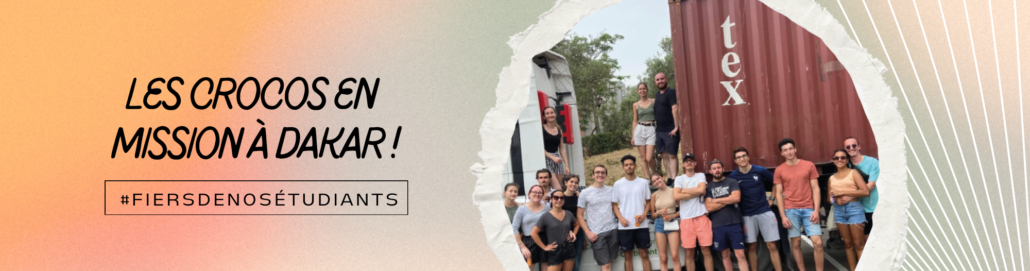
#ProudOfOurStudents | Our students from Nîmes on a mission in Dakar
Our students have talent and ideas to spare! While our students in Montpellier are getting involved in a community service project in Togo, our students in Nîmes have chosen Senegal and the city of Dakar for the annual humanitarian project organized by the Crocos du Monde association. It’s a wonderful initiative that we didn’t want to miss the chance to share. Here’s a report and an interview.
To learn more about the ins and outs of this project, we sat down with Joffrey Buland, the 2021–22 President of Crocos du Monde! Check out his interview below!
Hello, Joffrey. Could you please introduce yourself and tell us what your role is in this project?
Hello, my name is Joffrey Buland, and I am currently a second-year medical student in Nîmes. During the “Dakar 2022” project organized by Crocos du Monde, when I was a first-year medical student, I served as president of the association. The president’s role, in collaboration with the executive committee, is to organize the international project. We were responsible for communicating with local contacts, issuing requests for quotes for the end-of-year shipping container, and organizing its shipment as well as the trip to the destination.
Can you tell us more about this project? What did it involve?
This project was a first for Les Crocos du Monde; our goal was to launch an international initiative that would be more sustainable—a long-term partnership that could be renewed each year. It was with this same goal of sustainability in mind that we came up with the idea of the shipping container, to give a second life to the supplies we were able to collect throughout the year. Since Les Crocos du Monde is focused first and foremost on sharing and sustainable development, the idea seemed like a natural fit. The goal was to collect medical and paramedical supplies throughout the year through various partners, which were then shipped to Senegal—specifically to the Fatick General Hospital, located 150 km south of Dakar.
Why did you choose Senegal? What motivated your decision?
We turned our attention to Senegal thanks to a doctor at the Nîmes University Hospital, Dr. Christophe Boisson, who helped us immensely in setting up our project. Dr. Boisson has been sending containers of medical supplies to Dakar for several years now; it was with him and our trusted contacts on the ground that we decided to focus our efforts on the Fatick General Hospital. This led to an official partnership between the Carémeau University Hospital and the Dakar University Hospital, of which “Les Crocos du Monde” and Fatick are branches. This partnership has three main areas of focus: the delivery of medical supplies—in which we participated—medical and paramedical training through the simulation center, and training for biomedical engineers and technicians.
How did you organize the collection of supplies?
The collection of supplies began with the hospital identifying its needs and providing us with a list. From that list, we selected the supplies we were able to obtain—those that were within our reach. The “Dakar 2022” project was therefore primarily focused on the nephrology unit, which is currently undergoing rapid development in Fatick. Once we had identified our target, we reached out to our partners—including individuals, other organizations, and, primarily, the Nîmes University Hospital and Dr. Boisson—and began our search and collection efforts.
All in all, what kind of materials were you able to collect? How much is that?
By the end of the year, we had collected enough to fill a 33-cubic-meter container—2.5 metric tons of equipment. Most of it was urology and nephrology equipment, including catheters and urinary ostomy kits, but we also collected some surgical equipment, such as ventilator circuits and laparoscopy kits. We were also fortunate to find large electronic equipment, seven emergency stretchers, and a delivery table. Since the goal was to give the items we sent a second life, all expiration dates were checked, and all electronic equipment was tested and refurbished as needed through Apelem, an association of biomedical engineers and technicians that is part of the partnership with the Nîmes University Hospital.
You were part of the trip in July. How did it go? What did you and your colleagues get out of it?
The four of us traveled to Nîmes with three second-year medical students, two of whom are now part of the executive committee. The goal was to take them on a tour of facilities such as the Fatick General Hospital, where they will be collecting supplies, so that they could get a clear idea of their upcoming 2023 project. At the same time, we wanted to introduce them to our trusted partners and local contacts, which will facilitate better communication in the coming year and help them understand the why, the how, and the for whom. This trip was deeply enriching on a personal level; it allowed us to see and understand different hospital and cultural systems, with resources that also varied to some extent depending on the facility.
Does this inspire you to get involved in humanitarian medicine?
Humanitarian medicine has always been my life’s work; ever since I started PACES, my goal has always been to join Doctors Without Borders or other organizations to go on missions. When I discovered the Crocos du Monde association, and I had the chance—along with my friends—to get involved in my own way starting in my first year of medical school, I didn’t hesitate. This year has allowed me to further deepen and strengthen this dream for after I graduate.
What about upcoming projects for Crocos du Monde?
To answer this question, I’ll hand it over to Chloé Messines, the new president of Crocos du Monde for the 2022–2023 term.
Chloé: Les Crocos du Monde has always focused on the partnership between the Nîmes and Dakar university hospitals, and more specifically on putting together the container of medical equipment; the bulk of our internal funding and the events we organize are aimed at financing this project. Furthermore, it is important for us—as well as for our Senegalese partners—to meet in person and confirm that the container was well received. Just as we did last year, Les Crocos du Monde are committed to traveling to Dakar and Fatick to connect with the people who made this project possible. Now, our goal for this year is also to foster a vibrant community life for our members by offering a wider variety of events (clean walks, school outreach, outreach patrols, etc.), with a focus on inter-organizational collaboration (such as our participation in the “Nîmes en Rose” project led by the midwifery association and “Pep’s Week” with Tutorat Santé Nîmes). In this way, we’re drawing on the motivation of second-year medical and midwifery students to ensure the association’s successful development.