#ProudOfOurStudents | The Med’Trotters are back from Togo!
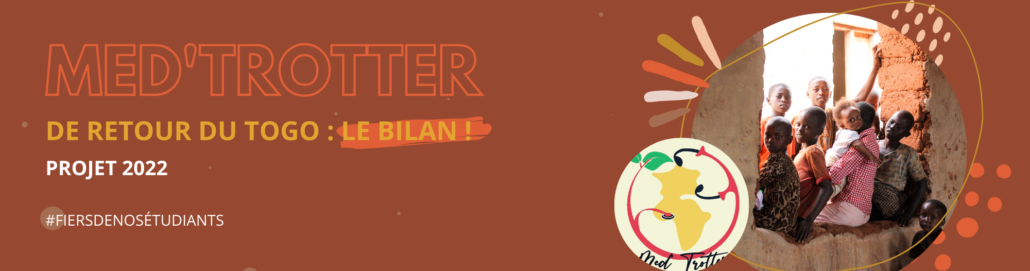
In July, through the ACM’s exchange program, 13 students had the opportunity to travel to Togo as part of a solidarity project for an organization working to renovate a school. A presentation evening for the International Solidarity Project was organized, featuring a film screening! Here’s a recap of the experience.
How was your trip?
The trip went wonderfully well. We were obviously very anxious because, although the project had been planned three years ago, it had never come to fruition due to the health crisis. So we were the first to go, but the trip went well—whether in terms of the preliminary planning (fundraising, grants, raffles…), safety, our relationship with the Togolese volunteers and the children, or the construction site itself… Our arrival was also well organized by our local partner organization, Espace Hotsi, which supported us from the moment we arrived at the airport until our departure, handling accommodations, meals, transportation, and more…
What were your responsibilities?
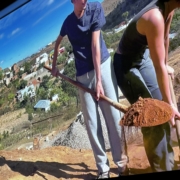
Our main mission was to help renovate four preschool and elementary school classrooms, as well as latrines. Our support was primarily financial, as we covered the costs of materials and volunteers (approximately 3,800 euros). We also provided hands-on assistance by contributing additional labor to the construction site.
In the afternoons, we organized games and workshops with volunteer children from the village (painting, dodgeball, etc.). We also attended the school’s end-of-year ceremony, where academic results were announced. We took this opportunity to provide the students with the school supplies they’ll need for the start of the 2022 school year, thereby ensuring equal opportunities, since not all children can afford to pay for the required supplies.
What have you put in place?
The project involved renovating the staircases (masonry), the roof, the gutters, and painting (we sanded and then repainted the exterior and interior walls).
Have you encountered any complications you didn't expect?
We can’t say we ran into any real complications. We had braced ourselves for some discomfort due to the different hygiene practices, but we actually adapted fairly quickly (adaptation happens fast when you have no choice). So, what surprised us most at first was how independent the children were, even from a very young age (sometimes a 5-year-old would carry and take care of his 1-year-old brother). We also noticed cultural differences regarding romantic relationships and how they’re conceptualized. Aside from the culture shock that’s inherent in this kind of experience, we didn’t really face any major complications; it’s simply a matter of adapting to every aspect of life in a country where the way of life is the opposite of what we’re used to in Europe.
Before your trip, you reached out to Médecins du Monde. How did you go about raising awareness?
In fact, we had initial contact with Médecin du Monde, who were very eager to support us on this adventure; unfortunately, after several follow-ups, we didn’t hear back from them. So we had prepared awareness-raising sessions, but once we were there, putting them into practice proved much more difficult than we had anticipated. First of all, because not all the children speak French well, depending on their age (they learn French in school since it’s the country’s official language). And above all, they just wanted to play with us and do physical activities. The diversity of the group therefore prevented us from carrying out our awareness-raising activities as we had hoped. This aspect of the mission is therefore an area for improvement for next year.
How did the experience affect you?
That’s a pretty tough question. I think it took each of us some time after we got back to “process” everything we’d been through. We don’t claim that this trip completely transformed us or that we’re now entirely different people. But this experience certainly left its mark and taught us a great deal on a human level. Sometimes it’s good to get a “wake-up call,” and we can say that what we experienced was a veritable cultural, social, and human whirlwind. Now that we’re back, we’re still ourselves—medical students at the Montpellier-Nîmes Faculty, caught up in the grind of our daily routine—but not a day goes by without me thinking back on that trip to Togo. I don’t know if this experience will make me a better person or improve my practice as a future doctor, but it has given me something—that much is certain.
What is your assessment of the situation?
I am pleased to say that the outcome of this mission is extremely positive. Of course, there is room for improvement in terms of planning the trip in advance, managing funds on site (difficulty making withdrawals), and preparing and adapting our outreach efforts. But the very fact that we carried out the mission successfully is an achievement in itself. Furthermore, we are certain of the value of our work, as we are in contact with Étienne, the school principal, who regularly sends us videos of the children attending classes in their newly renovated building. This project is therefore clearly worth repeating, while doing our best to iron out the minor hiccups from this year.
Do you have any new projects?
The new Vice Presidents in charge of Exchange Programs at the Association Carabine Montpelliéraine recently presented this year’s new project to medical students, which involves returning to Togo with the Espace HOTSI association. Indeed, we are convinced that continuing this mission is essential for another year. The project’s format will therefore remain the same (renovation projects, construction, tutoring, etc.), though the specifics are still to be determined with the new Med’Trotters team, which will be selected soon.