Tag archive for: well-being

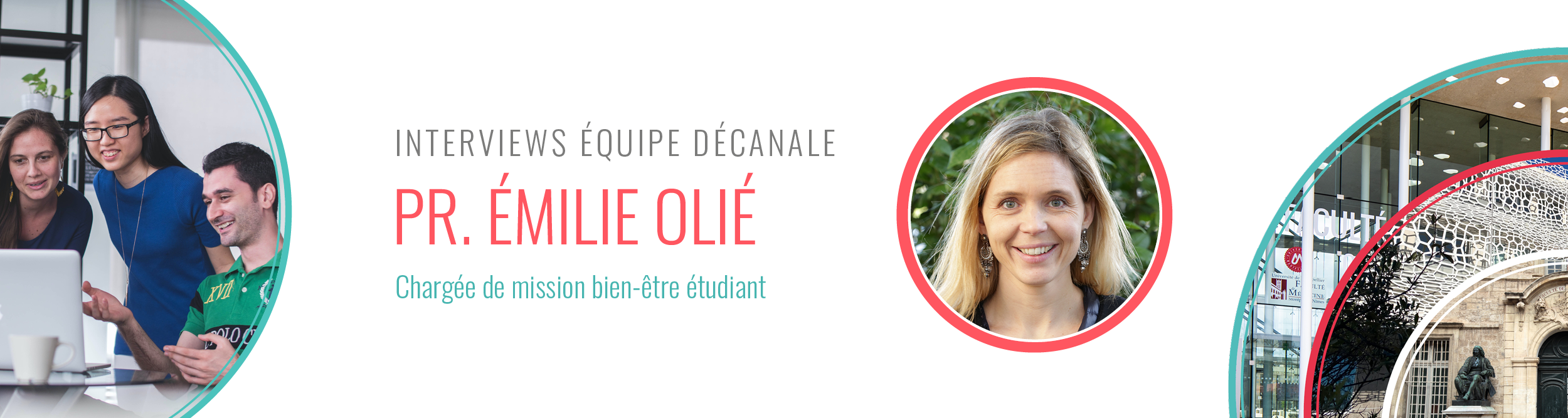
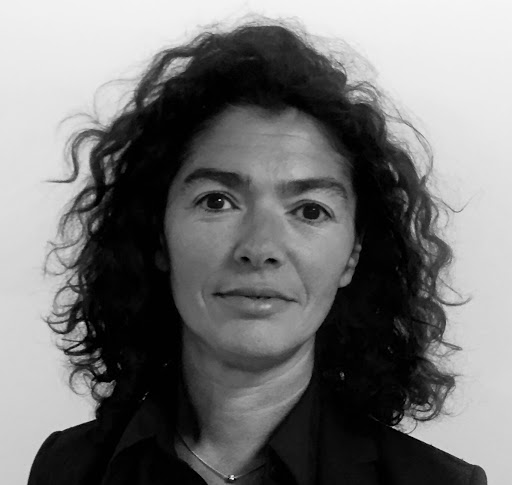
Every five years, a new dean's team, composed of vice-deans and project managers, is appointed by the Dean to represent him or her in specific tasks. This year, Professor Émilie Olié has been appointed Student Well-being Project Manager. Read her interview here to find out more about her background and the projects she hopes to implement as part of her role!


You were appointed by Dean Isabelle Laffont to the position of Student Well-being Officer. Can you tell us about your background and your area of expertise?

I am a psychiatrist specializing in mood disorders and suicidal behavior. After studying medicine in Paris, I completed my residency and clinical training in psychiatry in Montpellier.

As far as my career is concerned, a few years ago I developed a real interest in student well-being. We set up a project involving psychotherapy sessions to prevent burnout among medical students. In this context , Dean Mondain asked me to be the point person for the former CNA (Conseil National d'Appui, or National Support Council) for the quality of life of health students, which was renewed by the Dean with the new CNA-ES, and the position of project manager came about later.


How do you plan to balance your duties as a project manager with your other professional obligations?

I think that my activities as a project manager and my professional obligations are quite complementary. As part of my specialty, I am called upon to guide or even support students who are experiencing psychological difficulties. I intend to use my skills to promote student well-being.


You are the student welfare officer. What will your contributions and objectives be? What projects do you hope to carry out?

The first area of action concerns psychological health: strengthening psychological support within the Faculty, whether in terms of listening or guidance, raising awareness of the support mechanisms in place, and setting up training initiatives for students and administrative staff to enable them to identify and refer people in difficulty.

The second area of action concerns the implementation of measures to combat gender-based and sexual violence.


What motivated you to accept this appointment?

Firstly, because it is a worthy cause. We want students to thrive in the Faculty and to ensure that their studies are a positive experience. Secondly, because this appointment as Student Well-being Officer perfectly matches my specialty, which is to improve the daily lives of people who are suffering.


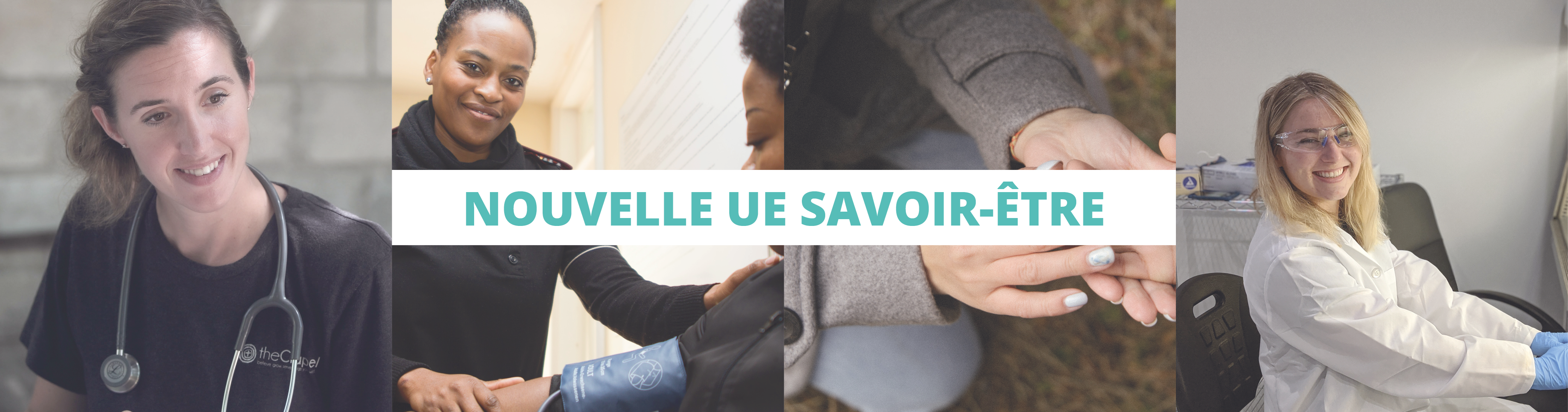
As debates on student mental health have resurfaced in the wake of the health crisis and at a time of undergraduate reform, our teaching teams have developed a unique educational concept in collaboration with students and users. Temporarily named "Interpersonal Skills and Therapeutic Communication," this empathy-focused teaching program is a true ethical and educational innovation. To learn more, we turned to the project leaders: Dr. Amandine Luquiens and Prof. Céline Bourgier, as well as Théo Lacoste, a student member of the steering committee.


Genesis of a project focused on empathy

A need for evaluation arising from the R2C evaluation methods

In 2018, the draft reform of the second cycle of medical studies (R2C) was submitted to the various educational managers at the Faculty and caught the attention of Professor Céline Bourgier. She noted that the R2C assessment methods would include evaluating students' interpersonal skills and empathy through the clinical skills certificate (C3). However, at that time, our training program did not include any courses dedicated entirely to developing these skills. 

Joined in 2019 by Dr. Amandine Luquiens, a psychiatrist and addiction specialist at Nîmes University Hospital, the two doctors will work together to lead the project to develop an innovative teaching unit capable of meeting the requirements of R2C. Their first step is to study the current level of empathy among medical students.


A striking observation: medical students' empathy declines as they progress through their studies.

Their initial findings are surprising. Through their bibliographic research, the two practitioners discovered that medical students tend to experience a decline in empathy throughout their studies. "This decline begins at the same time as hospital internships. It would seem that the difference between 'the idealization of the healthcare profession' and 'the reality of the healthcare profession' is a triggering factor," explains Amandine Luquiens.

Another observation: this decline is strongly correlated with the problems of burnout and depression that health students may encounter.


Structured teaching to halt this decline and ensure better quality of care in the future

These findings motivated the project leaders to create a new innovative teaching unit (UE) with a dual objective: 

  • Equip students with the tools and skills necessary to improve the quality of careby instilling in them a person-centered approach rather than just symptoms/pathologies.
  • Preventing psychosocial risks, not only for patients, but also for students, future healthcare professionals.

These two complementary elements will therefore be co-developed by a dedicated committee composed of teachers, students, and users.


A jointly developed EU for acquiring skills related to empathy towards oneself and towards patients

Stages in the construction of the EU

Such a university requires a period of creation and experimentation, which will take shape within the Faculty in five major stages: 

  • STEP 1

    Creation of a cross-functional steering committee

    As this was a collaboratively created course unit, the teachers were keen to set up a steering committee involving students to ensure that the course unit was tailored to their needs as closely as possible. The committee is also supported by the Faculty's Teaching Council (then chaired by Professor Denis Morin) and is made up of teachers from different backgrounds and specialisms in order to ensure a comprehensive overview of the project.

  • Review of existing arrangements and expansion of the steering committee

    With the help of administrative staff, Amandine Luquiens and Céline Bourgier are identifying existing teaching units and courses within the training program, focusing on the patient-doctor relationship, building the care relationship, and interpersonal skills. This allows them to contact the teachers responsible for the existing courses and integrate them into the steering committee for the new teaching unit.

    STEP 2

  • STEP 3

    Revision of existing courses, development of the EU

    The steering committee is proposing a new organization of existing courses over a period of five years. This involves reorganizing them into a more logical order, with a more gradual implementation that is consistent with students entering hospital internships. In parallel with the reorganization of existing courses, new courses are being proposed to complement the training program, such as the therapeutic communication module, divided into three progressive levels, which will incorporate the existing theater workshop.

  • Integration of the EU into the pilot promotion program

    The DFGSM2 2021-22 cohort is the pilot cohort and will inaugurate the entire EU curriculum over the five years. A few modules are also being offered to DFGSM3 students in order to test the curriculum (step 6). 

    STEP 4

  • STEP 5

    Follow-up of a cohort of students to evaluate teaching

    In order to measure the impact of teaching on students, three cohorts are regularly assessed on criteria related to empathy, well-being, and the concept of the care relationship. The DFGSM2 21-22 class will be compared to the DFGSM3 21-22 class, which will have benefited from a lighter teaching load, and to the DFASM1 21-22 class, which will not have been able to benefit from the various EU modules.


A structured EU to facilitate students' acculturation in the subject of emotion management

As Théo Lacoste, Vice Dean of Students for 2021-2022, points out, medical students are "perfectionists": "They are selected because they are the best. And this selection process continues over the years. The need to be, or at least appear, 'infallible' at all levels—whether professionally or emotionally—continues until it becomes an almost cultural component of our way of thinking." 

However, it is precisely a acculturation on this subject that this EU should encourage: Amandine Luquiens explains: "We are seeking to acculturate students, and even the faculty as a whole. The faculty takes care of its students, and students must take care of themselves. We will therefore help them to acquire tools that will enable them both to protect themselves and to curb 'emotional suppression', a management strategy used for many years by doctors to understand the patient-caregiver relationship."

 PTo achieve this objective, the EU is structured around four major modules, all of which are mandatory: 

  • Introduction to mindfulness meditation Mindfulness
  • Peer-to-peer exchanges of practices : this module encourages open discussion and also provides a better understanding of professional communication within a healthcare team.
  • Therapeutic communication : a multi-year module with theoretical instruction on announcements, integration of theater workshops, and simulation workshops.
  • Stigmatization in healthcare : a module featuring user testimonials in front of students about situations they may have experienced during their healthcare journey


In summary: an innovative initiative in more ways than one

Humanism is a core value of the Faculty. It is an integral part of its history, but it is also a value that will shape its future, as demonstrated by this innovative program in more ways than one. Indeed, it represents an ethical and educational innovation

  • Co-created with students, teaching staff, users, and administrative personnel: a true example of cross-functional collaboration between the women and men of our community. 
  • who is interested in the real social and societal issue for health students and intervenes early enough enough in their studies to anticipate it and long enough to address it in depth
  • which incorporates theoretical modules but also, and above all, highly practical modules, focused on a human approach to the patient-caregiver relationship, particularly through simulation workshops.
  • creator of key skills key skills in empathy and interpersonal skills: essential tools for a more humane approach to medicine
  • carrying a message both for students and their future patients


Open perspectives on other courses

The introduction of this EU in the medical curriculum inevitably raises the question of other courses offered by the faculty (midwifery, paramedical). "Medicine is relatively behind compared to other courses," admits Dr. Luquiens. "Indeed, there are already course units in other programs, but not in such a structured way over time. The idea is therefore, once this course unit has been proven, to "spread" it to other programs, with a view to taking a transdisciplinary approach to these skills."


Are you a PASS or LAS student? Discover Pep's Week, organized by your awesome association, Tutorat Santé Montpellier! Dates, program, and registration—find all the useful information in this article!


A wellness week for PASS and LAS students

To mark the end of the first semester exams and help students prepare for the second semester, the Montpellier Health Tutoring Association (ATSM) is organizing the 2022 edition of Pep's Week for PASS and LAS students!

Winner of the Montpellier Student Initiatives Trophy in 2018-2020 and highly appreciated by students, Pep's Week is a project that is very close to our hearts and one that we hope to repeat this year under the name "Pep's Week."

This week is dedicated to the well-being and relaxation of PASS and LAS students. To this end, the ATSM is organizing numerous activities in partnership with students from different disciplines in order to provide the best possible support to first-year students by offering them psychological and educational assistance. The development of this well-being is a key objective, which has become essential since the start of the health crisis.

The 2022 edition, January 24 to 28

Pep's Week will take place from January 24 to 28, 2022. During this week, the ATSM will offer various activities involving qualified speakers, opportunities for discussion and sharing between students and tutors, every lunchtime at the Montpellier Faculty of Medicine, on the ADV Campus (641 Avenue du Doyen Gaston Giraud).

For this new edition, the theme is " Japan." Participants will receive a Welcome Pack containing lots of special goodies related to ATSM partnerships.


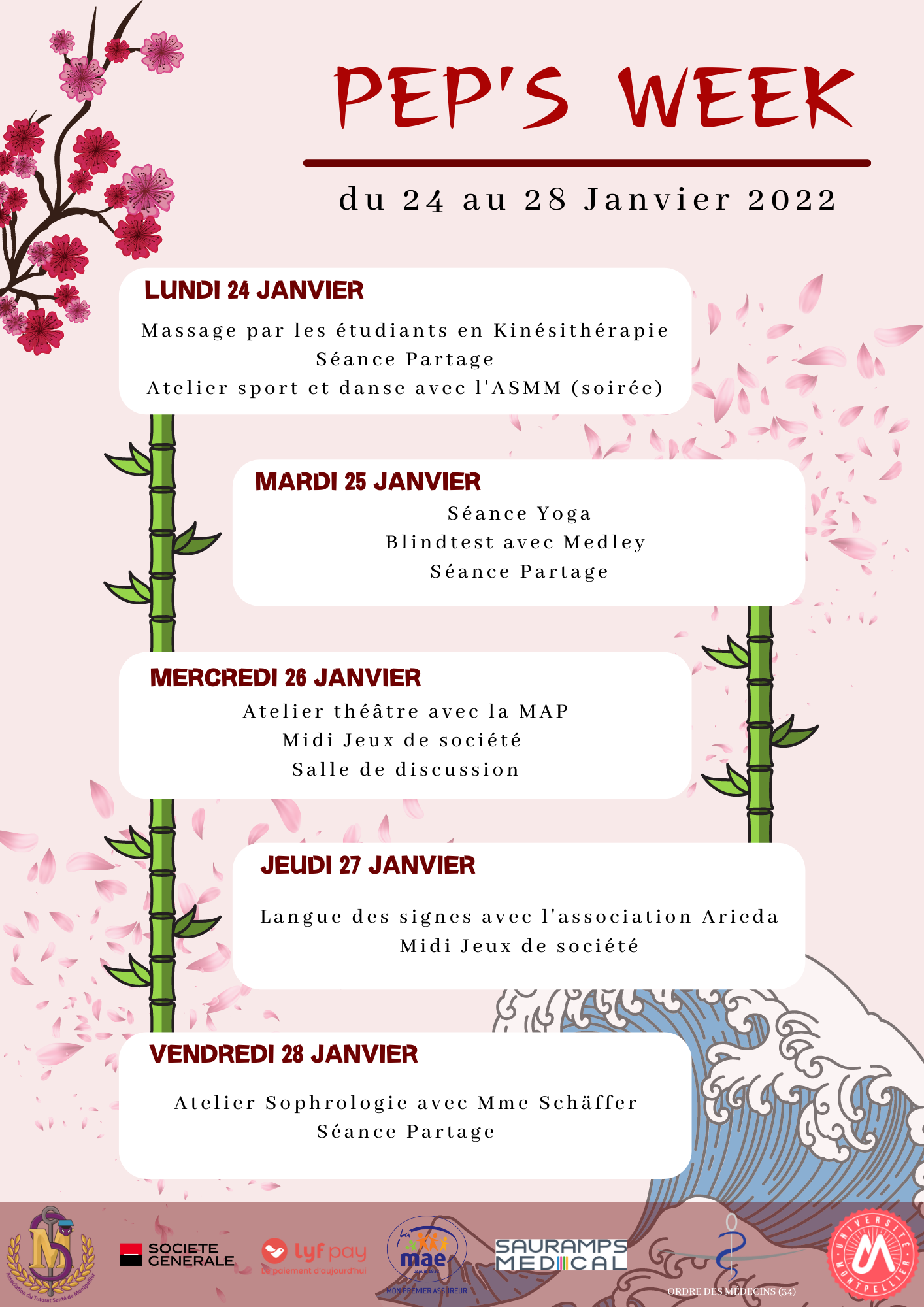
Here is the detailed program for the week:


Registrations

Pep's Week is free but requires prior registration. It couldn't be easier! Simply register by clicking on the button below:


Nutrition - 5 tips

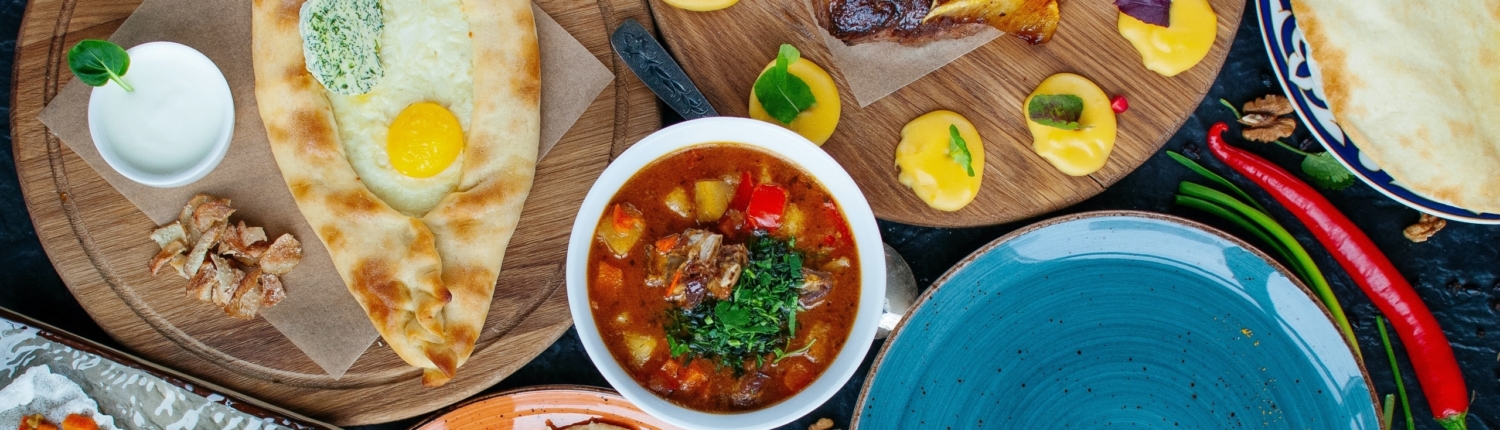
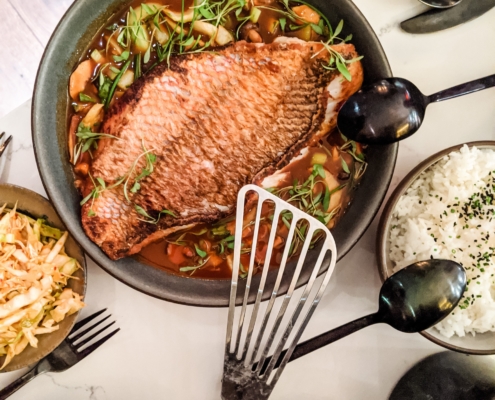
During this period of lockdown, there is no shortage of temptations when it comes to snacks and sweets... Should we give in and feel guilty, or resist and feel frustrated? We asked Professor Ariane Sultan, a professor at the Faculty specializing in nutrition, and Nicolas Sahuc, a dietitian who lectures at the Faculty. Together, we have compiled five dietary and nutritional tips to follow during lockdown... but that's not all!


1 / Listen to your body and its needs!

Lockdown is disrupting our habits: our schedules are changing... and so are our bodies! Sometimes, we don't feel hungry at the traditional "breakfast, lunch, dinner" times. Don't panic! According to Nicolas Sahuc, we need to pay close attention to our body's rhythm, which varies from day to day and is not necessarily aligned with "social" schedules: "Don't worry if you're not hungry at 'mealtimes'; instead, eat when you really hungry. " To do this, you need to listen to your body and pay attention to your true feelings of hunger and satiety. "This does not necessarily mean eating three meals a day..." emphasizes Professor Sultan.

In summary: consider your biological rhythm and listen to your hunger cues before even thinking about nutrition! 


2 / Don't select or reject any foods: think about how long they will keep you feeling full! 

When you're hungry, any food will do to satisfy your hunger. However, not all foods keep you feeling full for the same amount of time.The dietitian's advice is to opt for foods that will keep you feeling full for longer: choose a banana over a cookie for your snack, or better still, if you're really hungry, eat a proper balanced meal.


3 / Don't feel guilty, but think globally!

However, don't feel guilty if you really want that cookie for your afternoon snack. The key is to think about nutrition in a holistic way: "Nutrition is all about overall balance. If you eat balanced meals regularly and at your own pace, there's no reason to feel guilty." Conversely, balanced nutrition is not a "one-shot" deal: a single balanced meal from time to time is not enough! Professor Sultan confirms this: "A balanced diet is more about the week than just a single day."


4 / Focus on balanced meals

“A balanced meal will keep you feeling full for around five hours, whereas an unbalanced meal or snack will only keep you feeling full for two to two and a half hours." It is therefore important to compose your meals with a range of foods that will satisfy your hunger over time. “Contrary to popular belief, a meal without bread or starchy foods will not help you stay slim, as you will be hungry again after 2 hours.” For a balanced and substantial meal, it is recommended to combine: bread, starchy foods, a source of protein (meat, fish, eggs, or vegetable protein), a dairy product (yogurt or cheese), fruits and vegetables for fiber, and a small amount of fat. Ariane Sultan reminds us that "this combination should be adapted to the intensity of your hunger.". As for meal variety, the dietitian emphasizes that "the composition of a balanced meal is always the same, you just need to vary the foods according to your tastes!" 


An example of a balanced meal: 

  • 1 portion of Basque-style chicken with vegetables (fresh or frozen), rice, and salad
  • 1 piece of bread
  • 1 yogurt or 1 piece of cheese
  • A few strawberries


But don't forget Professor Sultan's advice to carefully gauge your hunger: "If you're not very hungry, there's no need to eat all those starchy foods, or reduce the amount you eat!"

5 / High-carbohydrate snacks for periods of intense work

And because we know that for many, exams are approaching, we asked the dietitian for his recommendations regarding snacks during periods of intense work. According to him, “You should prioritize foods rich in carbohydrates, such as cereal bars or fruit compotes, which are balanced and convenient. Swedish Havreflarn-style cookies are also a good alternative: they don't have too much added sugar and are easy to make yourself.” Nevertheless, our dietitian reminds us: “Before even thinking about snacks, the most important thing is knowing how to manage your stress! Breathing exercises are very effective in helping you do this.” “And don't forget physical activity!” adds the professor, “Physical activity is possible in any circumstances, even when confined! You just have to adapt it and adapt yourself!”


Of course, we weren't going to leave you hanging: we've selected a few Swedish pancake recipes for you... : 

Recipe 1 Recipe 2 Recipe 3

…and apps to help you manage stress:


We will get back to you in the next few days regarding physical activity, so stay tuned! In the meantime, get cooking!


Healthcare Professionals:

We thank them for their help in writing this article.

Ariane Sultan

Ariane Sultan

Professor of Nutrition

Ariane Sultan is a professor of nutrition and a member of the nutrition and diabetes team at Montpellier University Hospital, Lapeyronie Hospital. As chair of the CLAN (food and nutrition liaison committee) at Montpellier University Hospital, she teaches several courses in nutrition and diabetology at the Faculty of Medicine.

Nicolas Sahuc

Nicolas Sahuc

Dietitian

Nicolas Sahuc has been a certified dietitian since 2003, specializing in eating disorders. He regularly gives seminars to medical interns at our faculty on eating disorders and childhood obesity.