4th OCCITAN CONFERENCE ON PSYCHOMOTRICITY: 11/21/26
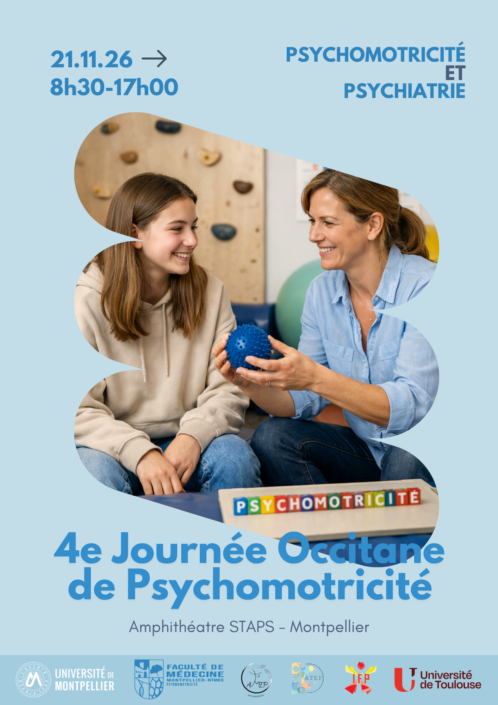
On Saturday, November 21, 2026, from 8:30 a.m. to 5:00 p.m., the Psychomotor Therapy Training Institutes in Montpellier and Toulouse are pleased to host:
The4th Occitan Psychomotor Therapy Day (JOP), UFR STAPS campus in Montpellier
This edition of the JOP will focus on the theme “Psychomotor Therapy and Psychiatry,” incorporating historical perspectives and the most recent advances in the treatment of children, adults, and the elderly. The event will also be streamed via videoconference.
SAVE THE DATE!!
Check out our editorial, the preliminary program, and the call for papers below.
You can register via this link: Azur-Colloque
We hope to see many of you there.
Editorial
The relationship between psychomotricity and psychiatry—two closely related disciplines—stems primarily from the shared history of their semiology. Indeed, it has long been established that many people with mental disorders (depression, schizophrenia, anxiety disorders, etc.) exhibit psychomotor symptoms that, depending on the context, may include psychomotor agitation, impulsivity, stereotypies, psychomotor retardation, catatonia, mild neurological signs, or deficits in perception and nonverbal communication involved in interpersonal relationships (Balsters et al., 2012; Deniker et al., 1990; Sanders & Keshavan, 1998; Walther, 2015). Long before Ajuriaguerra, the pioneers of modern psychiatry—Griesinger, Kahlbaum, Wernicke, Kraepelin, Bleuler, Kleist, and later Leonhard—attributed a central role to these psychomotor manifestations in the description and definition of mental disorders, with some of them doing so as early as the mid-19th century.
The shift that took place amid the exponential growth of psychopharmacology during the20th century significantly contributed to a decline in interest in psychomotor manifestations in psychiatry. Other, more ideological developments veered toward the most simplistic form of reductionism by viewing psychomotor disorders as exclusively secondary to the presence of psychopathologies or unconscious conflicts. However, while the presence of psychomotor disorders in patients who initially presented with psychiatric disorders is not a new finding, it does not necessarily imply a causal relationship in which psychiatric disorders are the cause of pathological or atypical psychomotor manifestations.
Crucially, the direction of the relationship between these two categories can now be viewed in reverse: an ever-increasing body of research indeed demonstrates the psychiatric consequences resulting from the initial presence of psychomotor disorders. Whether we consider, for example, developmental coordination disorder (DCD) in children, attention-deficit/hyperactivity disorder (ADHD), or certain forms of dystonia in adults, recent research suggests that these fundamentally psychomotor disorders significantly increase the risk of developing mental disorders from the perspective of developmental trajectories (Draghi et al., 2021; Eng et al., 2023; Escobar et al., 2023; Riglin et al., 2021).
Internationally, interest in psychomotor symptoms has been revived in psychiatry in recent years, including with regard to their cerebral correlates (Lozano-Goupil et al., 2025; Morrens et al., 2017; Northoff et al., 2021; Walther, 2015; Walther & Heckers, 2024). This has led to a rapid expansion of research in the field, coupled with the gradual reintroduction of psychomotor symptoms into the diagnostic criteria of certain classifications of mental disorders. On the other hand, knowledge about psychomotor disorders and their psychopathological consequences—including in older adults—continues to be documented (e.g., regarding ADHD in older adults: Fischer & Nilsen, 2024).
In addition to the historical descriptions by the pioneers of psychomotor therapy that are gradually coming to light (Foucher et al., 2021), what other insights does contemporary scientific research provide regarding psychomotor symptoms in psychiatric disorders? Why and in what ways do psychomotor disorders ultimately impact mental health in individuals who were initially free of psychiatric disorders? What do recent studies contribute to our understanding of psychomotor semiology in psychiatry, and vice versa? How can we take a fresh look at the links between psychomotor therapy and psychiatry and reinvent psychomotor practices in light of current data?
It is becoming clear that new diagnostic and therapeutic approaches will emerge in the near future, particularly thanks to new technologies and AI, and that psychomotor therapists, psychiatrists, neurologists, and allied health professionals should seize the opportunities offered by this renewed perspective on psychomotor and psychiatric disorders. The ambitious goal of this 4th JOP will therefore be to enable psychomotor therapists and healthcare professionals from all backgrounds to update their knowledge on the links between psychomotor therapy and psychiatry across all stages of life, and to define the new contours of future clinical practices.
We hope to see many of you there—as always, in a friendly atmosphere!
References:
JH Balsters, M., J Krahmer, E., GJ Swerts, M., & JJM Vingerhoets, A. (2012). Verbal and nonverbal correlates of depression: a review. Current Psychiatry Reviews, 8(3), 227–234.
Draghi, T. T. G., Cavalcante Neto, J. L., & Tudella, E. (2021). Symptoms of anxiety and depression in schoolchildren with and without developmental coordination disorder. Journal of Health Psychology, 26(10), 1519–1527.
Eng, A. G., Phan, J. M., Shirtcliff, E. A., Eisenlohr-Moul, T. A., Goh, P. K., & Martel, M. M. (2023). Aging and pubertal development differentially predict symptoms of ADHD, depression, and impairment in children and adolescents: An eight-year longitudinal study. Research on Child and Adolescent Psychopathology, 51(6), 819-832.
Escobar, A. M., Pringsheim, T., Goodarzi, Z., & Martino, D. (2021). The prevalence of depression in adult-onset idiopathic dystonia: a systematic review and meta-analysis. Neuroscience & Biobehavioral Reviews, 125, 221–230.
Fischer, S., & Nilsen, C. (2024). ADHD in older adults—a scoping review. Aging & Mental Health, 28(9), 1189–1196.
Foucher, J. R., Jeanjean, L. C., de Billy, C. C., Pfuhlmann, B., Clauss, J. M., Obrecht, A., … & Hirjak, D. (2022). The polysemous concepts of psychomotricity and catatonia: a European multi-consensus perspective. European Neuropsychopharmacology, 56, 60–73.
Lozano-Goupil, J., Shankman, S. A., Walther, S., Wuethrich, F., Maher, R. E., Grzelak, L. N., & Mittal, V. A. (2025). Automatic quantification of hand gestures in current and remitted Major Depressive Disorder during oral expression. Journal of Affective Disorders, 389, 119684.
Morrens, M., Hulstijn, W., & Sabbe, B. (2007). Psychomotor slowing in schizophrenia. Schizophrenia Bulletin, 33(4), 1038–1053.
Northoff, G., Hirjak, D., Wolf, R. C., Magioncalda, P., & Martino, M. (2021). All roads lead to the motor cortex: psychomotor mechanisms and their biochemical modulation in psychiatric disorders. Molecular Psychiatry, 26(1), 92–102.
Riglin, L., Leppert, B., Dardani, C., Thapar, A. K., Rice, F., O’Donovan, M. C., … & Thapar, A. (2021). ADHD and depression: investigating a causal explanation. Psychological Medicine, 51(11), 1890–1897.
Sanders, R. D., & Keshavan, M. S. (1998). The neurologic examination in adult psychiatry: from soft signs to hard science. The Journal of Neuropsychiatry and Clinical Neurosciences, 10(4), 395-404.
Walther, S. (2015). Psychomotor symptoms of schizophrenia mapped onto the cerebral motor circuit. Psychiatry Research: Neuroimaging, 233(3), 293–298.
Walther, S., & Heckers, S. (2024). Mapping psychomotor behavior in the brain. JAMA Psychiatry, 81(1), 7–8.
Preliminary Schedule
9:00 a.m.–9:40 a.m.
A Historical and Epistemological Approach to the Links Between Psychiatry and Psychomotricity
 Jean-Arthur MICOULAUD-FRANCHI
Psychiatrist, University Professor – Hospital Practitioner, Researcher at the SANPSY Laboratory, CNRS / University of Bordeaux
————————————–
9:40–10:10 a.m.
Psychomotor Symptoms in Psychiatric Disorders

Clément de BILLY
Geriatric Psychiatrist, Hospital Physician, Strasbourg Center for Non-Invasive Neuro-Modulation
Jack FOUCHER

Psychiatrist, Neurologist, University Professor – Hospital Practitioner, Center of Excellence for Psychoses, Coordinator of the Strasbourg Center for Non-Invasive Neuromodulation
————————————–
10:10 a.m.–10:40 a.m.
Nonverbal Communication in Schizophrenia
Juliette LOZANO-GOUPIL

Postdoctoral Fellow in Clinical Psychology at Northwestern University, Chicago, USA
————————————–
10:40 a.m.–11:15 a.m.: Coffee break
————————————–
11:15 a.m.–11:45 a.m.
A Neurodevelopmental Approach to Psychiatry

Antoine LEFRERE
Psychiatrist, Director of the AP-HM Bipolar Disorder Center of Excellence, researcher at the Timone Institute of Neurosciences, Aix-Marseille University
————————————–
11:45 a.m.–12:15 p.m.
Psychopathological Consequences of ADHD on Developmental Trajectories

Diane PURPER-OUAKIL
University Professor – Hospital Practitioner, Head of the Department of Child and Adolescent Psychosomatic Medicine, Saint-Eloi Hospital, Montpellier University Hospital
————————————–
Afternoon
Results of the Occitadys study among students enrolled in training programs on ADHD in children and adolescents
Thiébaut-Noël WILLIG
Pediatrician, President of Occitadys, Toulouse
————————————–
Psychomotor Intervention in Psychotrauma
Audrey TIREAU
Psychomotor Therapist
————————————–
Preliminary Results of the EPSiD ( Mild Neurological Signs Assessment) Calibration
Marie-Lou SERVANT, Jean-François CONNAN, Elodie MARTIN, Frédéric PUYJARINET
Psychomotor therapists
Call for Papers
Would you like to participate as a speaker at the4th edition of JOP, to be held on Saturday, November 21, 2026, in Montpellier? Don’t hesitate! We invite you to submit your presentation proposals now. Each presentation will last 20 minutes, followed by a 5-minute discussion with the participants.
Proposals for papers must be submitted in the following format:
- A title (20 words maximum)
- A summary of the presented work (300 words maximum)
- Five keywords
- A list of bibliographic references in APA7th edition format (maximum of 10 references)
- At the end of the document: information about the person(s) submitting the proposal: last name, first name, profession, place of employment (or educational institution for students), and, if applicable, a list of publications or presentations at other conferences
Speakers will be exempt from the registration fee.
Proposals for presentations should be submitted by May1, 2026, to Elodie Martin (elodie.martin1@utoulouse.fr) and Frédéric Puyjarinet (frederic.puyjarinet@umontpellier.fr).
The scientific committee also encourages professionals and students to submit poster proposals, which may be displayed throughout the day. Again, please don’t hesitate to submit your proposals. New knowledge can be shared in any format!