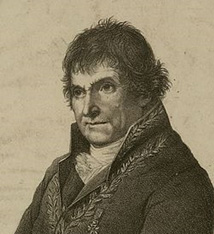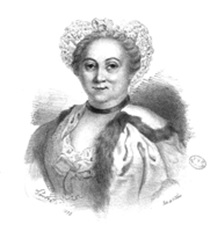
The commemorative plaque marking the8th centennial of the Montpellier University of Medicine
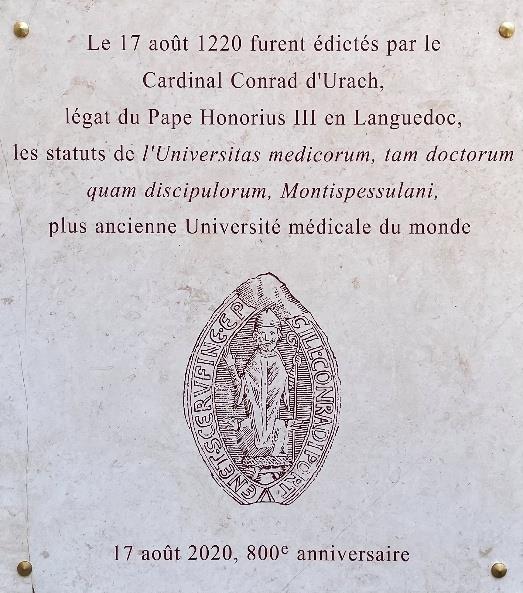
Founded on August 17, 1220, the Montpellier School of Medicine is the world's first medical university established under official legal statutes in the modern sense of the term.
The structured teaching of medicine by communities of teachers was not invented in Montpellier. It dates back to antiquity (the Hippocratic schools of ancient Greece in Cos, Cnidus, and Rhodes) or to the Middle Ages (highly organized medical education in imperial China during the Tang Dynasty, as well as in the Persian and Arab worlds—such as Fez—where clinical training similar to that in our modern university hospitals was provided). Schools of medicine led by masters developed later in Europe, primarily in Salerno, south of Naples (11th century). In Montpellier, these schools began to develop in the12th century, notably driven by the liberal policies of the city’s lords, the Guilhems, whose charter issued by Guilhem VIII in 1181 states that “any person, whoever they may be and wherever they may come from, may head a school of medicine.” Jewish physicians and scholars settled in Montpellier, bringing with them the Arabic medical knowledge from Al-Andalus, and came into contact with Christian physicians who had trained in Salerno. The Via Domitiana, built by the Romans, passes through Castelnau north of Montpellier, carrying pilgrims on the Way of St. James from the East and Italy toward Spain. There they found a helpful medical stopover, and the healed patients resumed their journey, contributing to the city’s reputation!
Learn more
August 17, 1220: a revolution in medical education, which became an academic discipline in the modern sense of the term!
Driven by the policies of the Guilhem family, medical schools proliferated over a period of 40 years, and the quality of instruction certainly varied widely, most likely even giving rise to a certain degree of quackery. Above all, the city—then administered by the kings of Aragon—was in danger of falling into the Cathar heresy. Pope Honorius III dispatched his legate, Cardinal Conrad of Urach, to combat Catharism in Languedoc “by any means necessary.” Conrad’s first act upon arriving in Languedoc was to found “the University of Physicians, comprising both teachers and students, in Montpellier.” The Roman Church then drafted one of the very first Christian texts praising medicine: medicine was created by God, its practice makes people better, and from this day forward, the Roman Church would protect the teaching of medicine in perpetuity.
By asserting its monopoly on medical education, the Church controls who teaches and who studies. This is the exact opposite of William VIII’s Charter of Tolerance. In this way, the Church was able to exert control over the Cathar population of Occitania: doctors would no longer assist them, particularly as death approached, when they were indispensable for determining a prognosis and, in a sense, advising on the vow of consolamentum—the only possible spiritual outcome for Cathar “Perfects.”
Professors and students remained laypeople but were associated with the clergy. They were protected from the laws of the city; this is the origin of “academic freedom.” The Roman Church established a subtle balance between matters falling under the bishop’s authority (moral and political issues) and those falling under the university’s authority (scientific and pedagogical expertise). Thus, for the first time in history, medical students were recognized as participants in an educational system and, as such, were protected by law: conflicts between students and teachers could be resolved on a legal basis—a framework that students have continued to develop and refine to this day.
In the historical classification of universities, Montpellier is one of the four so-called “spontaneously founded” universities, as it was among the first to receive its founding legal charter in the13th century, following a period of teaching in the12th century!
These four universities were Bologna and Oxford for law, and Paris for theology and the liberal arts (grammar, rhetoric, dialectic—in short, language and philosophy—; arithmetic, geometry, astronomy, music—the mathematical sciences—; the liberal arts are considered the core subjects of high school). Medicine was the last discipline to be elevated to university status, perhaps because it focuses on the body and the individual, whereas law focuses on the collective and society, and theology, philosophy, and mathematics focus on spirituality and the universal.
The universities officially founded after these four—and granted universal legitimacy (since they were founded by the pope or the emperor)—would be universities that relocated (Paris → Angers, Bologna → Padua, Oxford → Cambridge), and then, above all, universities established from scratch (Toulouse in 1229 to counter the Cathar heresy once again, or Naples, founded by the emperor in 1224 to assert his authority against the pope…). But it was not until the last third of the13th century that other universities, such as Bologna and Paris, began to structure the teaching of medicine in the same way as in Montpellier.
Continuous operation spanning more than 800 years
Montpellier is also the only medical university to have remained in continuous operation, even during the most turbulent periods of its history, such as the Wars of Religion, the French Revolution, and the German occupation. During the Revolution, while all French universities were closed between 1792 and 1794, the University of Montpellier managed to continue its operations thanks to support from the city government, which replaced royal funding.
The Faculty’s archives, together with the Hérault departmental archives and the Montpellier municipal archives, preserve a rich documentary heritage, including several authenticated historical copies (13th–15th centuries) of the original statutes of 1220, thus attesting to the long history and continuity of this institution.
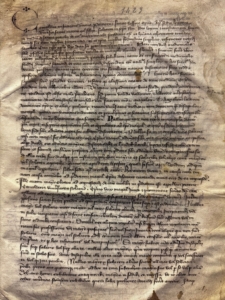
This documentary heritage has been a candidate for inscription on UNESCO’s Memory of the World Register since December1, 2025; the nomination is supported by the French government and led by the Faculty of Medicine and the University of Montpellier, the City and Metropolitan Area of Montpellier, the Departmental Archives, and the Hérault Department.