A Year of Tutoring
At the Montpellier Health Tutoring Association (ATSM), we have been committed since 2006 to supporting first-year health studies students (PASS/LAS).
Supported in particular by grants from the Hérault Medical Association and the School of Medicine—with whom we work closely—the support
we provide is designed to be high-quality but, above all, free of charge.
Our association is made up of students in their 2nd through 4th years in various health-related fields (midwifery, dentistry, and medicine), who are recruited and trained by university professors. Our goal is to enable any student to enroll in MMOPKI health programs (Medicine, Midwifery, Dentistry, Physical Therapy, Nursing) without financial constraints.
In this article, we invite you to discover what a year with us is like!
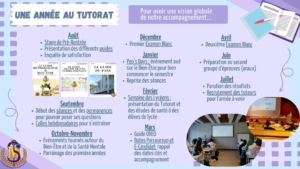
2023–2024 Mentoring Program
August
The first event organized by the tutoring program, aimed at first-year students, is the Pre-Semester Workshop (or SPR). First-year students participate in educational sessions covering the essentials of the first-semester courses, as well as workshops on study skills and well-being. This early start to the semester is strongly recommended for success in the PASS/LAS program. In fact, with the support of tutors, students develop their study methods using materials reviewed and approved by the faculty’s teaching team. This SPR concludes with a pop quiz—a graded and ranked exam—to prepare students for the type of exams they will take throughout the year.
As part of a commitment to continuous improvement, the tutoring program conducts a satisfaction survey at the end of the Pre-Semester Workshop to gather feedback from the students. This feedback is valuable for future planning, as it helps tailor the workshop to the needs of first-year students in the following academic year.
During the SPR, we introduce students to the Guides, which have been created by the ATSM tutors over the years. First, the PASS Guide (Specific Pathway to Health Care) and the LAS Guide (Bachelor’s Degree in Health Care) help students better understand the details of the reform, which continue to evolve each year. They also explain the programs (see also the Guide to Minor Programs for Academic Reorientation) and the general operations of the faculty, including an overview of the various student organizations there.
In addition to this guide focused on academic studies, these guides list various places in Montpellier where students can work, seek medical care, or enjoy themselves. The activities suggested are tailored to both the budget and the limited free time available to first-year students—keeping in mind that this downtime is essential for students’ physical and mental well-being.
There is also a Methodology/Well-Being Guide, which offers plenty of useful advice—both for managing daily life (diet, sleep, exercise, stress, etc.) and for learning to work more effectively—an International Students Guide, which is new for 2023, as well as an Oral Exam Guide, which helps students at the end of the year. The International Student Guide features numerous testimonials and tips covering administrative matters, practical issues, and adjusting to life in a new country—often far from family—which can be especially challenging for students in the PASS or LAS programs.
All of these guides are available on the ATSM's LinkTree.
September
In early September, two weeks after lectures begin, tutoring sessions start. Prior to the scheduled sessions, PASS students have access to materials in both print and digital formats: a number of multiple-choice quizzes, reviewed and approved by the subject-matter professors, which should ideally be completed in advance so they can be graded during the session. During these sessions, students gather in a lecture hall or classroom with several tutors. The tutors correct the multiple-choice questions by addressing the most complicated points and sharing their methods, tips, and othermnemonic techniques with the students. Students are welcome to ask any questions they may have. If they have further questions, they can use the online forum or visit the tutoring center, where tutors are available during pre-scheduled hours.
In Semester 1, LAS students must complete the “Health” course. Thus, the tutoring program for LAS students remains the same, except that the sessions are conductedonline. At the ATSM office, the position of vice president in charge of Health-Track Bachelor’s Degrees (LAS) was created following the reform; this person serves as the primary point of contact between students and the heads of the various faculties and answers students’ questions throughout the academic year.
To ensure equal opportunities among the various campuses hosting LAS students, sessions are held weekly on Zoom.
October–November
In addition to providing academic support, the tutoring program aims to expand its personal support for first-year students. It was with this goal in mind that the Health, Social Services, and Support Center and the Well-Being Center were created. This support is particularly valuable at the beginning and throughout the first semester, as this is when students are settling in, completing administrative procedures to obtain various forms of financial aid, and during the winter months, when the focus on mental health is even more pronounced.
The first year of health studies can be stressful and may take a toll on students’ mental health. As a result, projects and initiatives are being developed to promote mental health within the faculty. In particular, the ATSM organizes training in suicide crisis prevention and management, led by faculty professionals, to equip ATSM members with the skills to refer students in distress to appropriate resources. This training, which complements the pedagogical training our tutors receive, ensures that we are qualified to extend our support beyond academic matters. Our directory,“Key Contacts for Psychological Support,”lists contacts for various emergency situations, psychological counseling, support for a range of issues, and assistance for students with disabilities; it is also available via the LinkTree mentioned above.
The ATSM works in collaboration with the Joint Office for Preventive Medicine and Health Promotion (SCMPPS) and the Handiversité Office to implement the Disability Tutoring Program. The Disability Tutoring Program is in line with our commitment to equal opportunity among students: sessions are held in small groups (2–5 students) to accommodate each student’s needs, but the session curriculum is strictly the same as that of the academic tutoring program. The ATSM is one of the few tutoring programs in France to offer this type of support, and every effort is made to ensure that we continue to provide high-quality education to all our students without any discrimination.
A mentoring campaign is also organized in October: all first-year students can sign up for it. They are then paired with second- and third-year students in the MMOPK program to ensure they receive the best possible support throughout the year.
December
The month of December in the tutoring program concludes—two weeks after the end of lectures—with the first mock exam. Over the course of two days, students are placed in a real exam setting: the same sequence of tests, duration of the exams, and number of multiple-choice questions per subject as on the actual exam day. To support the students, this final practice session is proctored and facilitated by the tutors. At the end of these two days of mock exams, the exams are graded, scored, and ranked. Students then have access to their scores and rankings. The development of these sessions and mock exams, in direct collaboration with the teachers, ensures that the educational resources used are representative and accurate. This event, which brings together more than 900 students each year, therefore provides realistic preparation for the ranked exam they will take in early January.
January
The second semester follows the same schedule as the first: sessions begin in late January and end in early April. What sets this semester apart is the preparation for the Essay Question (QR) in the Humanities and Social Sciences (SHS). The SHS tutors first conduct standard sessions to reinforce the PASS students’ knowledge and then organize Essay Question (EQ) workshops. These sessions focus on the methodology of the EQ and are supplemented by EQ consultations: a tutor schedules a consultation slot with a student to review in detail the strengths and areas for improvement in the student’s submitted EQ, enabling personalized and tailored support.
The Montpellier Health Tutoring Association, in addition to providing effective academic support, offers PASS/LAS students emotional and methodological support . We therefore have an Instagram page, “Tuto Pep’s” (@tuto_peps), as well as a Facebook page called “Tuto Pep’s, ” both of which are designed to help students make the most of their first year. There, you’ll find study tips, advice on healthy living, mental health, applying for scholarships, and managing housing, as well as words of encouragement, introductions to the various degree programs, and information on changing your major.
For example, there are the “Midis Partage,” where tutors come to answer questions from PASS/LAS students and share their experiences during the lunch break. “Midis Jeux” are also organized, featuring board games, as well as “Blind Tests” organized by the Med’ley music club, where first-year students can come to relax.
Finally, the major wellness event of the year takes place from late January through early February: the Pep’s Days. This event consists of four lunchtimes spread over two weeks, featuring activities such as massages by physical therapy students, blind taste tests, sophrology sessions, sign language classes, self-hypnosis, and more… Savory and sweet buffets are available to students, and Welcome Packs filled with goodies are handed out. This completely free event allows PASS/LAS students to take their minds off things and have fun with their friends during their breaks in what has been a particularly challenging year for them.
The academic counseling center is especially important during the second semester, as this is when the Parcoursup and E-Candidat application processes take place. In addition, after receiving their first-semester grades, many students begin to question their academic path. It is also during this time that we organize a Career Guidance Fair at the university: the concept is similar to a career fair, but it features students from programs other than MMOPKI, many of whom are in the paramedical field.
February
Every year, the Joint University Service for Information, Guidance, and Career Placement (Scuio-IP) recruits one of our tutors to serve as their ambassador. This ambassador’s role will be to present health-related degree programs at various high schools in the region. All tutors also receive training on the Reform of Admission to Health Studies so they can best answer students’ questions. PASS/LAS students also have access to an OREO (Guidance and Reorientation) forum on their Moodle platform, where they can ask any questions related to their academic guidance.
We also interact with high school students at college fairs, immersion days, and open houses where we are present. At some fairs, we even serve as direct representatives of the Montpellier School of Medicine. It is the VP OREO’s role to organize these events, in collaboration with the school.
High School Students’ Week has been held every year since 2021 during the February school break. To ensure that as many high school students in the region as possible can participate, the various sessions are held on Zoom, typically in the late afternoon. This program is completely free, and you can attend as many sessions as you’d like. If health conditions permit, we also offer an in-person day where high school students can come and explore the university and learn how it operates.
During this week, high school students will have the opportunity to learn about the various health-related programs available after completing a PASS or LAS track, and how to gain admission to these programs. There is also a study skills session to help students prepare for that infamous “first year.” Finally, we offer introductory sessions to the various courses students will take during their first year, linking them to the concepts they’ve learned in high school. The goal of this week is to reassure high school students about the challenges of their future studies.
March
The tutoring program provides support both academically and emotionally, even beyond the first year. In fact, our Career Redirection Guide ensures that everyone has a backup plan in case they are not admitted to a healthcare program after completing a PASS or LAS program. In this guide, you’ll discover many other—sometimes lesser-known—programs, such as certain paramedical programs, and learn how to apply to them.
However, this requires some thought throughout the year, as it’s important not to miss key deadlines on platforms like Parcoursup or E-candidat, which allow you to have a backup plan for the coming year.
April
The second-semester mock exam is similar to the first-semester one. Spread over two days, it includes four 1-hour exams (UE4, UE6, UE8, UE9), one 1.5-hour exam (UE7: Biophysics), and a 2-hour essay exam (UE5: Humanities and Social Sciences), just like the final exam held in late April. Thanks to the enthusiasm of the tutors supervising these exams, the mock exam takes place in a positive atmosphere.
It serves as a final practice session and allows students to refine their study methods, improve their knowledge, and gauge their standing among their peers before the actual graded exam.
June
The tutoring program also provides free preparation for the second set of exams. These consist of two oral exams: a commentary on an image-based document and an analysis of an issue related to human health. Each exam lasts 30 minutes, with 20 minutes of preparation, a 5-minute presentation, and a 5-minute discussion with the panel. Thus, during the week preceding their oral exams, the tutors—who have been selected and trained by the faculty advisors in charge of the oral exams—conduct three preparation sessions for the students they are mentoring.
This is an opportunity for students to practice public speaking, develop their critical thinking skills, and become familiar with the format of these exams. For PASS students, this preparation takes place in small groups in person. The same program is offered online for LAS students.
July
At ATSM, tutors are recruited in July. Second-year health studies tutors are called Trainee Tutors (TS), and they are supervised by the Vice President in charge of Trainee Tutors throughout the year. The recruitment process aims to identify the best candidates to mentor first-year students.
This supervision of tutors continues throughout the academic year, notably through ongoing training provided, on the one hand, by third-year Qualified Tutors (TQs) who mentor Trainee Tutors (TSs), and, on the other hand, through training sessions on a wide variety of topics: Reform of the admission process for health studies programs, creation of multiple-choice questions, training on tutors’ rights and responsibilities… In fact, tutors have rights and responsibilities, such as attending their PASS and LAS sessions, holding in-person or online office hours, proctoring quizzes and mock exams, and answering questions from PASS/LAS students on the dedicated forum; it is the combination of fulfilling these responsibilities that enables us to provide high-quality tutoring. At the end of the year, following an interview with the tutoring program’s supervising professors, Trainee Tutors can become Qualified Tutors.
Finally, our association is recognized by the Ministry of Higher Education and Research, having obtained ministerial accreditation that attests to the quality and relevance of our support, which aims to promote equal opportunity and ensure that health studies are accessible to everyone. Throughout the year, we strive to provide high-quality tutoring, remaining true to our commitment to offer completely free support centered on solidarity among student cohorts—a cornerstone of health studies at the Montpellier-Nîmes School of Medicine.
ATSM Contacts:
Facebook: Tutorat Santé Montpellier
Instagram: @tutoratsantemtp
Twitter: @TutoratSanteMTP