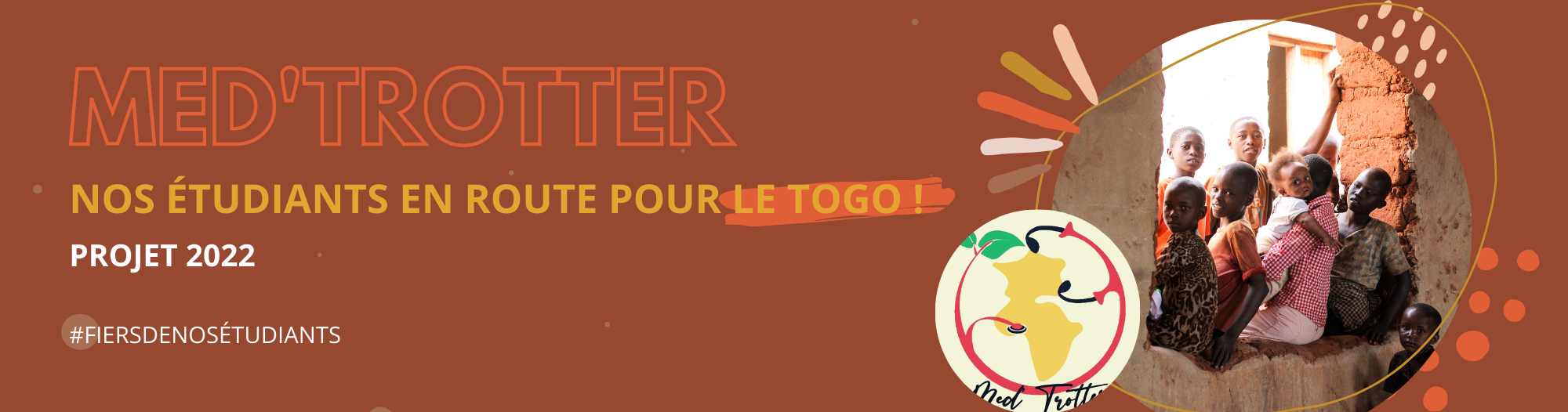
Did you know? This year, the ACM exchange program is organizing an international solidarity mission to Togo! 13 students will have the opportunity to fly out in July to join an association working to rehabilitate a school. Interview.

Who are you?

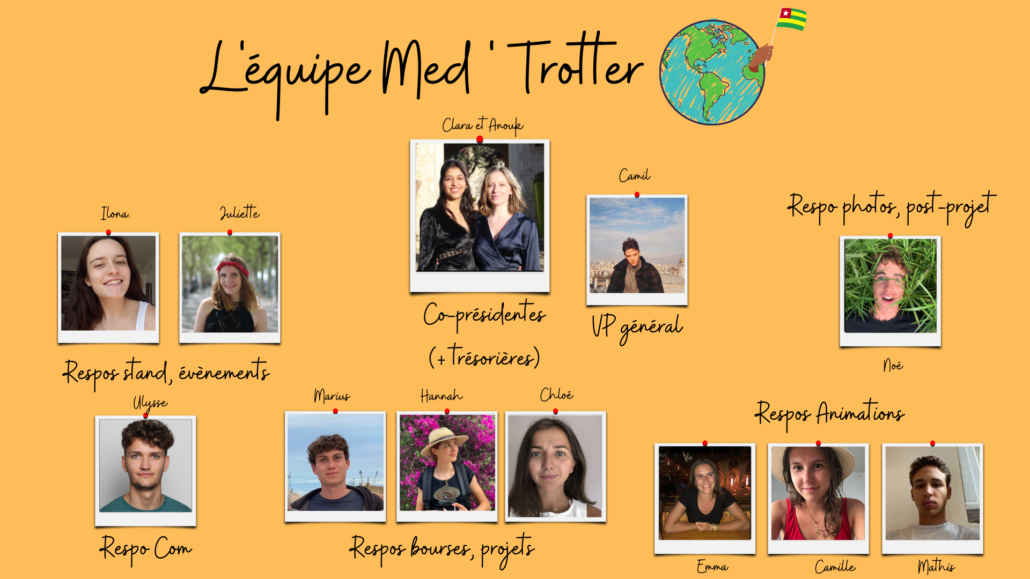
We are Anouk Evrard and Claire Boin. Currently DFGSM3 students at the Faculty, we are also elected to the ACM. Our role as VP Exchange is to facilitate international exchanges (whether for incoming or outgoing students) or interCHU exchanges (exchanges between CHUs during the summer internship). 

New this year is the international solidarity project we've named "Med'Trotter"! 

Can you tell us more about the Med'Trotter project?

Med'Trotter is a project that was born in the mind of Camille Borne, our former VP Exchange, in 2019. Unfortunately, due to the health crisis, the project didn't come to fruition, which is why we've decided to bring it back this year!

In concrete terms, this is a project in conjunction with "Espace Hotsi". This Togolese association organizes renovation projects to improve the quality of life of local residents.

This year, the aim is to spend a month helping this association with the renovation of a school in Wli, near Tsévié.

How are you going to help Espace Hotsi? 

With elbow grease! For one month, we'll be helping members of the association to renovate 4 classrooms and the sanitary facilities. This is very important because the school teaches kindergarten through to primary school, so it will benefit many children.

As it's very hot in Togo, we'll only be able to be on site in the mornings. We therefore plan to run workshops with the children and villagers in the afternoons. We've come up with several themes around art, drawing, sculpture, sport, singing, dancing and gardening! Of course, we'll also be helping out with tutoring and awareness-raising activities. To do this, we've taken inspiration from the actions we can carry out during our health services. We've also got in touch with Médecins du Monde, so that they can advise us on the most appropriate way of raising awareness. We really want to do things right.

And in the evenings, we'll be holding evening parties. We want to share our stories, cultures and traditions with the local population.


How can we help you realize this wonderful project?

This project requires a budget of 24,000 euros. These expenses are divided between the workcamp itself, the school and gardening equipment we need for the workshops, and, of course, transport, accommodation and medical expenses for the 13 medical students who are leaving!

To raise this money, we have already applied for a grant from FSDIE, which we have obtained. It will enable us to finance the trip of 5 of the 13 students who will be going. We have also applied for a grant from CROUS, JSI (Jeunesse Solidarité Internationale donated by Fonjep) and the département. We are awaiting the results.

Our last card is self-financing. To this end, we have set up the "TOGO Stand", which we set up once a month at the Faculty. Our aim is to sell snacks and, above all, second-hand clothes to finance our trip.


You can help us by donating unwanted clothes at the Corpo premises and/or by buying clothes you like when the stand is set up! There's no waste: clothes that aren't too worn out are given back during the "maraudes" organized by ACM's ISS department! 

We've also set up a fund for anyone who would like to make a donation.


Finally, we're organizing a tombola in April! All you have to do is buy a ticket from the corpo. The draw will take place at our Togo stand on April 21! Pins will also be on sale for the occasion, so don't forget to come and see us and follow us on our instagram account: @med_trotter !


In brief

  • The international solidarity project

    • Helping restore a school 
    • Benefit from a unique international experience based on exchange
    • 13 medical students take part in this adventure
    • A project to be financed to the tune of 24,000 euros
  • How can we help?

    • Donate unwanted clothes to the local corpo
    • Buy second-hand clothes at the booths
    • Participate in the Tombola
    • Donate to the kitty
    • Follow and relay @med_trotter !


After winning the MUSE Take-Off 3 award, Drs Herrero and Bonnel presented the PREPABLOC training course at the "Recherche Et Innovation Chirurgicale 2021" session of the French National Academy of Surgery. The course was awarded the prize for pedagogical innovation! A look back at this unique training program.


PRÉPABLOC: training for tomorrow's operating room professionals

Project construction

The launch of PREPABLOC is the result of a co-creation process initiated by Dr. Herrero and supported by Dr. Ferrandis. A multi-professional, multi-disciplinary team was put together, comprising :

  • The teaching team of the CHU IBODE school,
  • Heads of Clinics-Assistants at CHU and ICM hospitals,
  • LIRMM teams,
  • Gypsotherapist at the University Hospital Emergency Department. 


Training program

Proposed and coordinated by the Innovation Extractor, this is an innovation marathon in the form of a competition between teams of around ten people. Creativity sessions enable teams to design useful projects in record time, and to learn how to "pitch" them at the end of the week. The five themes were stress, communication, the surgical education of tomorrow, the attractiveness of the OR professions and inventing an Escape Game.

Future IBODEs, tutors to tomorrow's surgeons, had the chance to take part in a variety of theoretical and practical workshops over the course of a congress-style week. The heads of the IBODE school focused their presentations on hygiene and instrumentation. The Heads of Clinic-Assistants from the CHU andICM led theory classes, giving accounts of their work as hospital surgeons, running workshops on suturing and surgical knots, and allowing students to test their skills on a laparoscopic console. LIRMM teams also collaborated on the high-tech hospital simulation platform on the Arnaud de Villeneuve campus, which Dr. Debien and his teams bring to life on a daily basis. A workshop was also dedicated to the creation of plaster casts with Christophe, the gypsotherapist in charge of the CHU's emergency department.


The objectives of this course  
  • Training students before they arrive for their internships

    To be able to offer all medical students structured, harmonized training prior to their arrival in hospital surgical internships or emergency departments.

  • Reducing student stress

    As well as that of the supervisors who welcome them into the blocks and who, in addition to the time needed to train them on top of their workload, were always worried about seeing them make mistakes due to a lack of knowledge of this oh-so-controlled environment.

  • Raise awareness that harmonious teamwork is a key to success

    This will benefit both the patient and the serenity of a demanding workplace.

  • Encouraging vocations for these professions

    With objective information.

  • Early introduction to project-based innovation methodology

    Po ensure that students know how to create, structure and present projects in line with their ambitions for their professional and scientific future.

A project supported by MUSE

This project was made possible thanks to the financial support of MUSE (Montpellier University of Excellence) through a call for projects " Take OFF 3 " won in June 2020 with the active help of the Innovation Extractor (Dr. Christophe BONNEL and Anaïs CAUSSE). The team at MUSE's Centre d'Innovation Pédagogique (CSIP) has also contributed to the project, with the creation of a fun, interactive card game and the scripting of an "Escape Game" to be offered next year.


PREPABLOC: a highly successful training course

Project success

The creation of this Free Teaching Unit was a success with the students. Indeed, founded by a multi-professional and multi-disciplinary team, this project was particularly well received by an interested public made up of students in their 3th year medical students, LIRMM engineering students (Roboticians) and IBODE students (Operating Room Nurses).


The future of PREPABLOC

The students particularly appreciated the experience and the winning project on the surgical education of tomorrow is currently being studied with a view to giving it a future. The Nîmes teaching teams, already well versed in these concepts, are already in the loop to adapt it, and the PREPABLOC team will be sharing its experience with all those in France who wish to draw inspiration from it, in accordance with the wishes of the academy.


At a time when debates on students' mental health have resurfaced in the wake of the health crisis, and at a time of 2nd cycle reform, our teaching teams have developed, in collaboration with students and users, a unique teaching concept. Temporarily named "UE Savoir-Être et communication thérapeutique", this empathy-oriented teaching program represents a genuine ethical and pedagogical innovation. To find out more, we turned to the people behind the project: Dr Amandine Luquiens and Pr Céline Bourgier, as well as Théo Lacoste, a student member of the steering committee.


Genesis of a project centered on empathy

A need for evaluation born of R2C evaluation methods

In 2018, the draft reform of the second cycle of medical studies (R2C) reached the hands of the Faculty's various pedagogical managers and caught the attention of Pr Céline Bourgier. She noted that the student assessment procedures following the R2C would focus, among other things, on assessing students' interpersonal skills and empathy, through the clinical skills certificate (C3). However, at this point in time, there are no courses entirely dedicated to the development of this skill in our training offer. 

Joined in 2019 by Dr Amandine Luquiens, psychiatrist-addictologist at the CHU de Nîmes, the two doctors will therefore join forces to steer the project to develop an innovative teaching unit, able to meet the requirements of R2C. Their first step is to study the current level of empathy among medical students.


A disturbing finding: medical students' empathy declines as their studies progress

Their initial findings were surprising. In the course of their bibliographic research, the two practitioners discovered that medical students tend to experience a decline in empathy throughout their studies. "This decline begins concomitantly with hospital internships. It would seem that the difference between the 'idealization of the nursing profession' and the 'reality of the nursing profession' is a triggering factor", explains Amandine Luquiens. - explains Amandine Luquiens

Another observation is that this decline is very strongly correlated with the problems of burn-out and depression that health students can experience.


Structured teaching to halt this decline and ensure better quality of future care

These findings motivated the project leaders to create a new, innovative teaching unit (UE) with a dual objective: 

  • Giving students the tools and skills they need to improve quality of careby instilling in them a person-centred approach and not just on symptoms/pathologies
  • Preventing psycho-social risks, not only for patients, but also for studentsfuture healthcare professionals.

These two complementary elements will be co-developed by a dedicated committee of teachers, students and users.


A co-constructed EU for the acquisition of skills around empathy with oneself and with patients

Stages in the construction of the EU

Such an EU requires a period of creation and then experimentation, which will take shape within the Faculty in 5 major stages: 

  • STEP 1

    Creation of a cross-functional steering committee

    As this was a collaborative UE, the teachers were keen to set up a steering committee including students, to ensure that the UE was adapted to them in the best possible way. The committee is also supported by the Faculty's Pedagogical Council (chaired at the time by Prof. Denis Morin) and is made up of teachers from different backgrounds and specialties, to ensure a global vision of the project.

  • Inventory of existing resources and expansion of the steering committee

    With the help of the school administrative staff, Amandine Luquiens and Céline Bourgier compiled a list of the existing UEs and courses within the training offer, focusing on the patient-physician relationship, the construction of the care relationship and interpersonal skills. This enabled them to make contact with the teachers responsible for the existing courses, and to involve them in the steering committee for the new UE.

    STEP 2

  • STEP 3

    Redesign of existing courses, development of the EU

    The steering committee is proposing a new organization of existing courses over a 5-year period. This will be achieved by reorganizing them in a more logical order, with a more gradual implementation in line with students' entry into hospital internships. In parallel with the reorganization of existing courses, new ones are proposed to complete the training offer, such as the therapeutic communication module, divided into 3 progressive levels, into which the pre-existing theater workshop will be integrated.

  • Integrating the EU into the program of a pilot promotion

    The DFGSM2 class of 2021-22 is the pilot class, and inaugurates all the EU courses over the 5 years. A few modules will also be offered to DFGSM3s in order to test the teaching (stage 6).

    STEP 4

  • STEP 5

    Follow-up of a cohort of students to evaluate teaching

    To measure the impact of teaching on students, 3 classes are regularly assessed on criteria linked to empathy, well-being and the concept of the care relationship. The DFGSM2 21-22 class will be compared with the DFGSM3 21-22 class, which will have benefited from lighter teaching, and with the DFASM1 21-22 class, which will not have been able to benefit from the various EU modules.


A UE structured to facilitate students' acculturation to the subject of emotion management

As Théo Lacoste, Vice-Dean of Students 21-22, reminds us, medical students are "perfectionists": "They're selected because they're the best. And this selection process continues over the years. The need to be, or at least appear to be, 'infallible' at all levels - whether professionally or emotionally - continues until it becomes an almost cultural component of our way of thinking."

But it is precisely this acculturation Amandine Luquiens explains: "We're looking for students, and indeed the whole faculty, to become acculturated to the subject.What we're looking for is an acculturation of students, and indeed of the Faculty as a whole. The Faculty takes care of its students, and the students must take care of themselves. So we're going to help them grasp the tools that go hand in hand both to protect themselves and to curb "emotional suppression"; a management strategy used for many years by doctors to apprehend the patient-caregiver relationship."

Po achieve this objective, the EU is structured around 4 main modules, all of which are compulsory:

  • Introduction to mindfulness meditation
  • Peer exchanges between peers: this module not only frees up the exchange of ideas, but also helps to better understand professional communication within a team of caregivers.
  • Therapeutic communication Therapeutic communication: a multi-year module with theoretical teaching on announcements, integration of workshop-theater and simulation workshops.
  • Stigmatization in care Stigmatization in care: a module featuring users who talk to students about situations they have experienced in the course of their care.


To sum up: an innovative initiative in more ways than one

Humanism is one of the Faculty's core values. Not only is it an integral part of its history, it is also a key value for its future, as demonstrated by this innovative program in more ways than one. Indeed, it is an ethical and ethical and pedagogical innovation :

  • co-created with students, teaching teams, users and administrative staff: a real example a true example of cross-functional collaboration between the men and women of our community
  • which addresses a real social and societal issue and societal issues of healthcare students, and which intervenes early enough early enough in their curriculum to anticipate long enough to deal with it in depth
  • which includes theoretical modules but also, and above all practical modules, focusing on a human approach to the of the patient-caregiver relationship, notably through simulation workshops
  • creating key competencies empathy and interpersonal skills: essential tools for a more humane medicine
  • with a message both for the students and for their future patients


Open prospects for other courses

The introduction of this UE in the medical curriculum inevitably raises the question of the other courses offered by the faculty(maieutics, paramedical). "Medicine is relatively behind other courses", concedes Dr Luquiens. "In fact, UEs already exist in other curricula, but not in such a structured way over time. The idea is therefore, once this UE has been made reliable, to 'spin off' to other courses, with a view to a trans-disciplinary approach to these skills."