Below you will find the complete procedure regarding confirmed and suspected cases of COVID-19: reporting, who to contact, and recommendations. This procedure applies to all students at the faculty as well as all administrative and teaching staff.
 

Reminder of the Principles to Be Applied


  • MASKS ARE REQUIRED

    Wearing a mask is mandatory for everyone at all times on university campuses, including university facilities (and in the city). Washing your hands with hand sanitizer is recommended, as is maintaining a sufficient distance between everyone whenever possible.We also ask that you follow these rules in your daily life, as these precautions should not be limited to university grounds.

  • WAITING TO TAKE A PCR TEST

    If you are waiting to take a PCR test (or waiting for the results), regardless of the reason for the test:

    • If you are a student not affiliated with a hospital: You should not attend any classes or internships, and you must notify your registrar's office by email.
    • If you are a hospital student currently on a clinical rotation:you must notify the Department Chair and/or the department manager of this situation as soon as possible, andfollow the procedure below titled “CHU Info – COVID-19 for Hospital Students.”
    • If you are a faculty staff member: You must contact your institution’s COVID liaison atmedecine-covid19@umontpellier.fr
  • YOU ARE A CONTACT PERSON AT RISK

    If you are a "high-risk contact," whetheror not you have symptoms,

    • Students: You must not attend any classes or, for hospital-based students, any clinical rotations, and you must notify your registrar’s office by email.
    • Hospital students: If you are a hospital student currently on a clinical rotation, you must immediately notify the department head and/or the department manager of this situation and notify your academic office by email.
    • Staff: Do not come to work. Contact the COVID Crisis Response Team for instructions: medecine-covid19@umontpellier.fr
  • YOUR PCR TEST IS POSITIVE

    If your PCR test is positive:

    • For all students (whether enrolled on campus or off-campus, during the academic term or an internship): You must always notify the academic affairs office responsible for your year of study at your respective campus (Montpellier or Nîmes) by email as soon as possible.
    • For students currently in session: You must stay at home and follow the university procedure below titled “Covid-19 Information from the University of Montpellier.”
    • For hospital students currently on clinical rotations, you must notify the head of the department (Department Head and/or Senior Nursing Manager) where you are assigned and also submit your sick leave form to the University Hospital’s Medical Affairs Department (damsco-etudiants-hospitaliers@chu-montpellier.fr) Please also follow the procedure below titled “CHUInfo – COVID-19 for HospitalStudents”  .”
    • For staff members: You must report your situation to the COVID coordinator via email at medecine-covid19@umontpellier.fr and submit your sick leave form to the Faculty’s HR office.


Definitions of the various possible situations


  • Confirmed case: A person, whether symptomatic or asymptomatic, with an RT-PCR test result confirming infection with SARS-CoV-2.
  • Possible case: A person exhibiting clinical signs suggestive of COVID-19, whether or not they have had high-risk contact with a confirmed case within 14 days prior to the onset of symptoms, and for whom an RT-PCR test has been ordered by a physician.
  • High-risk contacts: A high-risk contact is any person who has had direct contact with a confirmed casein one of the following situations without effective protective measures (surgical mask worn by the confirmed case or the contact; a general-purpose mask manufactured to the AFNOR standard or equivalent worn by both the confirmed case AND the contact; or a sneeze guard or other physical barrier, such as glass or Plexiglas). This therefore applies to:
    • students or teachers in the same class or group,
    • any person who has shared the same living space (home, etc.) as a confirmed or probable case, or who has had direct face-to-face contact with a confirmed case at a distance of less than 1 meter, regardless of the duration (e.g., conversation, meal, flirting, hugs, kisses). However, people who briefly crossed paths in a public space are not considered high-risk contacts,
    • any person who has provided or received hygiene or care services,
    • any person who has shared a confined space (office, meeting room, personal vehicle, etc.) for at least 15 minutes with a confirmed case, or who has been face-to-face with a confirmed case during several episodes of coughing or sneezing.

Processing of Personal Data


The processing of personal data is governed by the regulations currently in effect, as specified on the ARS website:

The goal is to gain as accurate a picture as possible of the spread of SARS-CoV-2 among students in the UFR so that, if necessary, we can adjust teaching methods and prevent these infections as much as possible, both during class periods and during internships. Finally, this program will help protect you and your loved ones.

The Faculty administration thanks you in advance for your essential contribution to the implementation of these principles and remains available to answer any questions you may have.

University Library

See below for details on the opening hours of the university libraries and study rooms across all our campuses starting in September 2020!


University Libraries

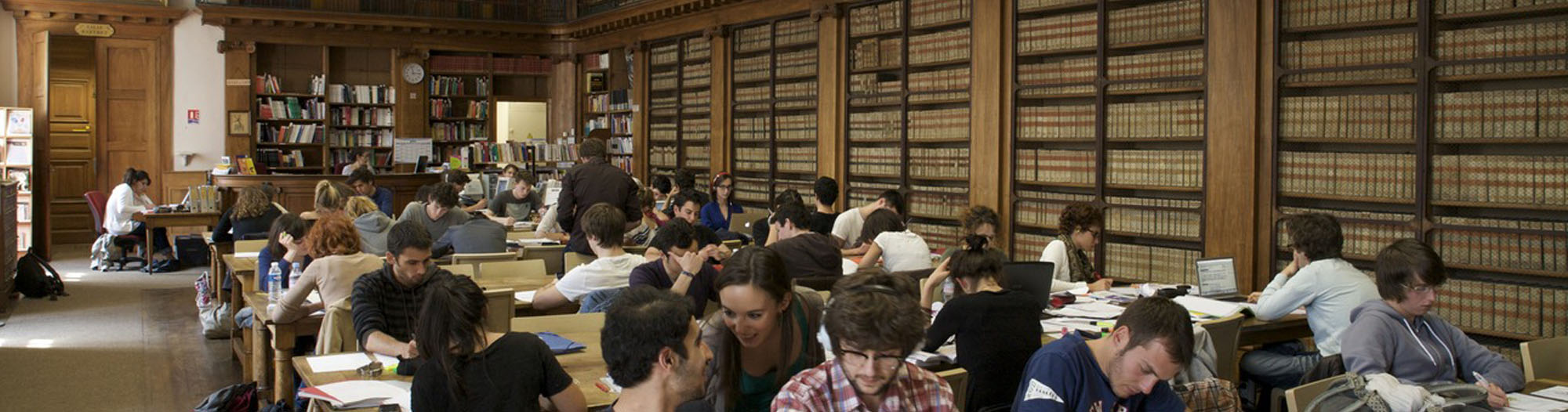
All university libraries on our three campuses (UPM, BH, Nîmes) will reopen on August 31, 2020, and remain open through October 16, following their usual hours.

Extended hours (evenings and weekends) will resume at the affected university librariesstartingMonday, October 19

In light of the health crisis, library capacity has been reduced to ensure compliance with social distancing guidelines. Handwashing upon entry and before handling any materials, the mandatory wearing of masks at all times, designated traffic flow paths, and adherence to physical distancing will be required in all university libraries.


Workrooms

Study rooms on all campuses will reopen to students on August 31 during their regular hours. Wearing a mask is strictly required in these areas.


NWe would like to remind you that, for everyone's safety, Wearing a mask is required in all Faculty and University facilities, including libraries and study rooms. We ask our students and visitors to follow this rule and practice preventive measures to limit the spread of the virus.


Welcome—or welcome back—to the Faculty! Our doors are finally reopening for our students. Below are the start dates and details for the new semester for our various programs.

Coronavirus-Related Measures

Due to the health crisis, we would like to remind you that masks are required on all faculty premises. We also ask our students and visitors to follow safety guidelines. Hand sanitizer is available at the entrance to all our locations.


PASS and PACES


 PASS

  • Orientation meeting on September 4 at 9:00 a.m. on all campuses (ADV, Flahault, Nîmes)
  • Classes begin on September 7 at 8:00 a.m.


PACES (repeat students)

  • Orientation meeting on September 1 at 1:00 p.m. on all campuses (ADV, Flahault, Nîmes)
  • Tutorials begin on September 7


Medicine Program – Montpellier


Undergraduate Program
  • DFGSM2: Classes begin on August 24
  • DFGSM3: Classes begin on August 25


Graduate School
  • DFASM1: First day of class on August 31 at 10 a.m., UPM lecture hall
  • DFASM2: First day of class on September 3 at 10:30 a.m., UPM lecture hall
  • DFASM3: First day of class on September 3 at 2:00 p.m., UPM lecture hall


Medicine Program – Nîmes


Undergraduate Program
  • DFGSM2: Classes begin on August 24 at 9:00 a.m. in lecture halls 1 and 2
  • DFGSM3: First day of class on August 25, 2:00 p.m. in lecture halls 1 and 2

>> AFGSU from August 31 to September 10, 2020.

Graduate School
  • DFASM1 : Back to school on September 1 at 9 a.m. in Lecture Hall 1,
    • Course selection at 10:30 a.m. in Lecture Hall 1
  • DFASM2 : Back to school on September 1 at 2:00 p.m. in Lecture Hall 1,
    • Course selection at 3:30 p.m. at Le Châlet
  • DFASM3 : Back to school on September 1 at 4:00 p.m. in Lecture Hall 1,
    • Course selection at 5:30 p.m. in Lecture Hall 1

>> Start of hospital internships: September 7, 2020


Maieutic Track – Montpellier

Undergraduate Program
  • DFGSMa2: Classes begin on August 24
  • DFGSMa3: Classes begin on August 24
Graduate School
  • DFASMa1: Start of the school year on August 24
  • DFASMa2: Start of the school year on October 12


Maieutic Track – Nîmes


Undergraduate Program
  • DFGSMa2: First day of class on August 24, 9:00 a.m. in lecture halls 1 and 2
  • DFGSMa3: First day of class on August 25, 2:00 p.m. in lecture halls 1 and 2

>> Nursing internship from August 31 to September 17, 2020.

Graduate School
  • DFASMa1: First day of class on August 31 at 9:00 a.m. in Room 434 A
  • DFASMa2: First day of class onAugust 31 , 8:00 a.m. in Room 434 A


Paramedical Programs


Speech Therapy
  • Back-to-school meeting on September 1; classes begin on September 3
  • 5th Grade: School starts on September 1
Orthoptics
  • Back-to-School Meeting on September 11
  • 3rd grade: school starts on September 11


Master's in Health


Gerontology
  • Master's in Gerontology: Management and Coordination of Services and Facilities: The semester begins on Monday, September 21, 2020, at 9:00 a.m. in the Macabies Room (BH)
  • Master's in Gerontology: Monday, October 5, 2020, at 9:00 a.m. in the Macabies Room (BH)
SHS
  • Master's in Social Sciences and Humanities: The semester begins on Tuesday, September 22, 2020, at 2:00 p.m.in the Bonaventure-Laurens (BH) room

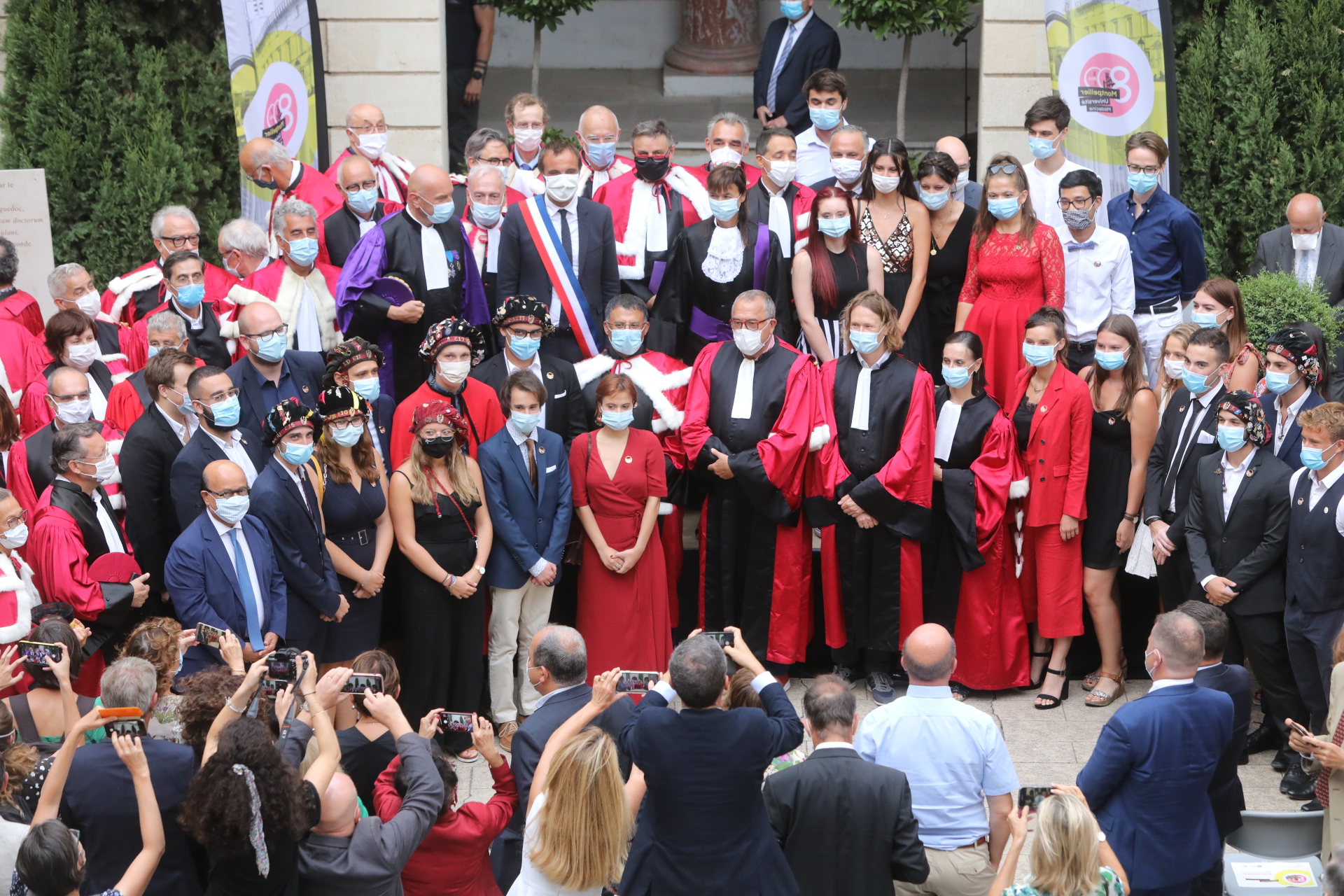
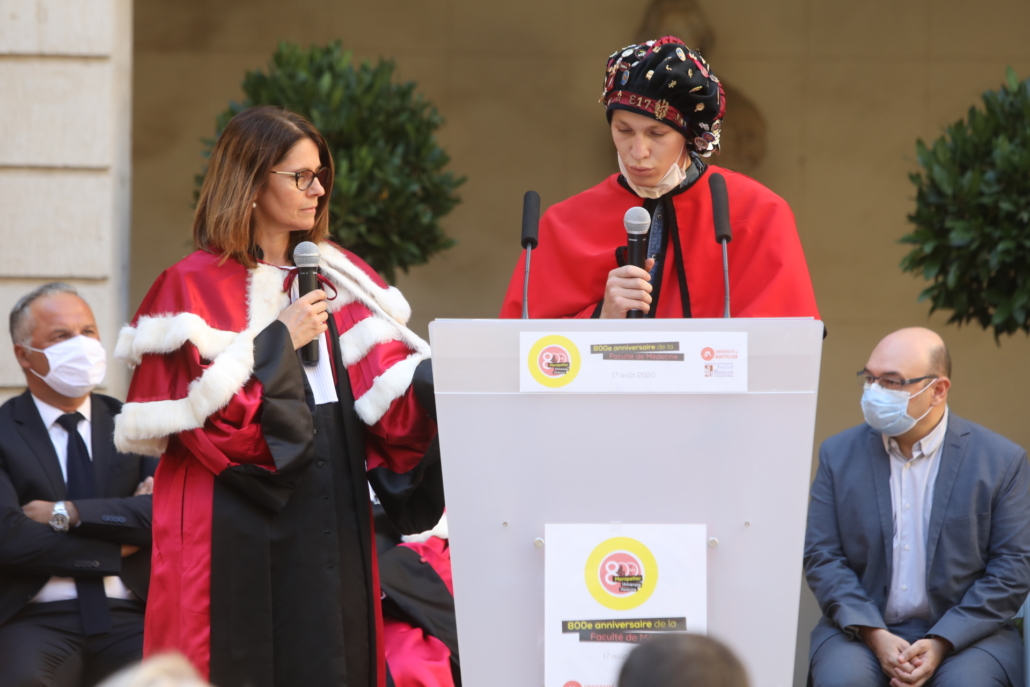
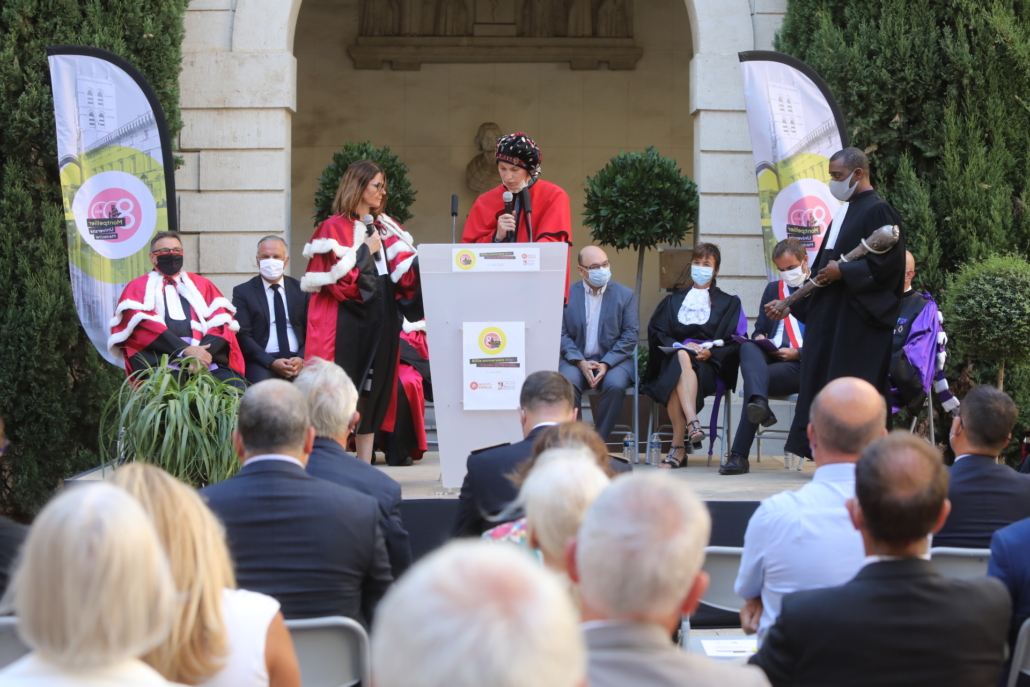
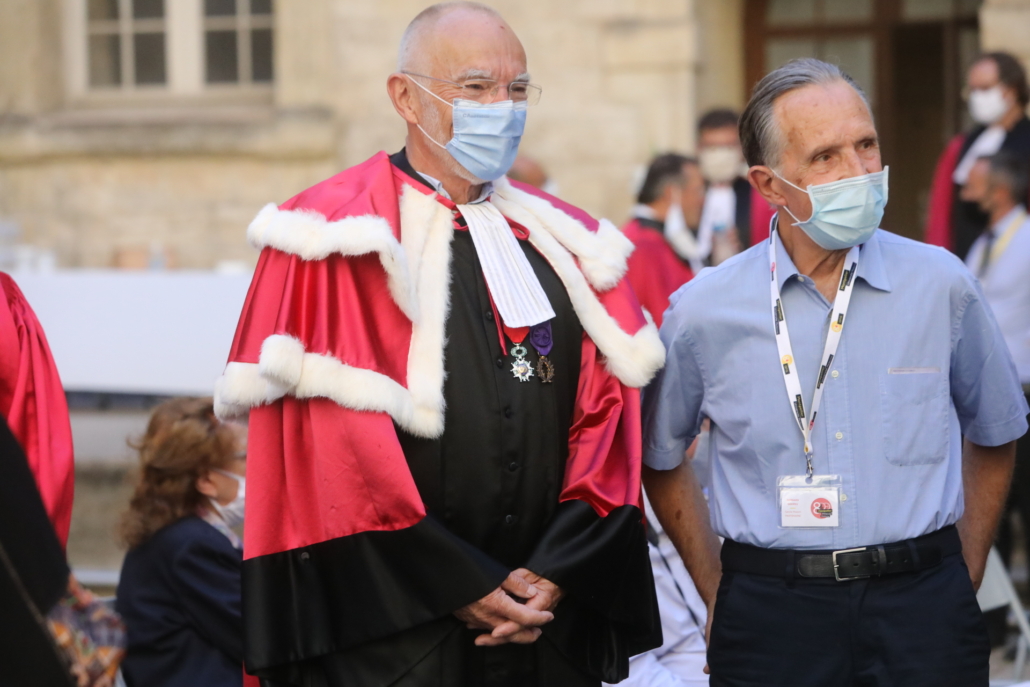
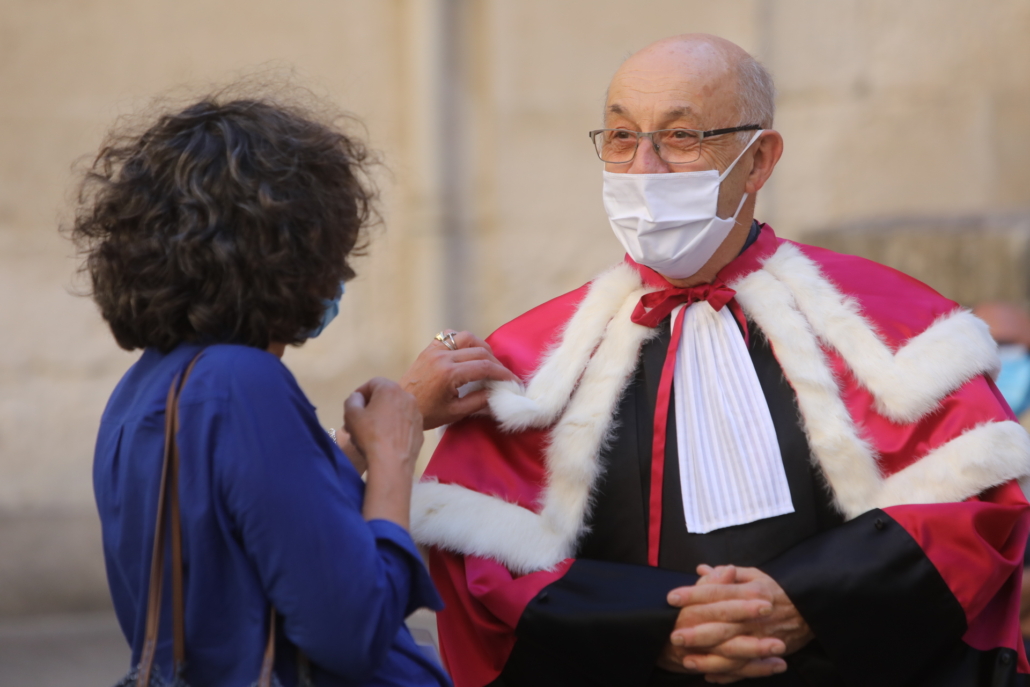
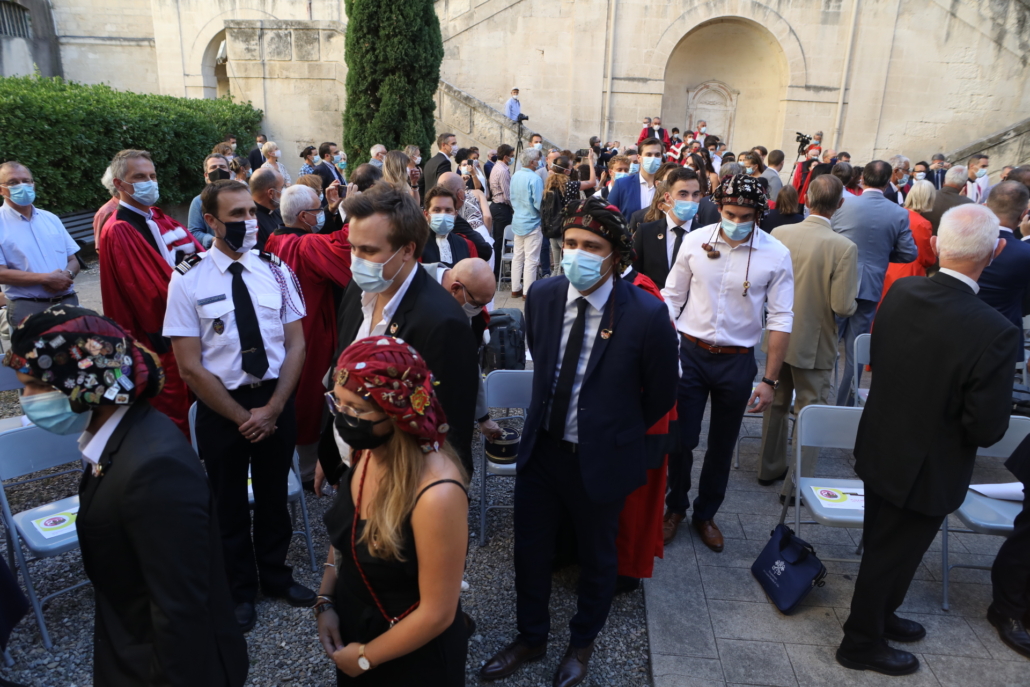
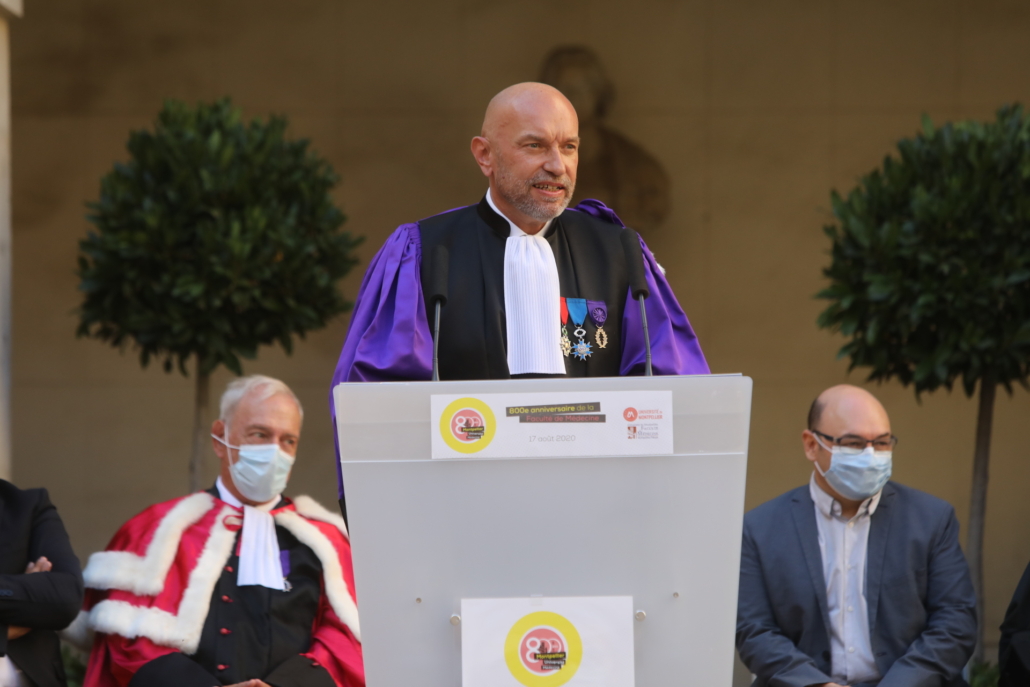
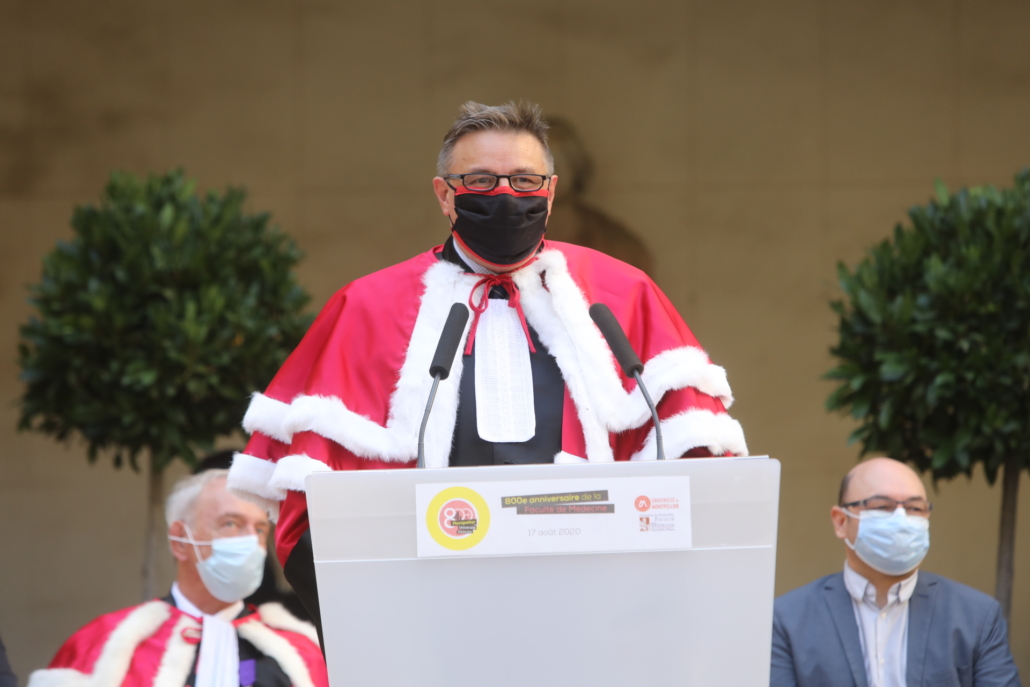
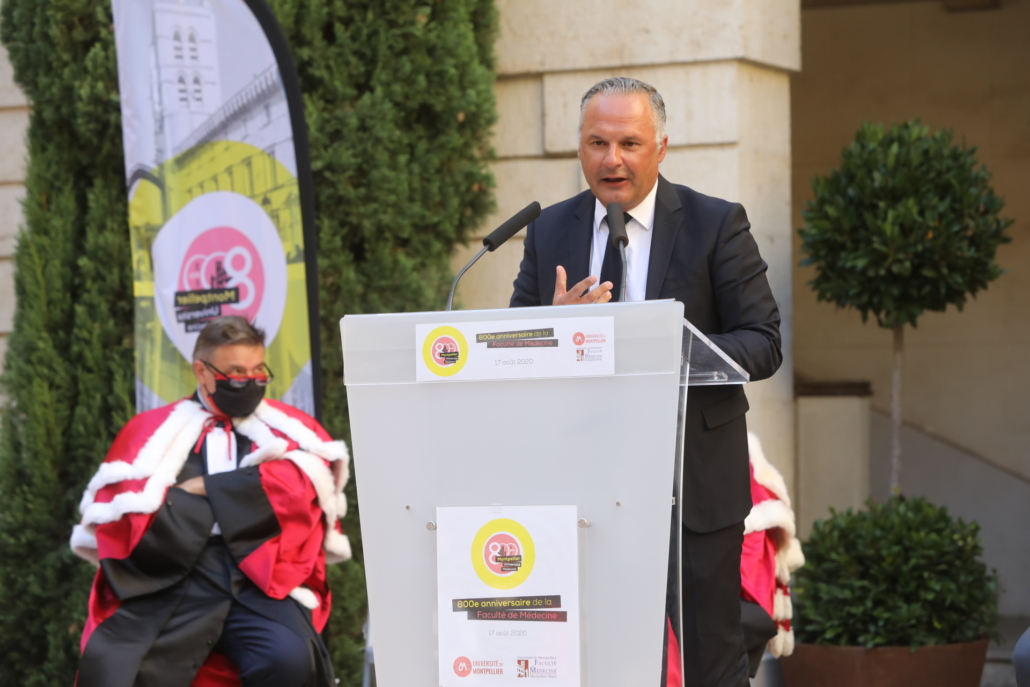
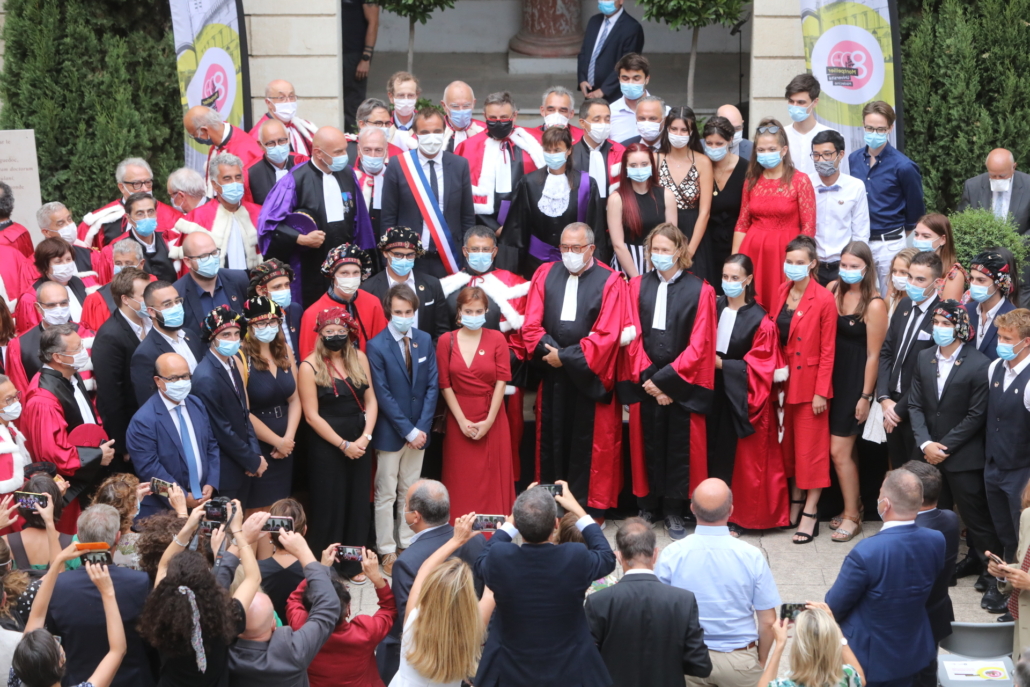
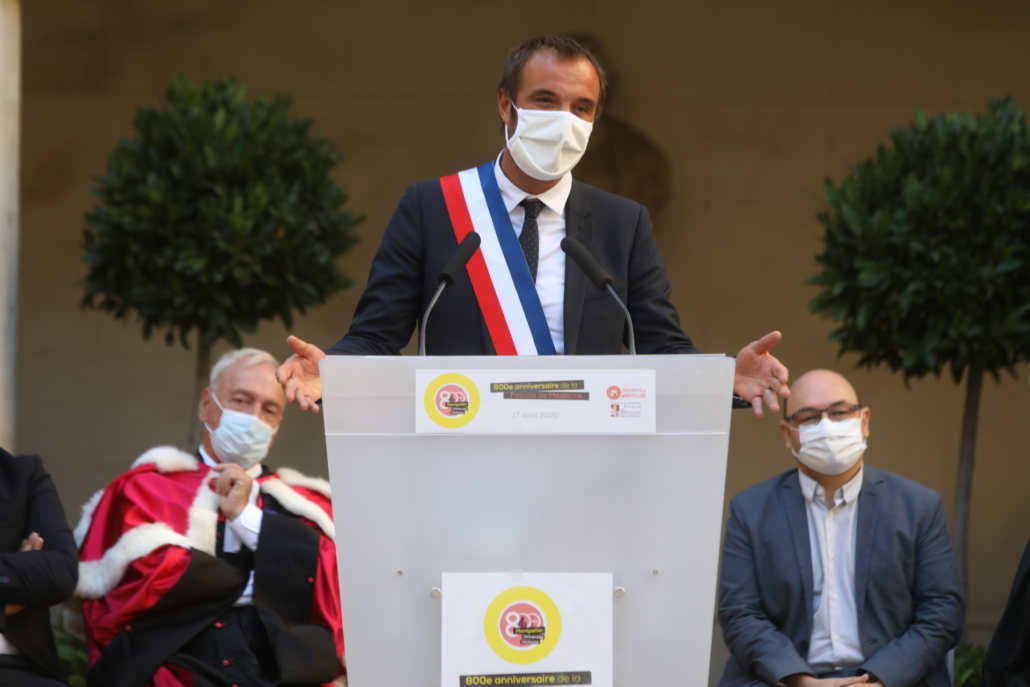
On Monday, August 17, 2020, the Faculty officially celebrated its 800th anniversary! Here’s a look back at an event marked by sharing and camaraderie. 

800 Years of History, Tradition, and Excellence

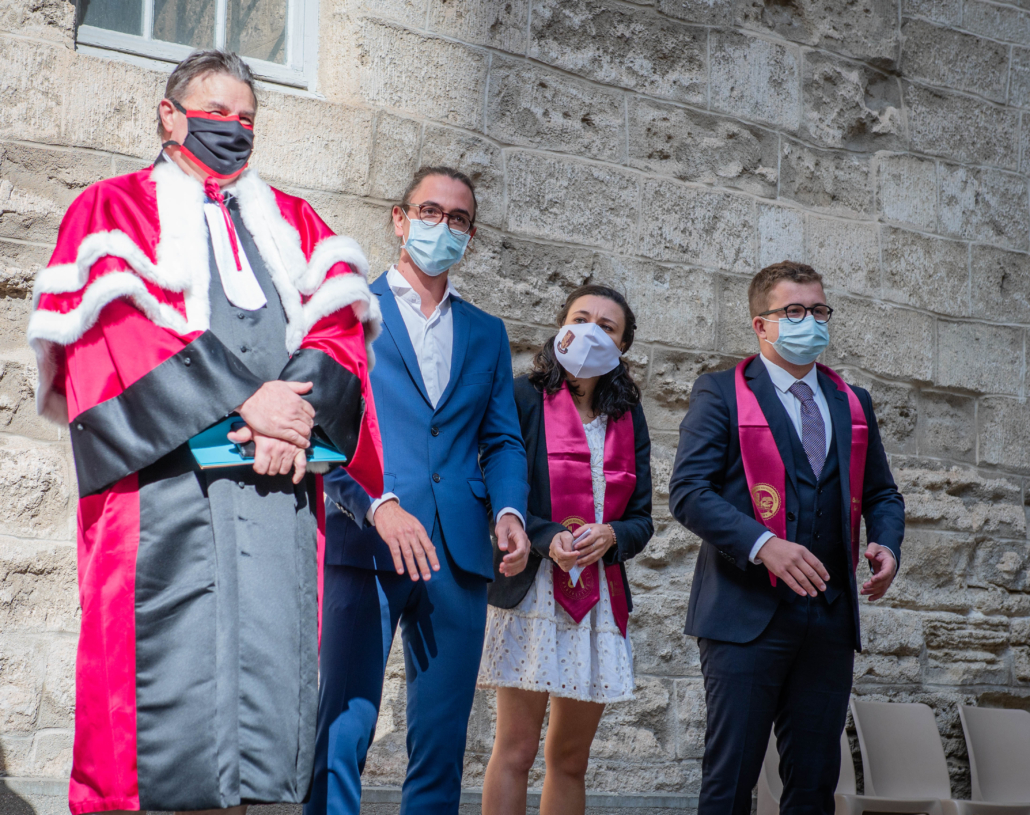
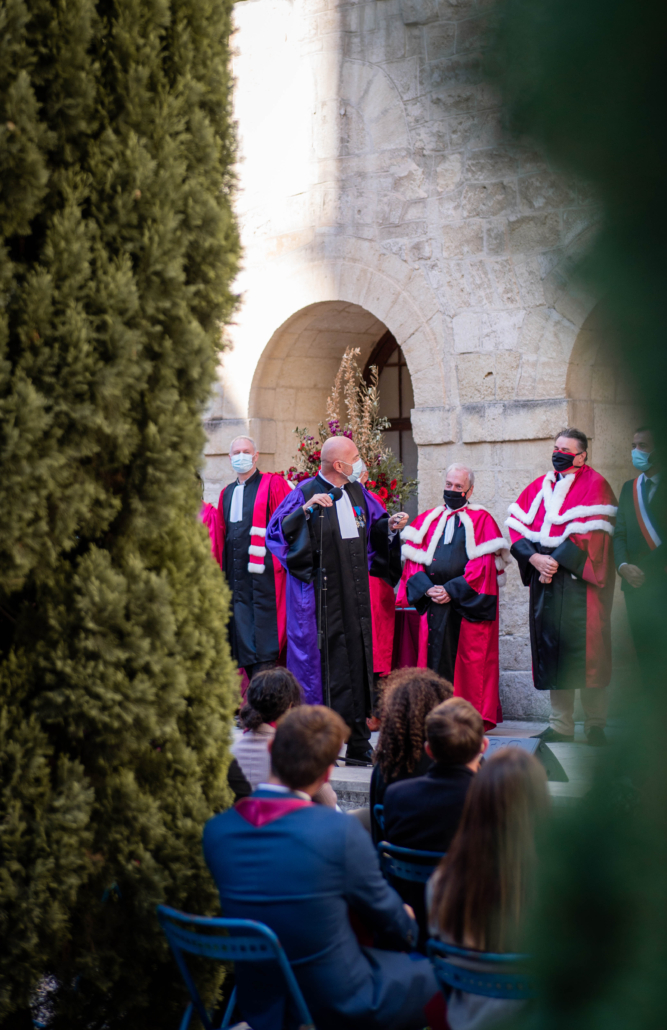
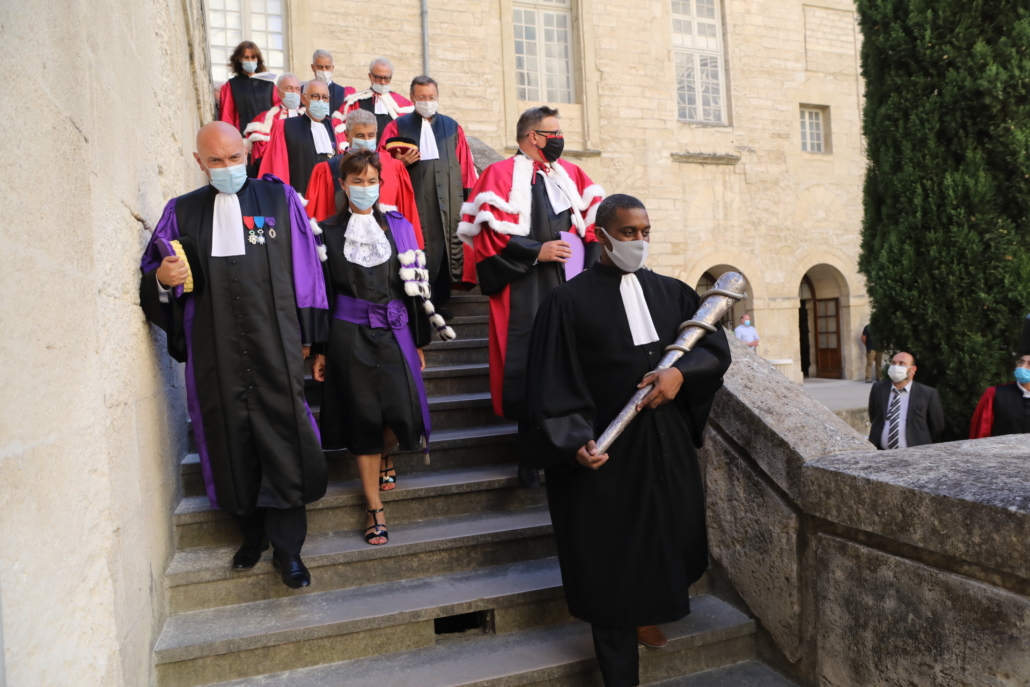
The ceremony begins at the top of the steps of the Cour d’Honneur. Teachers and students, dressed in their finest ceremonial attire, make their entrance into this historic venue alongside: 

  • from Philippe Augé, President of the University of Montpellier; 
  • from the Dean of the Faculty, Michel Mondain; 
  • from the Chair of the Steering Committee, Thierry Lavabre-Bertrand.

We were, of course, able to count on the presence and participation of representatives from local and regional governments:

  •  Mr. Christian Assaf for the Occitanie Region, 
  • Mr. Renaud Calvat for the Hérault Department, 
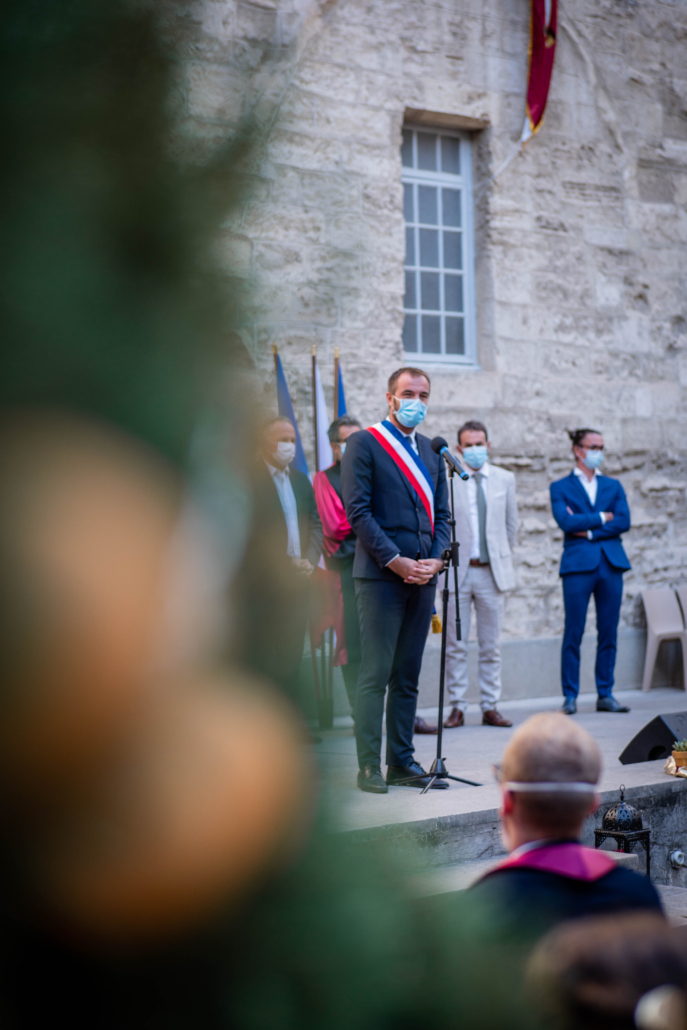
  • Mr. Michaël Delafosse, representing the Montpellier Metropolitan Area and the City of Montpellier 
  • and finally, Ms. Sophie Béjean, Superintendent of the Montpellier School District and the Occitanie Region.

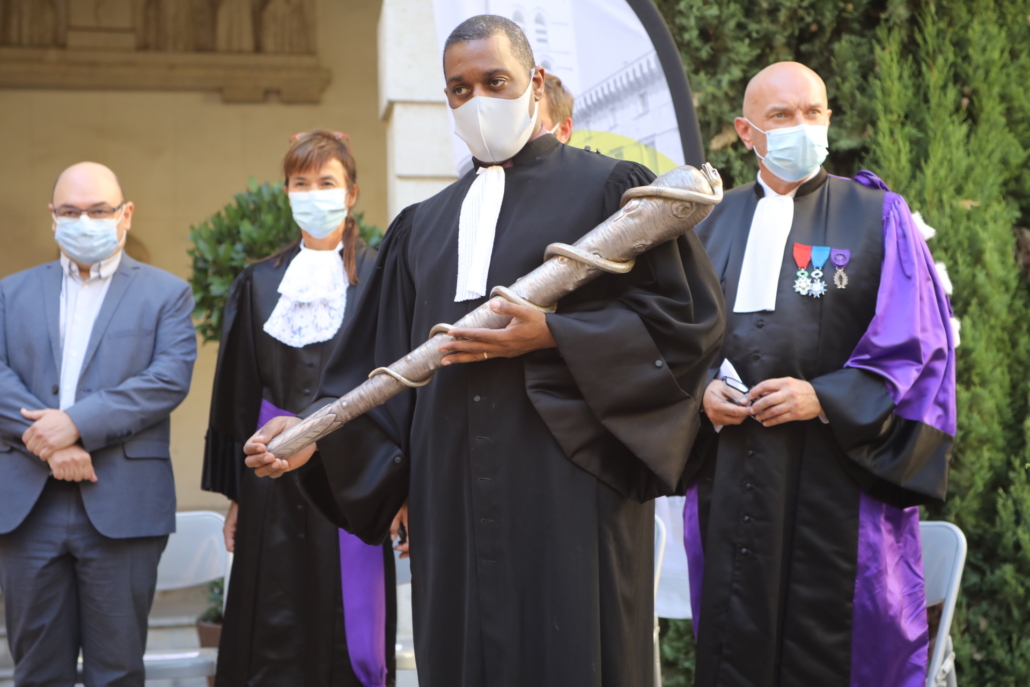
To ensure the ceremony began on the right foot, Professor Chanques and Usher Eddy Lamou presented our ceremonial mace—a symbolic object of the Faculty—to the audience. Resembling the rod of Asclepius, this mace symbolizes the punishment that awaits physicians who fail to honor the Hippocratic Oath.


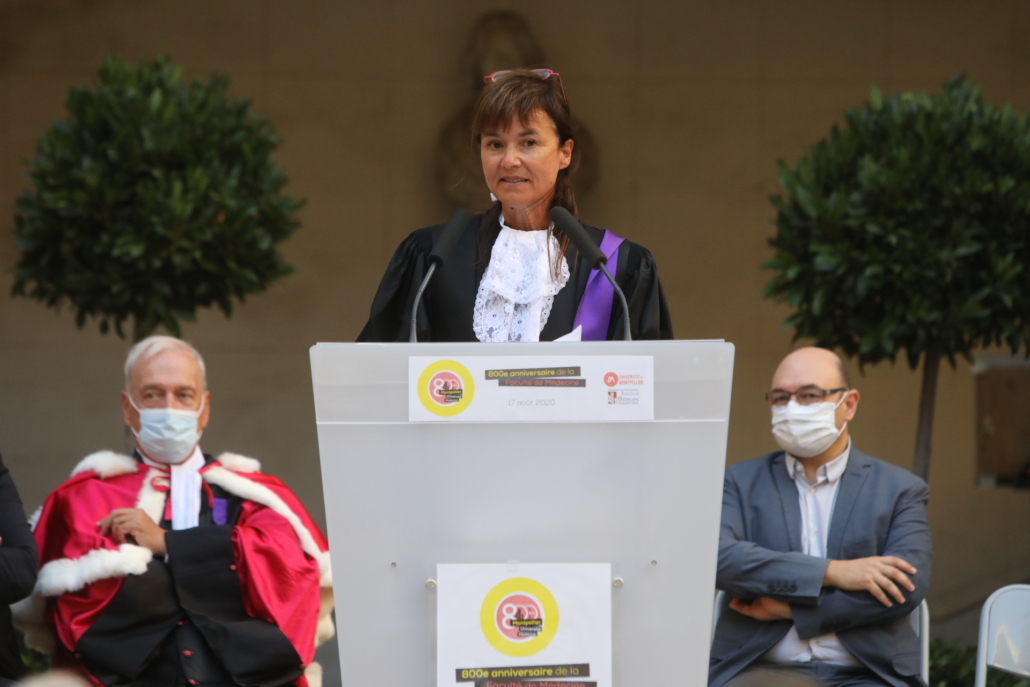
Next, it was the turn of Professor Valérie Rigau—the youngest member elected to the governing board—and Allan Guilley, a medical student and president of ACHEMM (the student association dedicated to the Faculty’s 800th anniversary), to read a translation of the Faculty’s original bylaws, thereby highlighting their historical and symbolic significance.


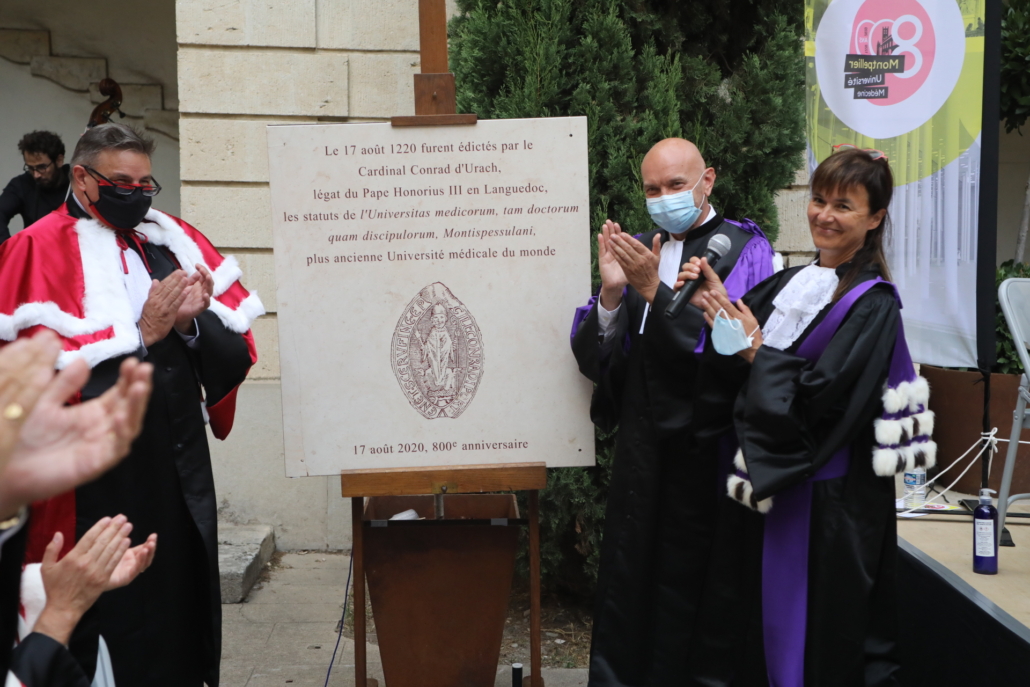
These statutes were promulgated on August 12, 1220, by the legate of Pope Honorius III, Cardinal Conrad of Urach. Since then, the teaching of medicine has continued uninterrupted in Montpellier, forging strong ties with the city, as both President Augé and Dean Mondain noted in their speeches.


A college proud of its past and looking toward the future

800 years later, the Faculty and its community are proud to celebrate this milestone. To mark the occasion, a commemorative plaque was unveiled—a way to honor the distinguished figures who have shaped our faculty, while continuing to write our history.

As current events show us, this journey will undoubtedly be full of challenges to overcome! These challenges will in no way alter the Faculty’s mission: we will be there to support and train the future healthcare professionals of tomorrow.


Relive the ceremony

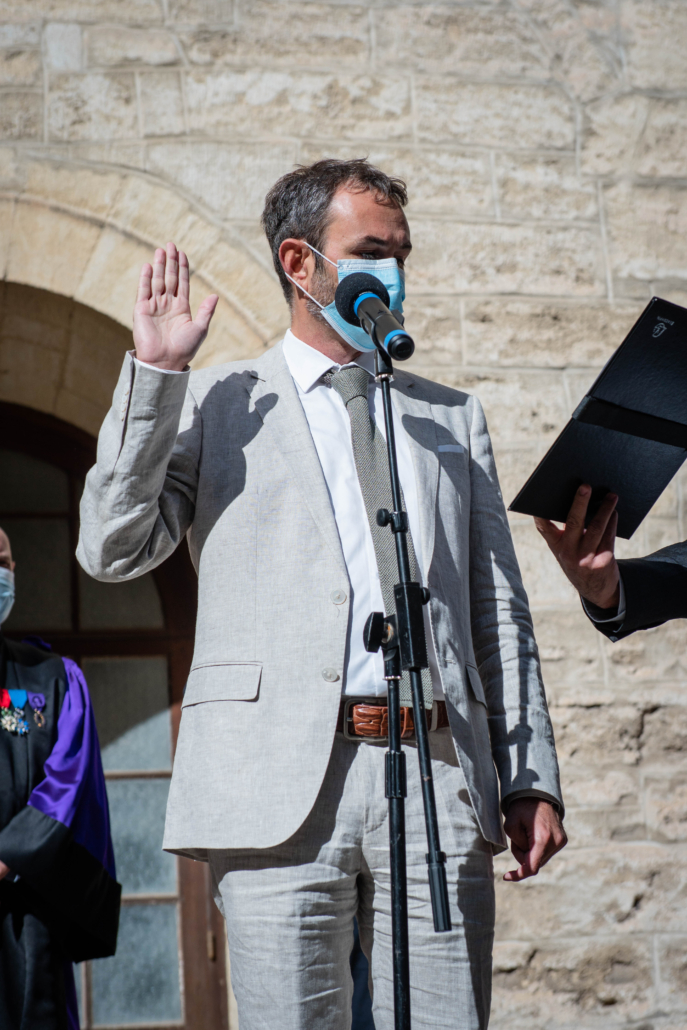
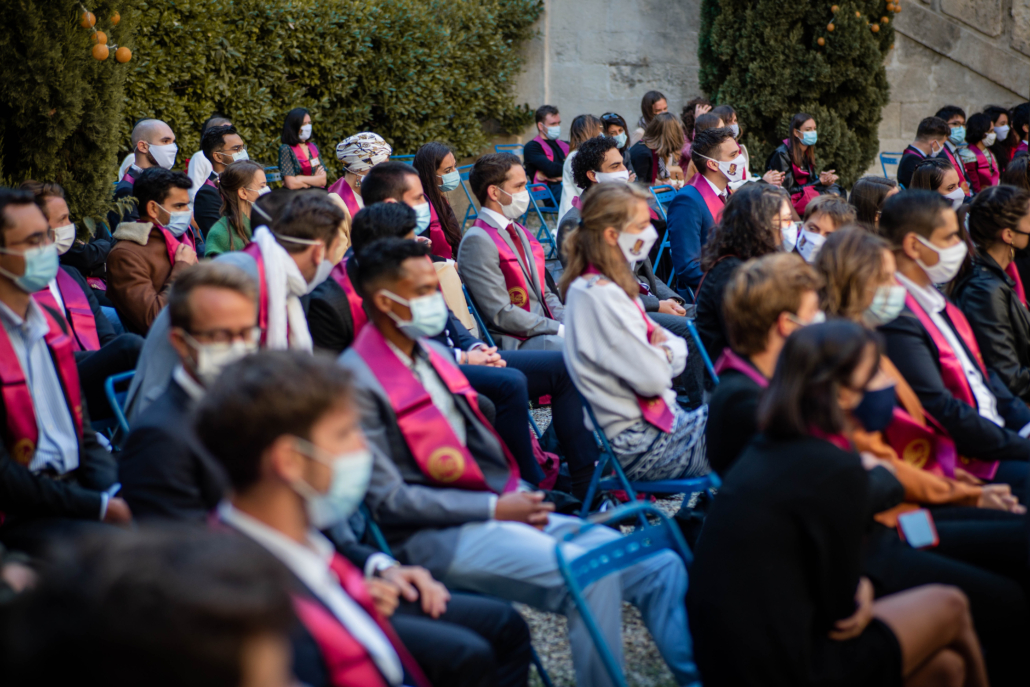
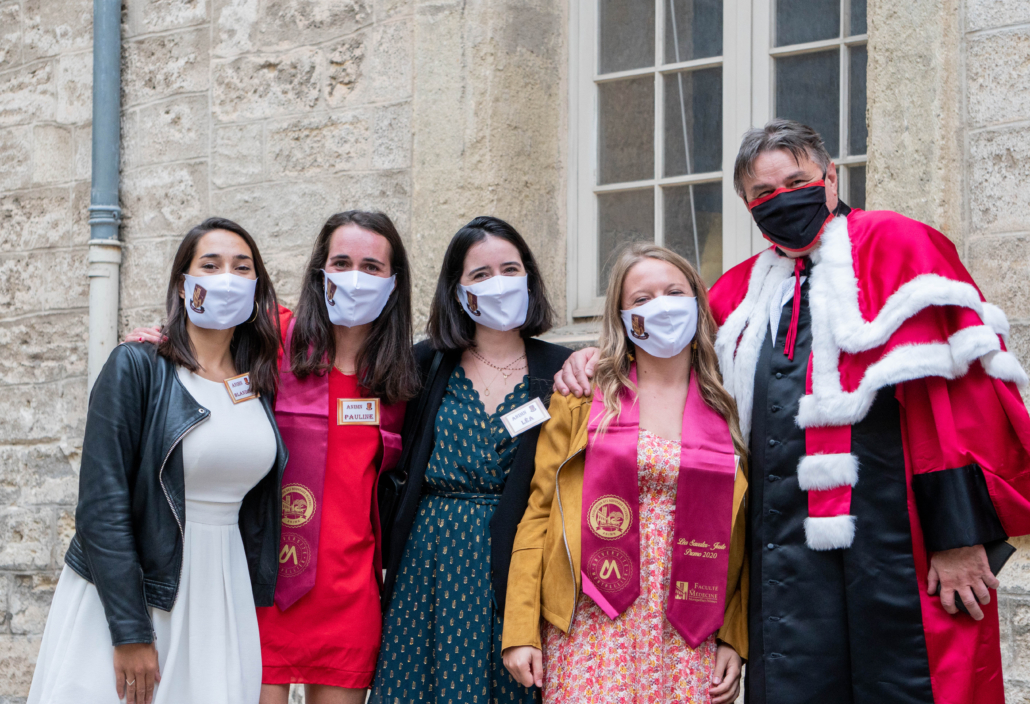
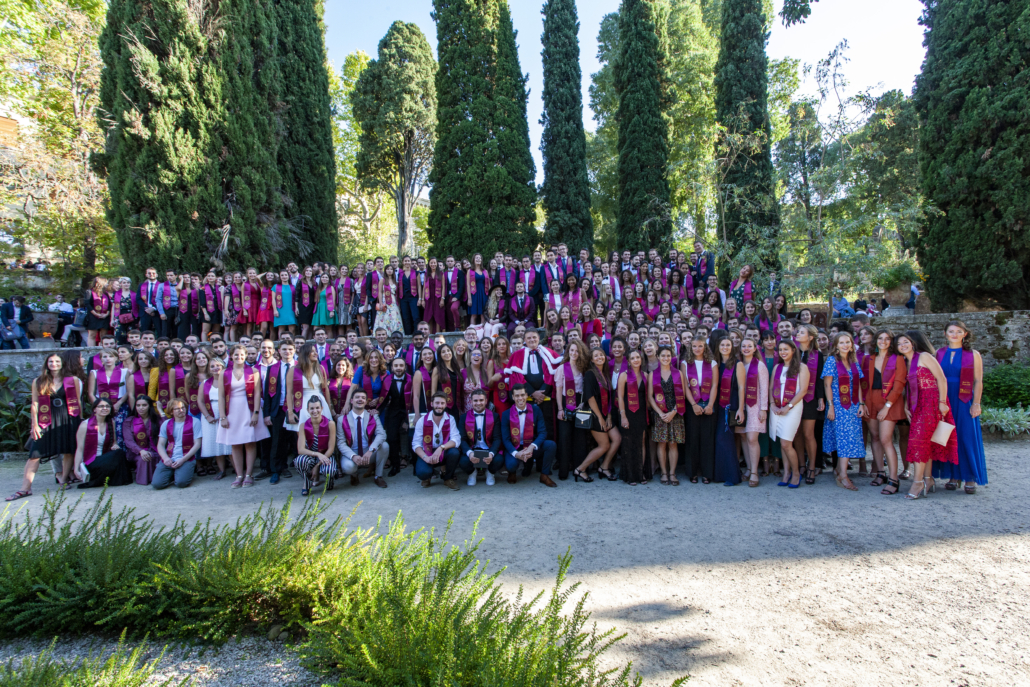
Below are photos of the ceremony taken by E. Perra. You can also watch the entire ceremony again by clicking the link below.


And to learn more about the events planned for the coming months to celebrate this anniversary in style, visit the official website at 800ans.fr!


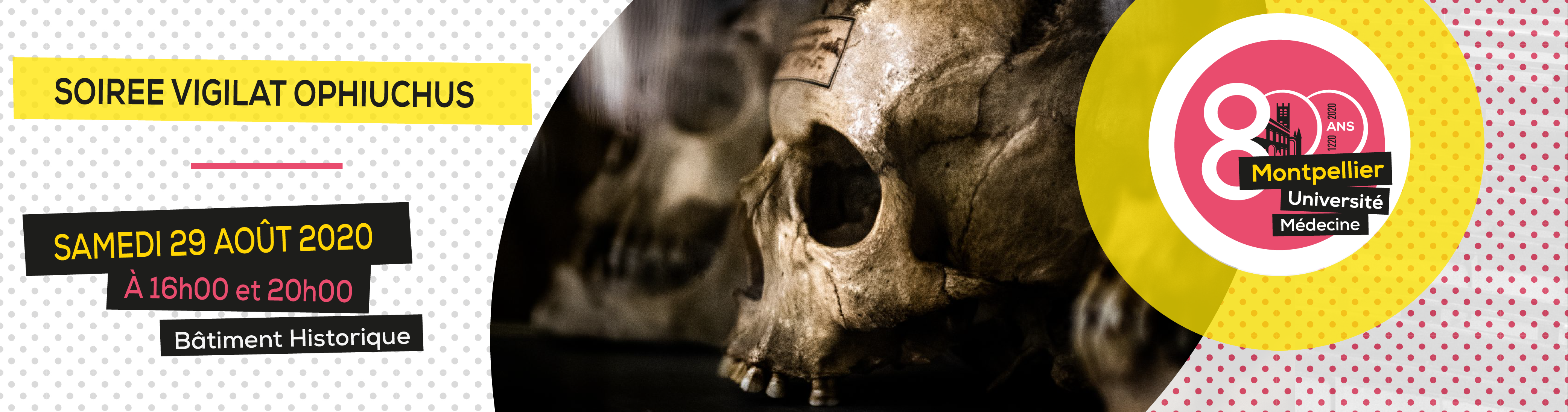
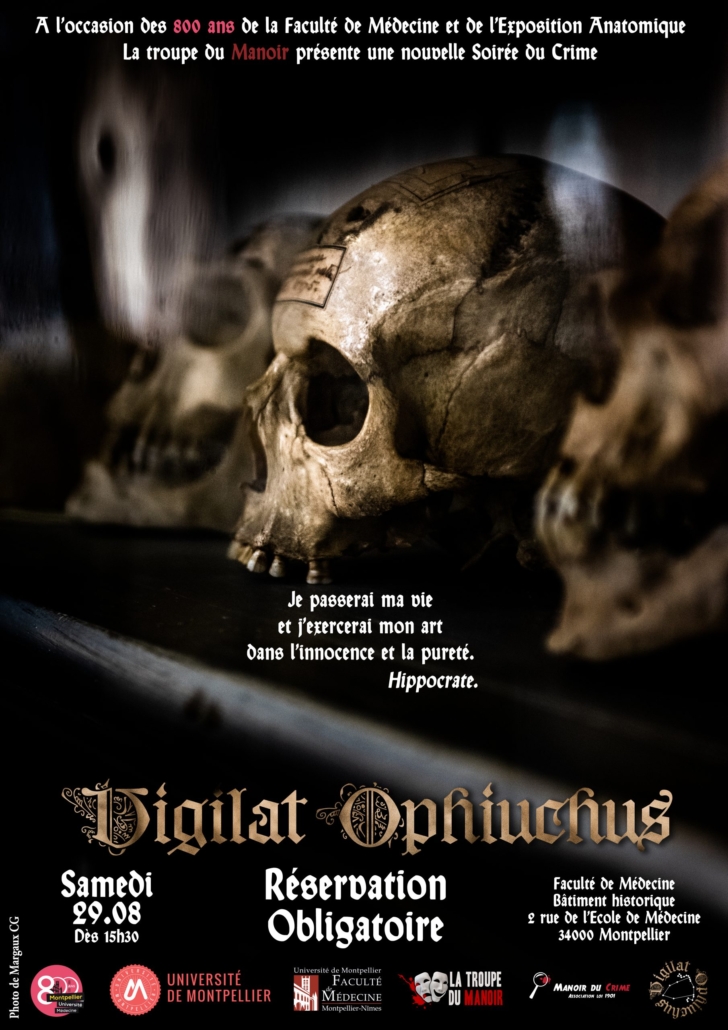
The year marking our Faculty’s 800th anniversary continues with a new, fun-filled event! Join the team at the Manoir du Crime on Saturday, August 29, for an unforgettable evening full of thrills…


A Full-Scale Investigation

This historic building will be the setting for a life-size game. Fans of Cluedo and mystery shows, put on your best detective outfit to solve the mysteries of the Troupe du Manoir!

1935. The press reports that the body of a famous surgeon was found in his home office, which was locked from the inside. However, this was no suicide. The police launch an investigation, and their inquiries soon lead our two detectives to the Montpellier School of Medicine. What conspiracy lies behind this skillfully disguised murder? What will our two investigators discover? Will they dare to delve into the mysteries of the Faculty of Medicine’s history?

Come join us for a Murder Mystery Night with a new twist, set amid our Faculty’s impressive anatomical collection!

On this special day, we’re up for a challenge. In fact, we’ll have to solve the longest mystery ever written by the Troupe du Manoir. To do so, it will be divided into two chapters.

A first group of teams will have the opportunity to solve Chapter I from 4:00 p.m. to 6:30 p.m. These same teams must then pass on everything they have discovered to the teams that will be solving Chapter II during a meal (under the guise of a police inspector). Armed with this information, the new investigators will have to unravel all the mysteries of the Montpellier School of Medicine.


An event requiring registration

Two sessions are offered, each including a buffet dinner:
The first session will be from 4:00 p.m. to 6:30 p.m. The second session will be from 8:00 p.m. to 10:30 p.m. Dinner will be served from 6:45 p.m. to 7:45 p.m.

Prices:
Session 1 OR Session 2 with meal: 40€
Session 1 AND Session 2 with meal: 60€

For more information on the Faculty’s 800th anniversary and the events organized to celebrate it, visit 800ans.fr!

We met AMEO earlier. Today, we’re heading to Nîmes and even farther afield with the Crocos du Monde association!

In a nutshell, what is the Crocos du Monde association?

Founded in 2007, “Crocos du monde” is the student humanitarian association of the Faculty of Medicine’s Nîmes campus. Its goal is to enable medical and midwifery students to get involved in humanitarian work—each in their own way—and to raise awareness of global disparities. The main objective is to organize an international solidarity project each year. Since the association’s founding, the Crocos have already traveled to Morocco, Burkina Faso, and even Togo last summer!

What activities do you carry out throughout the year? Can you tell us about them?

Throughout the year, we hold two major events: fundraisers for our international solidarity project and, starting this year, our local project in Nîmes, which has allowed us to implement social initiatives throughout our city.

To help fund our trip, we’ve been organizing events at our university since the beginning of the year. We’ve already held a few snack sales. During the holiday season, we raised money through gift-wrapping booths and a chocolate sale.

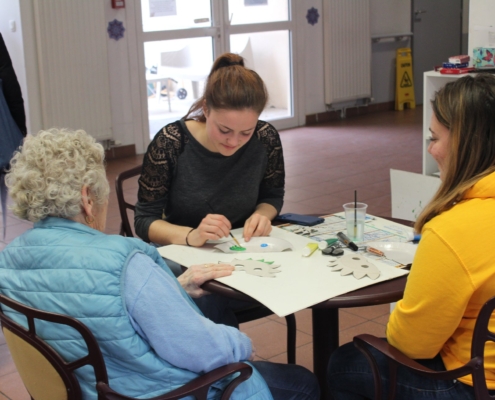
At the same time, the Nîmes project is structured around several initiatives, most of which are carried out in partnership with the French Red Cross in the Gard department, particularly for outreach patrols and visits to nursing homes.

Why did you join the organization as an individual member? What does your organization offer students?

I’ve always been interested in humanitarian work, and this organization has given me the opportunity to get involved through a variety of local initiatives that balance our academic commitments with the limited time we can devote to charitable activities.

This allowed me to become aware of the various needs around me and take action to address them, whether directly in Nîmes or through fundraising and preparing for the annual international solidarity trip.

Why and how do I join Les Crocos du Monde?

Our organization provides opportunities to get involved in social, community-oriented, and environmental initiatives. This allows you to get involved and stay true to your values. Furthermore, it complements your studies by fostering social connections and bringing you into contact with people in need.

You can join in September, after the back-to-school general meeting, and then at any time throughout the year. Simply fill out a membership form and pay a 10-euro membership fee by check or cash, and you’ll officially become a member of Crocos du Monde. The association is open to all students at the University of Nîmes (PACES/PASS, medicine, midwifery).

A few words about the 2020–2021 executive board?

The election of our executive committee takes place in two parts:

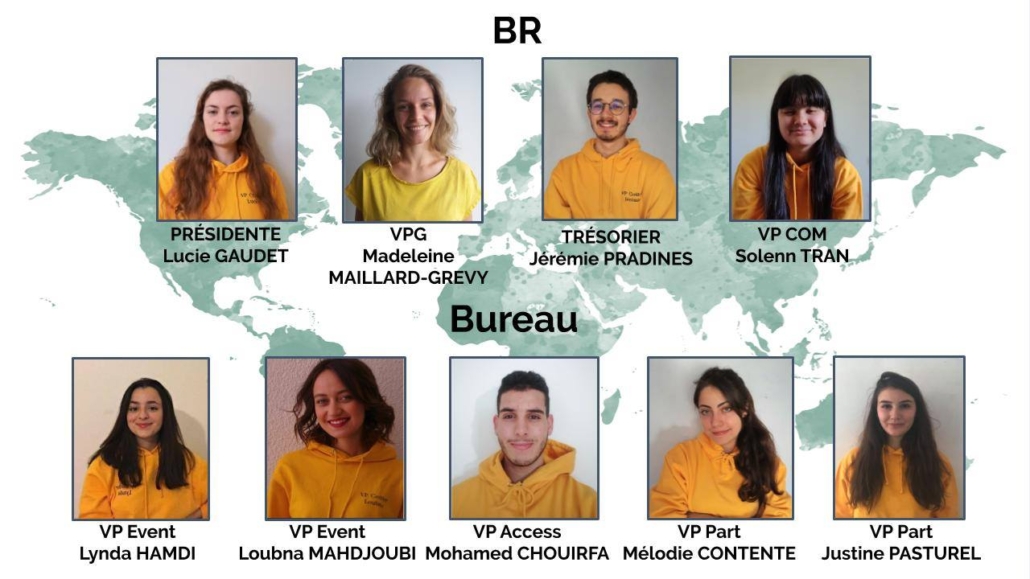
  • First, an executive committee (BR) is elected. Following an online campaign period, the election was held in early June. Due to the current health situation, we will hold the handover ceremony in person at the start of the school year.
  • Then, in late September, second-year members of the association (medicine or midwifery) will be able to run for office. After a short campaign, the BR selects its executive board based on the number of candidates per position.

For more information, feel free to follow us on social media:


Earlier this week, we metwith the Montpellier Health Tutoring Association. Today, we’re staying in Montpellier for our meeting with Kévin Vidal, the president of AMEO!

In a nutshell, what is AMEO?

AMEO is the Association of Orthoptics Students in Montpellier. It was founded in 2009 and aims to organize activities for orthoptics students through a variety of events. Through AMEO, we also represent students within the federations to which we belong— the AGEM (General Association of Montpellier Students) and the FFEO (French Federation of Orthoptics Students)—in order to defend their rights as students and ensure the quality of their education within the various governing bodies.

What activities or initiatives do you organize throughout the year?

Throughout the year, we organize various types of events:

  • Team-building events such as parties or group activities, as well as team-building weekends for new classes, an end-of-year gala, and a farewell party for recent graduates
  • Events focused on “prevention, solidarity, and citizenship,”such as fundraising drives for Pink October, the Telethon, or Sidaction.
  • As orthoptics students, we are in contact with the Valentin Haüy Association, an organization that advocates for the rights of people with visual impairments, provides them with training and access to employment, helps restore and develop their independence, and also offers cultural, sports, and recreational activities accessible to people with visual impairments.

AMEO also supports students throughout their studies and helps them transition into the workforce by sharing job openings with future graduates so they can enter the job market. Through these partners, AMEO also enables students to purchase orthoptic equipment at reduced prices by offering discounts or organizing group orders for educational materials.

Why did you personally choose the Orthoptics program, and what does the association offer students in this program?

Personally, I chose this field because the profession of orthoptist offers many opportunities. Patients come in all ages, and the conditions and rehabilitation methods are very diverse. For example, an orthoptist may work with premature infants or children with visual exploration issues, or with cases of atypical conditions such as shaken baby syndrome. We can also work with older adults who have AMD or other eye conditions that cause significant functional impairment and, in some cases, require low-vision rehabilitation, as well as with people who simply need glasses or orthoptic rehabilitation.

Another aspect of this profession that I really appreciate is the interdisciplinary nature of the work. We may find ourselves collaborating with occupational therapists to adapt the environment for people with visual impairments, with speech-language pathologists to develop visual exploration strategies for children with attention disorders, or with physical therapists in the field of posturology. It is, therefore, a profession in which every case is different, one that offers the choice of working in a healthcare facility or in private practice, and one that provides the opportunity to continue learning about a wide range of disciplines throughout our careers.

How do I become a member of AMEO?

To join AMEO, you must be an orthoptics student in Montpellier. The membership fee is 3€ per year. To join, simply submit your application at the association’s office located on the ADV campus!

A few words about the 2020–2021 executive board?

The election of the 2020–2021 executive board takes place at the end of June during the handover general meeting. Each slate running for the new executive board will present its rationale and plans. Each year, the executive board consists of at least one president, a secretary, a treasurer, a vice president in charge of communications, a vice president in charge of networking, a vice president in charge of partnerships, vice presidents in charge of events, and a vice president in charge of prevention, citizenship, and solidarity.

You can already find us on our social media channels:
Twitter: AMEOrthoptistes
Facebook: https://www.facebook.com/AMEOMtp/
Instagram: @ameo_orthoptie

After meeting with the Nîmes Health Tutoring Association, this week we’re joining the Montpellier Health Tutoring Association and its new president, Milla Esclafit-Cardoso! 

In a few words, what is the AssociationTutorat Santé Montpellier?

The Tutoring Program consists of second- and third-year health sciences students who have passed the PACES entrance exam and who have been selected and trained for one year by the professors in charge of that year’s program. Our goal is to provide free, high-quality academic and emotional support to any student at the University of Montpellier and its branch campuses who wishes to pursue a career in healthcare. To meet this need, three organizations are available to assist you: the Montpellier Health Tutoring Association, the Pharmacy Tutors Association, and the Nîmes Health Tutoring Program. 

These three organizations pool their resources to provide equitable support to all students and share a common goal of ensuring equal opportunity in the admissions process for health professions programs. 

What activities or initiatives do you organize throughout the year? 

To start the year off on the right foot, we’re offering a Pre-Semester Workshop open this year to all PACES and PASS students: its goal is to review the entire first-semester curriculum, help students develop effective study habits, and introduce them to the faculty so they can find their footing. 

Each week, we review the key points from each course across all subjects through multiple-choice quiz sessions led by professors: these sessions are offered at several different times so that students can adjust their schedules according to their availability. To help students with their questions, office hours are held every day at noon on campus, and a forum is also available to students. 

To ensure regular and representative assessment, we organize weekly graded quizzes attended by approximately 900 students across our three campuses, as well as mock exams, which this year drew more than 1,600 students in the first semester. 

To adapt to the lockdown and public health measures, we held our sessions and review sessions online via Zoom, which we recorded so that PACES students with an unstable internet connection could watch them. We also expanded our YouTube channel to diversify our remote content, focusing on parts of the course that we felt were difficult for students to understand.

Beyond academic support, we help students navigate a demanding year by promoting activities focused on well-being: board game lunchtimes, relaxation workshops, and more… Our biggest wellness event is Pep’s Week, which takes place in early January—a particularly difficult time for PACES students. To help first-year students connect with upperclassmen, we set up a student mentoring program right at the start of the year. 

To further promote equal opportunity, the Tutoring Service works withHandiversité to offer a disability support service for students who need reasonable accommodations during sessions or exams. 

Finally, in the context of reform, we serve as key points of contact both within the university—by organizing career guidance forums—and at the local level through various student fairs, as well as at the national level by participating in conferences that bring together tutoring organizations from across France.

What made you decide to join the organization? 

Tutoring helped me pass my PACES exam by supporting me for two years: this support was extremely valuable to me because I couldn’t afford to pay for the services of a private organization. The tutors’ availability, the quality of the sessions, and above all, the support they provided in every aspect of PACES life—from studying to maintaining a healthy lifestyle and staying motivated—really helped me get through that challenging time. It was a no-brainer for me to apply to become a tutor after I was admitted to my second year of medical school, so I was delighted to join the UE7 team (Health, Humanities, Society). My year as a trainee tutor was so fulfilling that I wanted to continue the journey by joining the Tutoring Board to help it reinvent itself during the year of the reform: so we changed our name from the Montpellier Medical Tutoring Association (ATM²) to the Montpellier Health Tutoring Association (ATSM) to better reflect our commitment to diversifying the backgrounds of incoming students across all health-related programs! 

What does the association offer students?

Beyond simply providing academic guidance, our goal is to offer genuine support to all young adults who are navigating university studies, life away from home, and a very substantial workload. Our core value is equal opportunity, ensuring that selection for this first year is based on academic ability rather than financial status. This aligns more broadly with our commitment to collegiality—a value we hold dear in the healthcare professions—and with our training, which is largely based on peer-to-peer learning. After all, we are first and foremost students who have gone through this challenge ourselves and who are trying to help PACES students just as we needed help when we were in their shoes!

Why do you think people should join your organization? 

In the first year, students can sign up for tutoring free of charge at any time throughout the year: there is no attendance requirement, but according to faculty surveys, attending 80% of the tutoring sessions is the best way to pass the entrance exam! 

If you wish to join the ATSM as a tutor, you will have the opportunity to be selected based on your application and an interview after your second-semester grades are released. You will then hold the status of Trainee Tutor during your second year and may continue as a Qualified Tutor when you advance to your third year. 

A few words about the 2020–2021 executive board?

The General Assembly to inaugurate our new executive board took place on June 9: we are all very excited to renew our commitment to supporting students repeating PACES, PASS, and LAS. We know that this year can be daunting for recent high school graduates, and we are ready to support them through this transition. 

We're in the process of changing our name, so for now, our old name is what appears on social media:

Facebook: Medicine Tutoring in Montpellier 

Instagram: 

Email contacts: 

  • General questions about the association, PACES, and PASS: asso.atsm@gmail.com
  • Questions about LAS: vicepresident.las.atsm@gmail.com
  • Questions about possible accommodations under the Disability Tutoring Program: vptutohandicap@gmail.com

Networks of other associations: 

Nîmes Health Tutoring: 

Association of Pharmacy Tutors: 

We've also put together a video presentation for you, in collaboration with the three tutoring programs!

Earlier this week , we met with the CNESF, the association for the midwifery program in Nîmes. We’re staying in Nîmes today for our meeting with Matthias Daudé, the new president of TSN!

In a nutshell, what is Tutorat Santé Nîmois?

TSN (Tutorat Santé Nîmes) is an association made up of second- and third-year medical and midwifery students at the Nîmes campus. We have all successfully passed the entrance exam for health studies, and drawing on this experience, we offer support to students entering their first year of a health-track program (PASS/LAS). 

What activities or initiatives do you organize throughout the year? 

Throughout the year, students are offered weekly practice sessions in the form of multiple-choice quizzes, during which tutors provide detailed feedback on the quizzes, share memory techniques, offer study tips, and provide support in preparing for exams. All sessions are reviewed by the subject instructors to ensure they remain closely aligned with the requirements of the final exams.

 In addition, we are organizing a pre-school-year workshop during the last two weeks of August. During these two weeks, we’ll cover the first-semester curriculum while providing as much guidance as possible on how to approach this challenging academic year. 

 We also offer practice tests and mock exams to help students prepare as thoroughly as possible through realistic practice, using questions that have been reviewed by professors.

What made you decide to join the organization? 

When I started my health studies, I wasn’t familiar with tutoring. At the university, I quickly heard about the organization and the support it offers. So I went to a session and immediately saw all the benefits this organization could provide me. 

After passing the PACES entrance exam and enrolling in a health sciences program, I wanted to join the tutoring program to share my personal experience from my first year. I wanted to help as many students as possible make progress so they could achieve their dreams. It felt natural to me to do everything I could to give back everything I received during my first year, because without the tutoring program, I would never have passed that exam.

What does the association offer students?

The TSN provides PACES students with genuine academic support through practice sessions and Q&A sessions, as well as moral support through the organization of student activities. We also have a mentoring program in which second- and third-year students take first-year students under their wing to guide them toward success.

Why do you think people should join your organization? 

Our association offers a wide range of services, including both educational and personal support, to help everyone make progress toward passing the entrance exams for the second year of health studies.

How do I sign up? 

The tutoring program is completely free! To join the tutoring program, simply follow the registration instructions, which will be posted on our social media accounts and on the faculty’s registration page.

A few words about the 2020–2021 executive board?

For the TSN association, the election of the executive board takes place in two phases. 

It all begins with the formation of the Executive Committee (BR). Once the candidates for the BR have been nominated, a campaign period begins during which the various teams present their plans for the year. This year, due to the health crisis, all elections and campaigns took place online. Once the campaigns are over, all second- and third-year tutors elect a BR, which will then organize the elections for the other positions on the Executive Board. 

Once all positions have been announced by the BR, each mentor who wishes to serve on the executive board submits a candidacy for the position. The candidacy period lasts one week. After this campaign period, the BR organizes a vote for the positions with multiple candidates. 

You can now find us on our social media channels!

To wrap things up, we’d like to share a video we created in collaboration with the three health tutoring organizations in Montpellier: the Montpellier Health Tutoring Association (ATSM), the Association of Pharmacy Tutors (ATP), and us, the Nîmes Health Tutoring Association (TSN)!

Following our meeting with Dis-Lalie, the Montpellier-based association for the speech-language pathology program, this week we’re meeting with the CNESF, the association for the midwifery program in Nîmes!

In a nutshell, what is the CNESF?

The Nîmes Midwifery Students’ Association is a nonprofit organization under the French Law of 1901 whose purpose is to represent midwifery students in Nîmes and to give them a voice within federations such as the ANESF (National Association of Midwifery Students, our program-specific federation) and the AGEM (General Association of Montpellier Students, our regional federation). It also aims to listen to midwifery students in Nîmes, advise them as much as possible, and defend their rights and interests. Our association helps energize the student life of its members by organizing solidarity and prevention events, as well as social, athletic, and cultural events. Finally, it aims to enhance our skills as future healthcare professionals through access to continuing education.

What activities or initiatives do you organize throughout the year?

We are working to expand our activities as much as possible through the association’s various divisions the association:

The Public Health Division has organized, for example, film screenings followed by coffee-and-conversation discussions to explore topics such as female genital mutilation or anonymous adoption, particularly following screenings of films in partnership with the Sémaphore in Nîmes.

As part of the annual awareness campaign for breast cancer screening, we created a calendar for Pink October. It features prevention tips and information, and the money raised was donated to the League Against Cancer. We also participated in the Telethon alongside medical students.

Thanks to the growth of social media, we have created posters for global awareness days—such as the one created in collaboration with ANESF for World Contraception Day—and informational quizzes on various topics are also available. We’ve established a mentoring program where upperclassmen mentor students from different graduating classes, which we plan to expand further next year. 

We organized festive and team-building events, including the end-of-year gala, which unfortunately could not take place. As we did last year, we continued to expand our babysitting network. As for AGEM and ANESF, we attend in person or remotely every board meeting and general assembly to represent the midwifery students of Nîmes in policy decisions.

Snack parties are held every month to raise funds for charities, to which we also donate children’s clothing and supplies.

Finally, we participated in PEPS Week, organized by Tutorat Santé Nîmes this year, at the student fair, as well as at the Faculty’s open house, to do our best to answer questions from prospective students.

Why did you personally choose the Maieutics track, and what does the association offer students in this track?


In my opinion, this is a field you choose out of passion. The program is long and 
require a significant investment, particularly in the many internships. But Supporting couples, mothers, women, and even babies is what makes The diversity of our profession—and that’s what drew me to it. We do indeed have a broad range of expertise; whether in the private, public, or independent sectors, we can support women throughout their pregnancy, childbirth, and postpartum period (provided there are no medical complications). We can also provide preventive gynecological care and contraception consultations. We sometimes face difficult situations, but the intense moments of life and emotion serve as a reminder of why we started this work in the first place.

The association, for its part, provides opportunities to get together—whether at the clubhouse or at events—and to learn through training programs offered by ANESF or AGEM. Members can also stay up to date on national news, which we share regularly. For those who want to get involved in student life, it’s a great way to thrive while working on your own projects and collaborating with other students.

Why do you think people should join your organization? 

Joining our association is, above all, a gesture of support. We represent midwifery students in the faculty’s student life. Joining allows you to stay informed about various events and connect with other associations within the faculty or outside of it. In fact, this results in membership in both AGEM and ANESF, which allows you to stay informed about discussions within these organizations and potentially make an impact by sharing your views on key issues. It’s an opportunity to take an active interest in the future of the profession and student life in the region, as well as to bring broader issues to light.

Membership is also the only way to vote at general meetings for the future teams that will represent you during the next terms. And on the fun side, membership gives you access to a whole host of partnerships that our fabulous VP of Partnerships has secured for us—from laser tag to products from Luneale, Fempo, and many others—all offering great discounts. Finally, we have partnerships with professional insurance providers that offer additional protection for students on internships.

How do I sign up? 

Joining is very easy: just come to our association’s office on campus between 12 p.m. and 2 p.m. (every day) and pay 7 euros—by check, cash, or even Lydia. We’ll give you a nice little membership card with our social media handles. You can join at any time throughout the year, but we close membership registration two weeks before the end-of-term General Assembly.

A few words about the 2020–2021 executive board?

Unfortunately, given the current health situation, this year’s handover will take place remotely. We are in contact with the executive board members running for the 2020–2021 term and who are more motivated than ever. There are exciting projects on the horizon that we look forward to learning more about in detail. It’s with a slight twinge of sadness that we’re stepping down from this term, especially given the difficult end to the year, but we have complete confidence in the dedication of the incoming executive board. They are motivated young women with experience and a lot of enthusiasm—everything needed to succeed. We couldn’t have handed over this term with greater peace of mind than with such a wonderful new generation taking the reins!

Feel free to follow us on social media:

– Instagram: @CNESF

– Facebook: Nîmes Midwifery Students' Association

– Twitter: @CNESF2